What it means
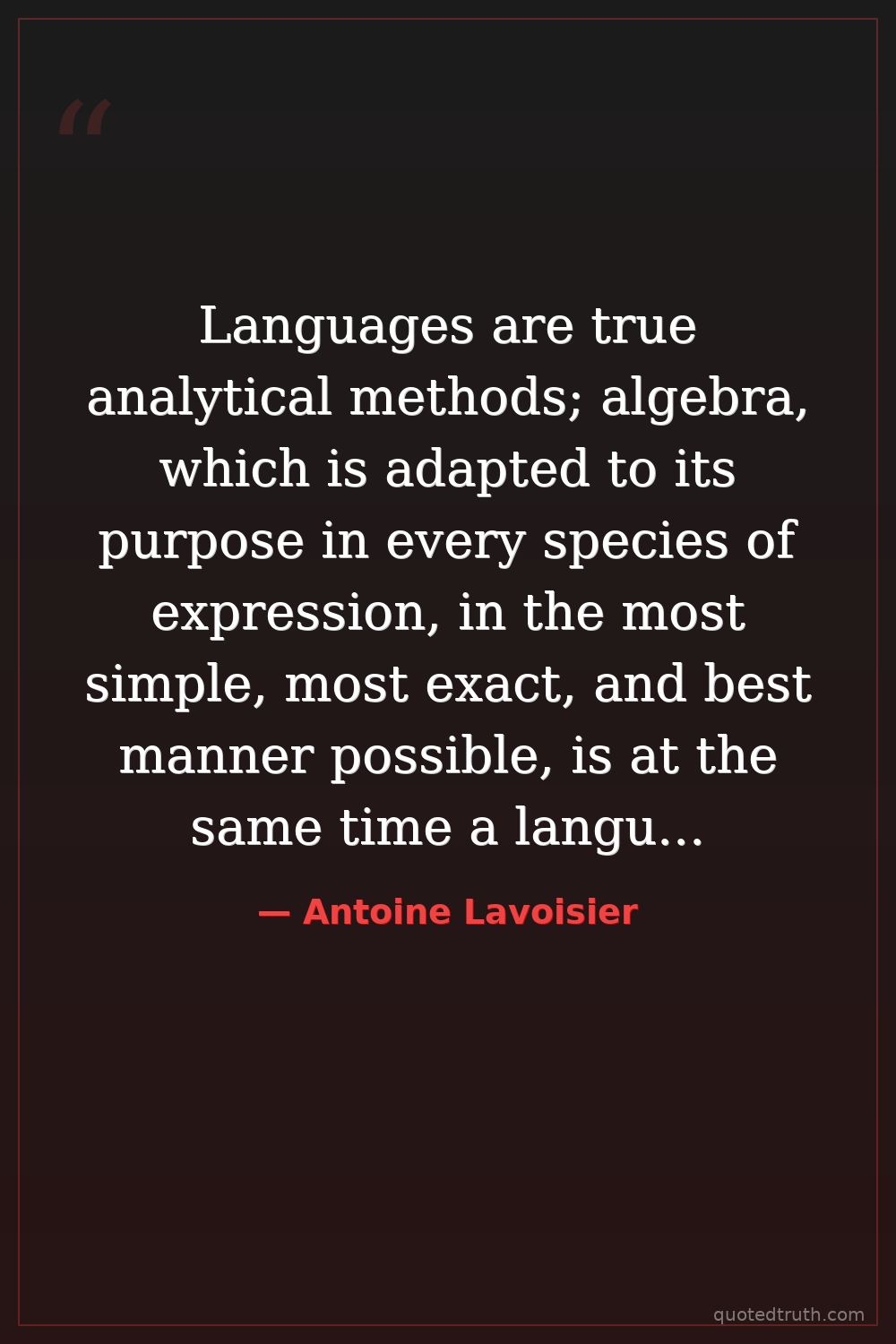
Language isn't just communication—it's a tool for thinking. When words and symbols are precise, they help us break down problems and reason clearly. Algebra is the prime example: its symbols are so economical and exact that manipulating them is itself a form of analysis. A well-designed language does the thinking for you, revealing structure that messy prose would hide. Clear notation equals clear thought, and bad vocabulary produces bad reasoning.
Relevance to Antoine Lavoisier
Lavoisier rebuilt chemistry by rebuilding its language. Before him, substances had confusing alchemical names; he co-authored the 1787 Méthode de nomenclature chimique, giving elements and compounds systematic names that encoded their composition. He believed chemistry's progress depended on precise terminology, just as mathematics progressed through algebraic notation. This quote captures the conviction that drove his reform: naming things correctly is doing science, because a rigorous vocabulary forces rigorous analysis.
The era
In the late 1700s, Enlightenment thinkers were obsessed with rational systems—Linnaeus classified life, Condillac argued science IS a well-made language, and the French Revolution would soon standardize weights via the metric system. Chemistry still used murky terms like 'phlogiston' and 'oil of vitriol.' Lavoisier wrote during this push to replace inherited confusion with logical, transparent frameworks, treating clear notation as the engine of scientific and social progress.
AI-generated insights based on extensive research and information for context. Factual errors? Email [email protected].