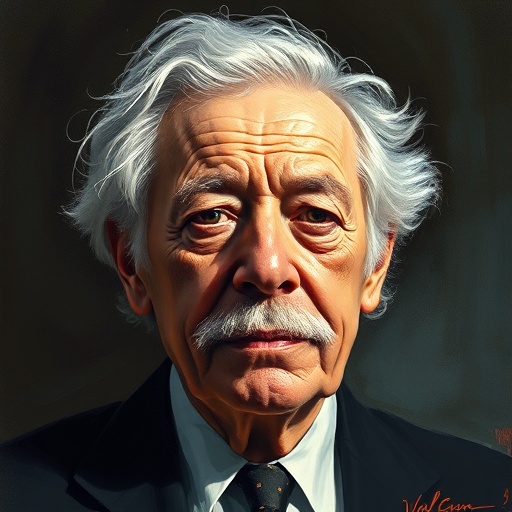
Linus Pauling — "The most important thing is to never stop questioning."
The most important thing is to never stop questioning.
The most important thing is to never stop questioning.
Click any product to generate a realistic preview. Up to 3 at a time.
* Initial load can take up to 90 seconds — revising the preview in another color is nearly instant.
"I realized that medical and biological investigators were not attacking their problems the same way that theoretical physicists do, the way I had been in the habit of doing."
"I have something that I call my Golden Rule. It goes something like this: 'Do unto others twenty-five percent better than you expect them to do unto you.' … The twenty-five percent is for error."
"Do not let your special talents in chemistry, your love for chemistry, keep you from developing your talents in other fields. Do not let yourself be a narrow specialist."
"I might well have become egotistical as a result [of the Langmuir Prize].... But... I think that I just said I shouldn't let this go to my head. I shouldn't think I'm really better than other people e…"
"The greatest pleasure in life is doing what people say you cannot do."
Found in 1 providers: grok
1 source checked
Curiosity drives all progress. Never accepting an answer as final—always probing why, how, and what if—keeps minds open and prevents error from hardening into dogma. In science, politics, or daily life, persistent questioning exposes hidden assumptions, challenges comfortable certainties, and generates insights that move understanding forward. Stopping that impulse means settling for an incomplete or wrong picture of reality, however convenient that picture might be.
Pauling embodied this throughout his career. He questioned classical chemistry's bonding models, developing resonance theory and electronegativity that reshaped the field—earning the 1954 Nobel in Chemistry. Then, at the height of McCarthyism, he questioned U.S. nuclear policy, circulating the 1958 Pauling Petition signed by 11,000 scientists, earning the 1962 Nobel Peace Prize. Later he challenged medical consensus on vitamin C. For Pauling, stopping questions was intellectual surrender.
Pauling worked through the atomic age's most morally fraught decades. The Manhattan Project proved science could reshape civilization—but also destroy it. Cold War politics made questioning authority dangerous; Pauling had his passport revoked for anti-nuclear activism. Meanwhile, the postwar scientific establishment was consolidating around government-funded consensus. Questioning both physical and political structures was genuinely courageous, not merely rhetorical, making this principle a lived commitment rather than an abstract ideal.
AI-generated insights based on extensive research and information for context. Factual errors? Email [email protected].
Your cart is empty