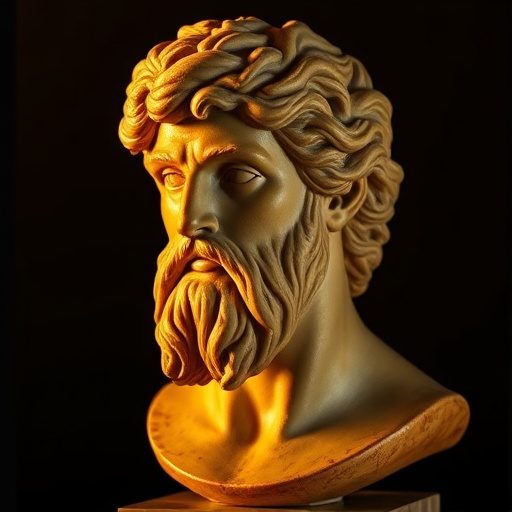
Pythagoras — "No one is free who has not obtained the empire of himself. No man is free who ca…"
No one is free who has not obtained the empire of himself. No man is free who cannot command himself.
No one is free who has not obtained the empire of himself. No man is free who cannot command himself.
Click any product to generate a realistic preview. Up to 3 at a time.
* Initial load can take up to 90 seconds — revising the preview in another color is nearly instant.
"Truth is so great a perfection, that if God would render himself visible to men, he would choose light for his body and truth for his soul."
"When you go to the temple to worship, do not wipe up the footprints."
"The oldest and shortest words, 'yes' and 'no,' are those which require the most thought."
"Don't wipe up a mess with a torch."
"Concern should drive us into action and not into a depression. No man is free who is not master of himself."
Greek philosopher and mathematician whose school in Croton combined geometry (the Pythagorean theorem), number-mysticism, and a religious-vegetarian way of life. Closely associated with Thales of Miletus (earlier pre-Socratic and the first philosopher). For an intellectual contrast, see Heraclitus, pre-Socratic Greek philosopher of flux — Heraclitus called Pythagoras 'the chief of swindlers' — among the founding insults of the philosophical-rivalry tradition. Their 'all is flux' vs 'all is number' poles still organize the philosophy of mathematics today (Platonist vs anti-realist).
Emphasizes self-mastery as the ultimate form of freedom.
Date: c. 5th Century BCE
PhilosophicalFound in 1 providers: gemini
1 source checked
Real freedom is not about escaping external rules or having power over others. It comes from mastering yourself: your impulses, emotions, appetites, and reactions. A person ruled by anger, cravings, or fear is still a slave, no matter their social status. Only those who can govern their own minds and actions with discipline and reason can claim genuine liberty in any meaningful sense.
Pythagoras founded a strict communal brotherhood in Croton where initiates practiced silence for years, followed dietary rules, examined their conduct daily, and pursued rigorous mathematical study. Self-discipline was the gateway to his teachings. He viewed mathematics and music not as isolated skills but as tools for ordering the soul, making this saying a direct reflection of his lived philosophy of inner mastery as the foundation of wisdom.
In 6th century BCE Greece, freedom typically meant civic status: not being a slave, owning property, participating in the polis. Pythagoras radically reframed it as an inner condition. This was an era when tyrants ruled many city-states and citizens debated political liberty, yet philosophers in the Pre-Socratic tradition were beginning to turn inward, asking what ordered a well-lived human life beyond politics and wealth.
AI-generated insights based on extensive research and information for context. Factual errors? Email [email protected].
Your cart is empty