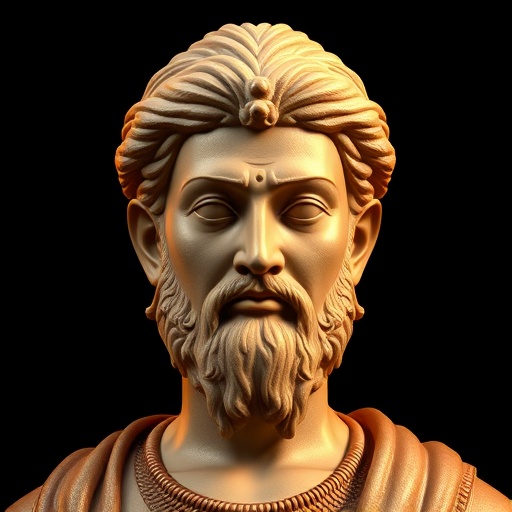
Mahavira — "Man's true nature is divine."
Man's true nature is divine.
Man's true nature is divine.
Click any product to generate a realistic preview. Up to 3 at a time.
* Initial load can take up to 90 seconds — revising the preview in another color is nearly instant.
"Kill no living thing."
"The soul is pure and eternal. It is never born, nor does it ever die."
"Look at the world with the eyes of a friend."
"He who knows one’s own soul knows the souls of all beings."
"Do not be led by the senses, but lead the senses."
24th and last Tirthankara of Jainism, whose teachings of strict ahimsa (non-violence), aparigraha (non-attachment), and karma reshaped ancient Indian religion. Closely associated with The Buddha (near-contemporary moral revolutionary, also reacting against Vedic ritualism). For an intellectual contrast, see Vedic Brahmanical ritual sacrifice, the animal-sacrifice-centered Vedic religion of his era — Mahavira's ahimsa demanded total non-violence, including not eating root vegetables that kill the plant — a maximum-distance ethical move from the Vedic priestly tradition that ritually sacrificed cattle and horses. The two cleanest poles of ancient Indian religious ethics.
Found in 1 providers: grok
1 source checked
Every human being carries an inherently sacred, pure soul at their core. Divinity isn't granted by gods, priests, or ritual—it already exists within you. Liberation isn't about earning worth from outside but uncovering what was always present inside. Strip away karma and desire and the soul's natural state emerges: perfect, omniscient, and free. You are not broken and in need of fixing; you are divine and in need of revealing.
Mahavira renounced royal wealth at 30, wandered naked for 12 years in radical non-attachment, and achieved kevala jnana—complete omniscience. He taught that every soul, the jiva, is inherently perfect regardless of caste or birth. His entire life demonstrated this belief: extreme asceticism wasn't self-punishment but the deliberate removal of karmic matter obscuring the divine core he insisted every living being already possessed.
Mahavira lived in 6th-century BCE India when Vedic Brahminism dominated spiritual life, tying a person's worth to caste birth and expensive sacrificial rituals only priests could perform. Asserting that every soul is inherently divine was a direct challenge to priestly gatekeeping and hereditary hierarchy. Alongside the Buddha, Mahavira helped spark the Shramana movement, democratizing enlightenment by making it a function of inner practice rather than birth or patronage.
AI-generated insights based on extensive research and information for context. Factual errors? Email [email protected].
Your cart is empty