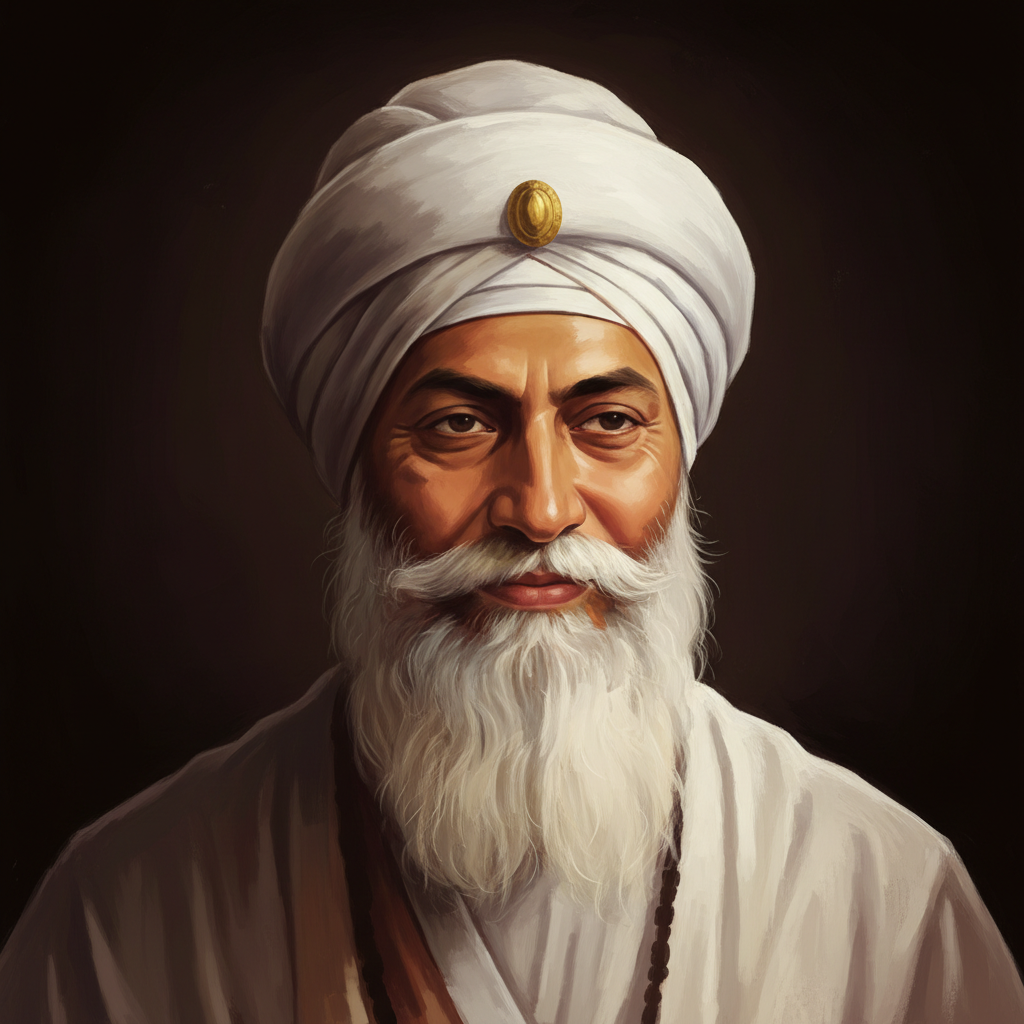
Guru Nanak — "Material wealth is temporary, while love and spiritual devotion are eternal."
Material wealth is temporary, while love and spiritual devotion are eternal.
Material wealth is temporary, while love and spiritual devotion are eternal.
Click any product to generate a realistic preview. Up to 3 at a time.
* Initial load can take up to 90 seconds — revising the preview in another color is nearly instant.
"With your hands carve out your own destiny."
"Be the wisdom your support. Be the compassion your guide and listen to the Divine Music that beats in every heart."
"He who has no faith in himself can never have faith in God."
"Death would not be called bad, O people, if one knew how to truly die."
"He who speaks truth, lives truth, and meditates on truth, he alone is pure."
Founder of Sikhism and the first of the Ten Sikh Gurus, whose teachings of one universal God and rejection of caste shaped Punjab. Closely associated with Kabir (mystical poet whose verses appear in the Sikh Guru Granth Sahib). For an intellectual contrast, see Brahmanical orthodoxy, the Hindu caste-and-ritual establishment of his era — Sikhism was founded as a deliberate alternative to both Hindu ritual hierarchy and Islamic exclusivism — Nanak's universalism was a structural rejection of caste and priestly mediation.
Found in 1 providers: gemini
1 source checked
Chasing money, possessions, and status brings no lasting satisfaction — these things are temporary and will eventually disappear. What genuinely endures beyond a person's lifetime is the love they give and receive, and their commitment to spiritual practice. In modern terms: stop optimizing for accumulation and start investing in relationships and inner life, because those are the things that actually persist.
Guru Nanak rejected material hierarchy from the start — born into a merchant family, he gave away his father's goods to feed the poor rather than pursue profit. His four major journeys across South Asia and Arabia were lived in voluntary simplicity. His hymns in the Guru Granth Sahib repeatedly warn that haumai — ego and attachment to wealth — blocks union with the Divine; Nam Simran, not accumulation, leads to liberation.
Punjab in the 1400s–1500s was a prosperous trade corridor under Muslim sultanates and later Mughal invasion. Feudal lords and religious clergy alike accumulated vast wealth while peasants toiled in poverty. The caste system explicitly linked spiritual status to birth-based wealth hierarchies. Guru Nanak emerged during the Bhakti movement, which challenged ritual religion and priestly gatekeeping, making his declaration that devotion — not wealth — defines spiritual worth a radical social critique.
AI-generated insights based on extensive research and information for context. Factual errors? Email [email protected].
Your cart is empty