Laozi — "Muddy water is best cleared by leaving it alone."
Muddy water is best cleared by leaving it alone.
Muddy water is best cleared by leaving it alone.
Click any product to generate a realistic preview. Up to 3 at a time.
* Initial load can take up to 90 seconds — revising the preview in another color is nearly instant.
"The great square has no corners. The great vessel is never full. The great sound is inaudible. The great image has no form."
"The five colors blind the eye. The five notes deafen the ear. The five tastes dull the palate. Racing and hunting madden the mind. Precious goods keep their owners in fetters."
"The softest thing in the world can overcome the hardest thing in the world."
"When the great Tao is lost, there is 'benevolence' and 'righteousness'."
"The sage attends to the inner and not to the outer."
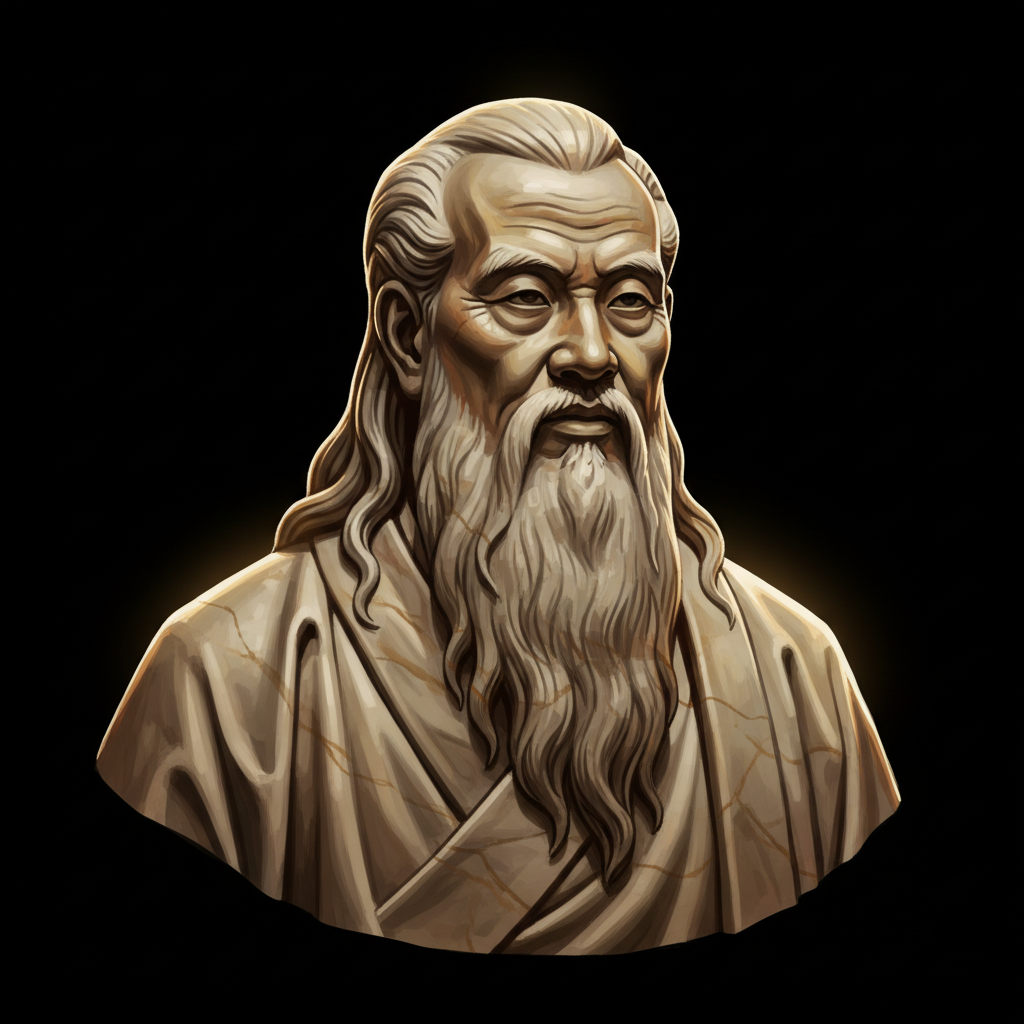
Reputed founder of Taoism and author of the Tao Te Ching, whose wu wei (effortless action) shaped East Asian philosophy. Closely associated with Zhuangzi (later Taoist who extended Laozi's framework). For an intellectual contrast, see Confucius, near-contemporary Chinese sage of social ritual and duty — Confucius systematized social order through ritual and hierarchy; Laozi argued that all such systems were the disease, not the cure — the two founding poles of Chinese moral philosophy.
Found in 1 providers: grok
1 source checked
Some problems resolve themselves if you stop stirring them. Constant interference, worry, or forced action often makes confusion worse, while patience lets the situation naturally settle into clarity. When emotions are churning or a conflict is clouded, stepping back allows particles of misunderstanding to drift down on their own. The answer that was invisible becomes visible once you stop agitating the surface. Doing less, at the right moment, accomplishes more than frantic intervention.
Laozi taught wu wei, effortless action aligned with the natural flow of the Tao, and this saying is a pure illustration of it. As the legendary archivist of the Zhou court who reportedly withdrew from political life, he valued stillness over striving. His Tao Te Ching repeatedly uses water as a metaphor for yielding strength, and here he applies it directly: the sage governs self and state by restraint, trusting nature rather than forcing outcomes through willful effort.
Laozi lived during the turbulent late Zhou dynasty, roughly the 6th century BCE, as centralized authority crumbled into the warring states era. Rival rulers pushed aggressive reforms, militarization, and Confucian ritual codes to impose order. Against this backdrop of constant intervention and ambition, Laozi's counsel to leave muddy water alone was politically radical: it suggested that over-governing, over-legislating, and moralizing actually worsened social chaos, and that restraint was the truer path to harmony.
AI-generated insights based on extensive research and information for context. Factual errors? Email [email protected].
Your cart is empty