Laozi — "When the great Tao is lost, there is 'benevolence' and 'righteousness'."
When the great Tao is lost, there is 'benevolence' and 'righteousness'.
When the great Tao is lost, there is 'benevolence' and 'righteousness'.
Click any product to generate a realistic preview. Up to 3 at a time.
* Initial load can take up to 90 seconds — revising the preview in another color is nearly instant.
"The five colors blind the eye. The five notes deafen the ear. The five tastes dull the palate. Racing and hunting madden the mind. Precious goods keep their owners in fetters."
"The sage rules by emptying their minds and filling their bellies, by weakening their wills and strengthening their bones."
"The more laws and ordinances are promulgated, the more thieves and bandits there will be."
"The difficult is done easily; the easy is done with difficulty."
"If you realize that all things change, there is nothing you will try to hold on to."
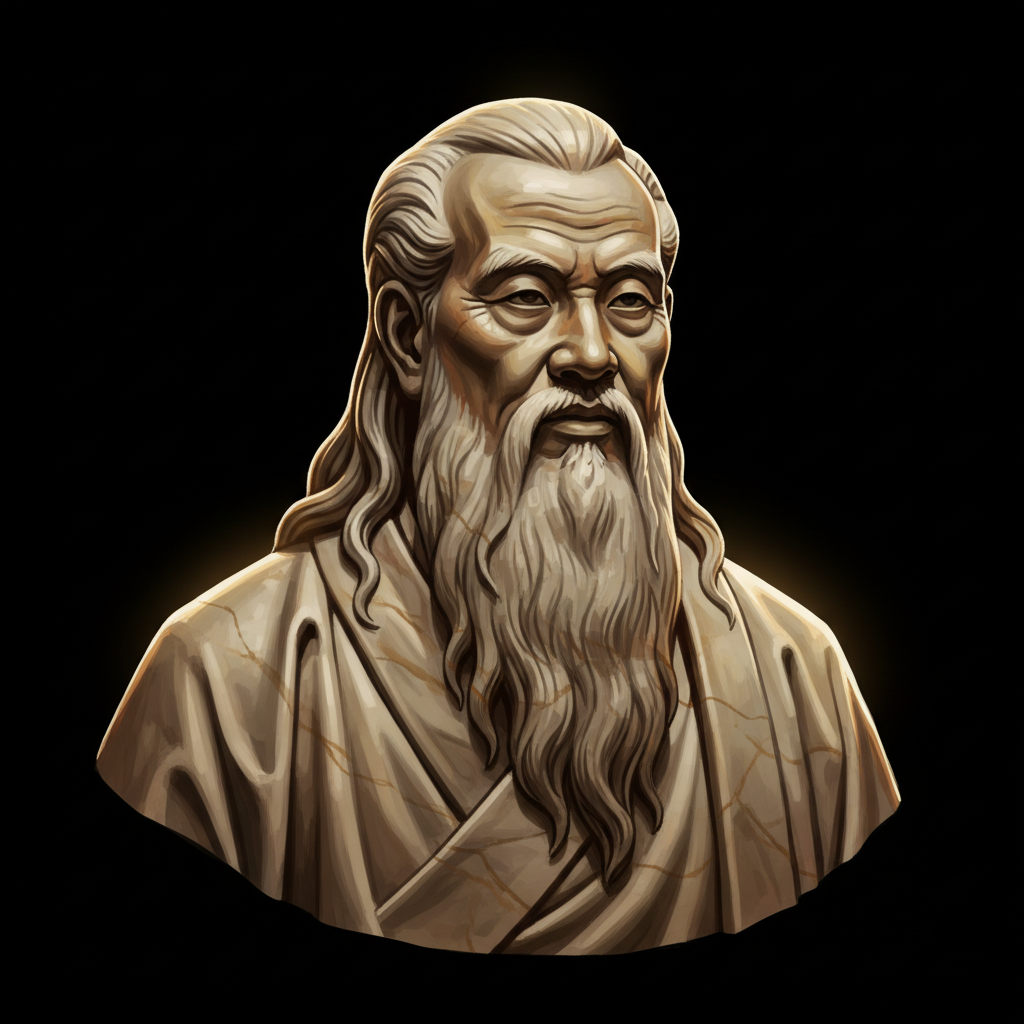
Reputed founder of Taoism and author of the Tao Te Ching, whose wu wei (effortless action) shaped East Asian philosophy. Closely associated with Zhuangzi (later Taoist who extended Laozi's framework). For an intellectual contrast, see Confucius, near-contemporary Chinese sage of social ritual and duty — Confucius systematized social order through ritual and hierarchy; Laozi argued that all such systems were the disease, not the cure — the two founding poles of Chinese moral philosophy.
Found in 2 providers: gemini,grok
2 sources checked
When a society loses its natural harmony and intuitive moral flow, it has to invent formal labels like 'kindness' and 'justice' to fill the gap. The very fact that people keep talking about virtues is evidence that those virtues are no longer lived. Real goodness needs no name; once you have to codify it, teach it, or demand it, the authentic version has already slipped away.
Laozi taught the Tao as an underlying Way that works without effort or labeling, and he distrusted the Confucian project of ranking virtues and ritual duties. As legend has it, he left civilization on an ox precisely because rulers were drowning in rules. This line captures his core conviction: naming, moralizing, and institutionalizing goodness is a symptom of decline, not a cure for it.
Laozi lived in the Zhou dynasty's unraveling, likely during the Spring and Autumn or Warring States period, when feudal lords warred constantly and Confucius and his followers were codifying ren (benevolence) and yi (righteousness) as social repairs. Ritual, hierarchy, and formal ethics were being promoted as answers to collapsing order. Laozi pushed back: the loud debate about virtues was itself proof that the older, unspoken Way had been abandoned.
AI-generated insights based on extensive research and information for context. Factual errors? Email [email protected].
Your cart is empty