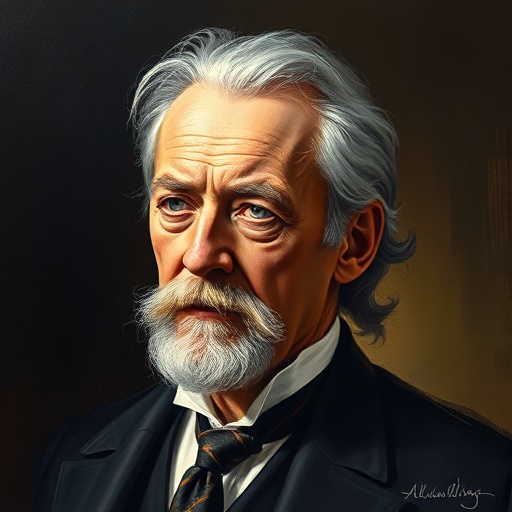
Alexander Fleming — "My only merit is that I did not discard the cultures at an early stage."
My only merit is that I did not discard the cultures at an early stage.
My only merit is that I did not discard the cultures at an early stage.
Click any product to generate a realistic preview. Up to 3 at a time.
* Initial load can take up to 90 seconds — revising the preview in another color is nearly instant.
"My work was not a flash of genius, but a gradual unfolding of facts."
"The bacteriologist is a detective. He must follow every clue, however small."
"I have been very lucky in my scientific career. I have stumbled on things by accident."
"I certainly did not plan to revolutionise all medicine by discovering the world's first antibiotic, or killer of bacteria. But I suppose that is exactly what I did."
"I have always been interested in the fight against disease."
Found in 1 providers: grok
1 source checked
Fleming is not claiming brilliance — he is crediting patience. The quote says his achievement came from resisting the impulse to discard a seemingly ruined experiment. When a mold contaminated his bacterial cultures, he paused instead of throwing them away. The lesson: great discoveries often hide inside apparent failures. What separates a discoverer from everyone else is sometimes just the refusal to give up on something that looks wrong.
In 1928, Fleming returned from vacation to find a mold had contaminated a petri dish growing Staphylococcus bacteria. Where the mold grew, bacteria had died. Most researchers would have discarded the plate as spoiled — he investigated instead. Known for his careful eye and self-deprecating manner, Fleming spent his career downplaying his role in penicillin's development, often crediting Florey and Chain. This quote is characteristically Fleming: deflecting genius while accidentally revealing it.
Fleming worked during an era when bacterial infections — pneumonia, sepsis, scarlet fever — killed millions with no effective treatment. World War I had demonstrated how infected wounds killed more soldiers than combat. The 1920s medical world was desperately seeking antibiotics. Fleming's 1928 discovery, and penicillin's mass production by the 1940s, transformed medicine entirely. His restraint in not discarding those cultures arguably saved more lives than any single moment in medical history.
AI-generated insights based on extensive research and information for context. Factual errors? Email [email protected].
Your cart is empty