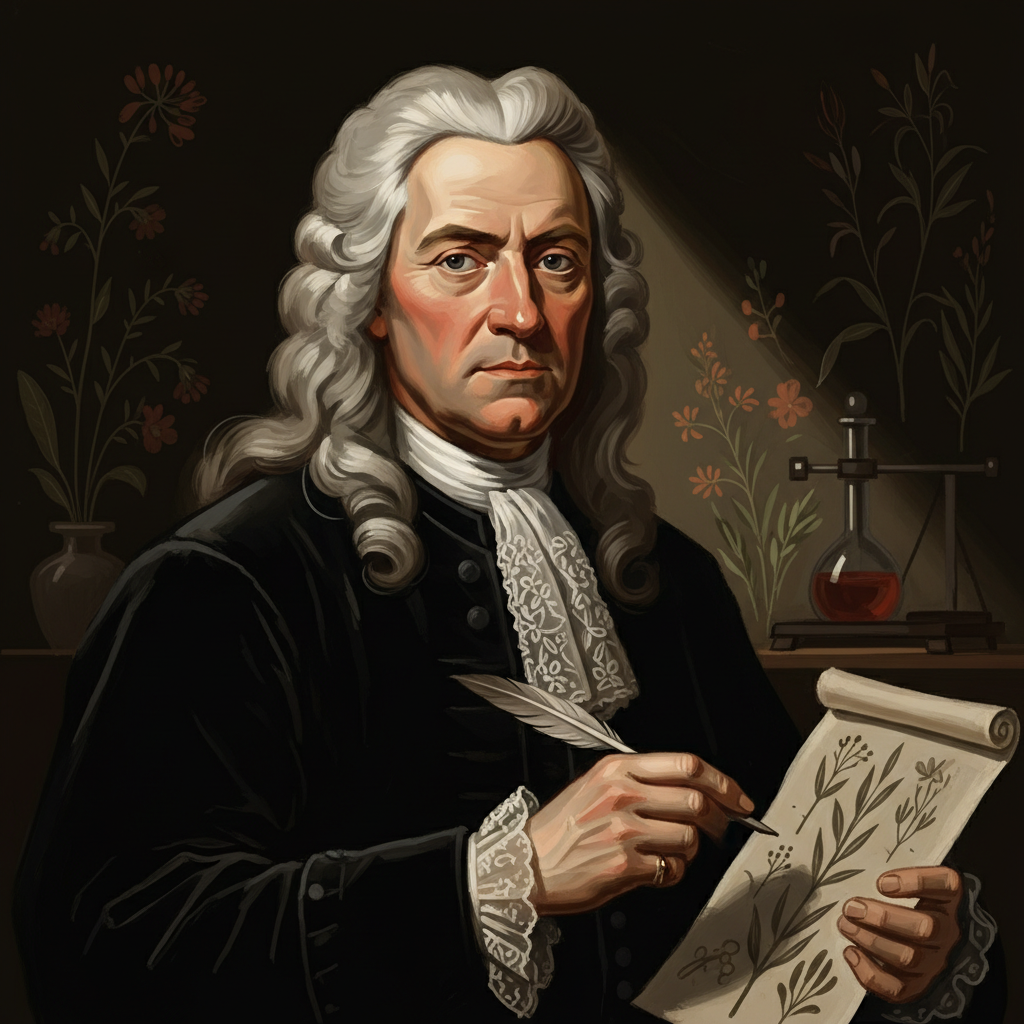
Carl Linnaeus — "The number of species is fixed and unchanging."
The number of species is fixed and unchanging.
The number of species is fixed and unchanging.
Click any product to generate a realistic preview. Up to 3 at a time.
* Initial load can take up to 90 seconds — revising the preview in another color is nearly instant.
"I have done more for the advancement of natural history than anyone else."
"I have seen no one who has been able to distinguish the species of plants better than I have."
"The whole world is a collection of wonders."
"Nature does not make any leaps. (Natura non facit saltus)"
"I have been called a second Adam."
Swedish botanist and the father of modern taxonomy whose Systema Naturae (1735) introduced binomial nomenclature for naming all species. Closely associated with Joseph Banks (British naturalist who carried Linnaean classification on Cook's voyages). For an intellectual contrast, see Comte de Buffon, French naturalist and Histoire Naturelle author (1749-1788) — Buffon explicitly attacked Linnaean fixed-categories taxonomy as artificial and rejected the binomial system; his gradualist, environment-shaped natural history was the explicit alternative. Anticipates the fixed-species-vs-evolution debate Darwin would later resolve.
Found in 1 providers: deepseek
1 source checked
This quote expresses the belief that all living kinds were created at the beginning and remain constant — no new species emerge over time and none permanently vanish. Life's diversity is a finished catalog, not an ongoing process. Classification is therefore possible and meaningful because categories are stable, discrete, and eternal rather than blurring into one another through gradual change or transformation.
Linnaeus built his entire career on this premise. His landmark Systema Naturae (1735) and binomial nomenclature assume species are real, discrete, and permanent — otherwise classification collapses. A devout Lutheran, he believed God created a fixed number of kinds at creation. Though late in life he acknowledged hybrids might blur boundaries, his foundational system required fixity to function, and he never embraced transformism.
In the early 18th century, natural theology dominated European science — studying nature meant cataloging God's deliberate handiwork. Fossils were poorly understood, and extinction itself was theologically troubling, implying divine imperfection. The Great Chain of Being posited a static, hierarchical nature. Before Lamarck and Darwin, species fixity was both scientific consensus and religious orthodoxy, making Linnaeus's conviction entirely mainstream and intellectually uncontroversial for his era.
AI-generated insights based on extensive research and information for context. Factual errors? Email [email protected].
Your cart is empty