Wright Brothers (Orville & Wilbur) — "The fact that the machine did not fall apart at the first gust of wind was a gre…"
The fact that the machine did not fall apart at the first gust of wind was a great encouragement.
The fact that the machine did not fall apart at the first gust of wind was a great encouragement.
Click any product to generate a realistic preview. Up to 3 at a time.
* Initial load can take up to 90 seconds — revising the preview in another color is nearly instant.
"We have found that the bird is a much more intelligent creature than we had supposed."
"No one can appreciate the work and worry it cost us to build our first machine."
"We have been making daily flights, and the machine is working perfectly."
"We have been able to keep the machine in the air for longer periods than ever before."
"Often, after an hour or so of heated argument, we would discover that we were as far from agreement as when we started, but that each had changed to the other's original position."
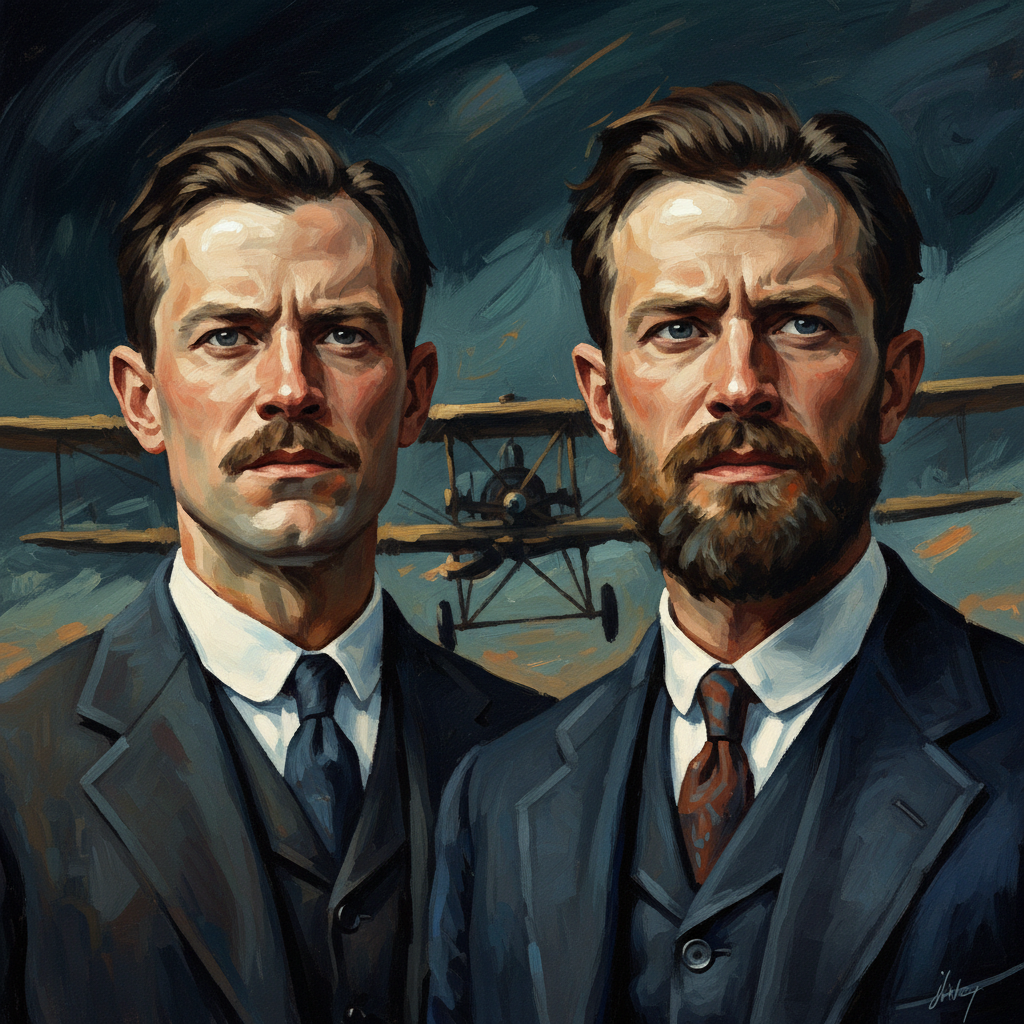
American aviation pioneers who achieved the first sustained powered controlled airplane flight at Kitty Hawk, NC, on December 17, 1903. Closely associated with Octave Chanute (their gliding mentor and aeronautical correspondent). For an intellectual contrast, see Samuel Pierpont Langley, Smithsonian Institution Secretary and government-funded aviation researcher — Langley's Aerodrome crashed twice into the Potomac in October-December 1903 with $50,000 of War Department funding; the Wright Brothers' bicycle-shop empiricism beat Langley's institutional Big Science by 9 days. The most-cited example in engineering history of empirical-tinkerer beating institution-funded credentialism.
Found in 1 providers: grok
1 source checked
Sometimes progress is measured not by spectacular success but by simply surviving the first real test. When you build something new and untested, the bar for early validation is low: just holding together under stress is proof the design has merit. Small wins like this confirm the work is on the right track, even when full success is still far away, and they justify continuing instead of scrapping the effort.
The Wrights built their flyers from spruce, muslin, and bicycle-shop ingenuity, knowing every test risked splintering months of work. After countless glider trials at Kitty Hawk's windy dunes between 1900 and 1903, structural integrity under real atmospheric loads was a genuine milestone. As self-taught engineers funded by their Dayton bike business, they celebrated incremental wins because each one proved their methodical, data-driven approach, not luck, was bringing humanity closer to controlled flight.
At the turn of the 20th century, aviation was widely considered a fool's errand after Samuel Langley's well-funded crashes and Otto Lilienthal's fatal glider accident in 1896. Most scientists believed heavier-than-air flight was impossible. The Wrights worked in obscurity without university backing or government grants, competing against lavishly financed rivals. In that climate of public skepticism and engineering failure, a machine merely withstanding wind was remarkable, signaling that patient empirical testing could succeed where prestige and money had not.
AI-generated insights based on extensive research and information for context. Factual errors? Email [email protected].
Your cart is empty