Wright Brothers (Orville & Wilbur) — "No one can appreciate the work and worry it cost us to build our first machine."
No one can appreciate the work and worry it cost us to build our first machine.
No one can appreciate the work and worry it cost us to build our first machine.
Click any product to generate a realistic preview. Up to 3 at a time.
* Initial load can take up to 90 seconds — revising the preview in another color is nearly instant.
"It is a pleasure to be able to inform you that the machine has been a success."
"Success in inventing depends on the close observation of nature."
"We did not find it necessary to use any of the formulas of the scientists, but we worked out our own formulas."
"The Wright brothers flew right through the smoke screen of impossibility."
"The difficulties were great, but our faith was greater."
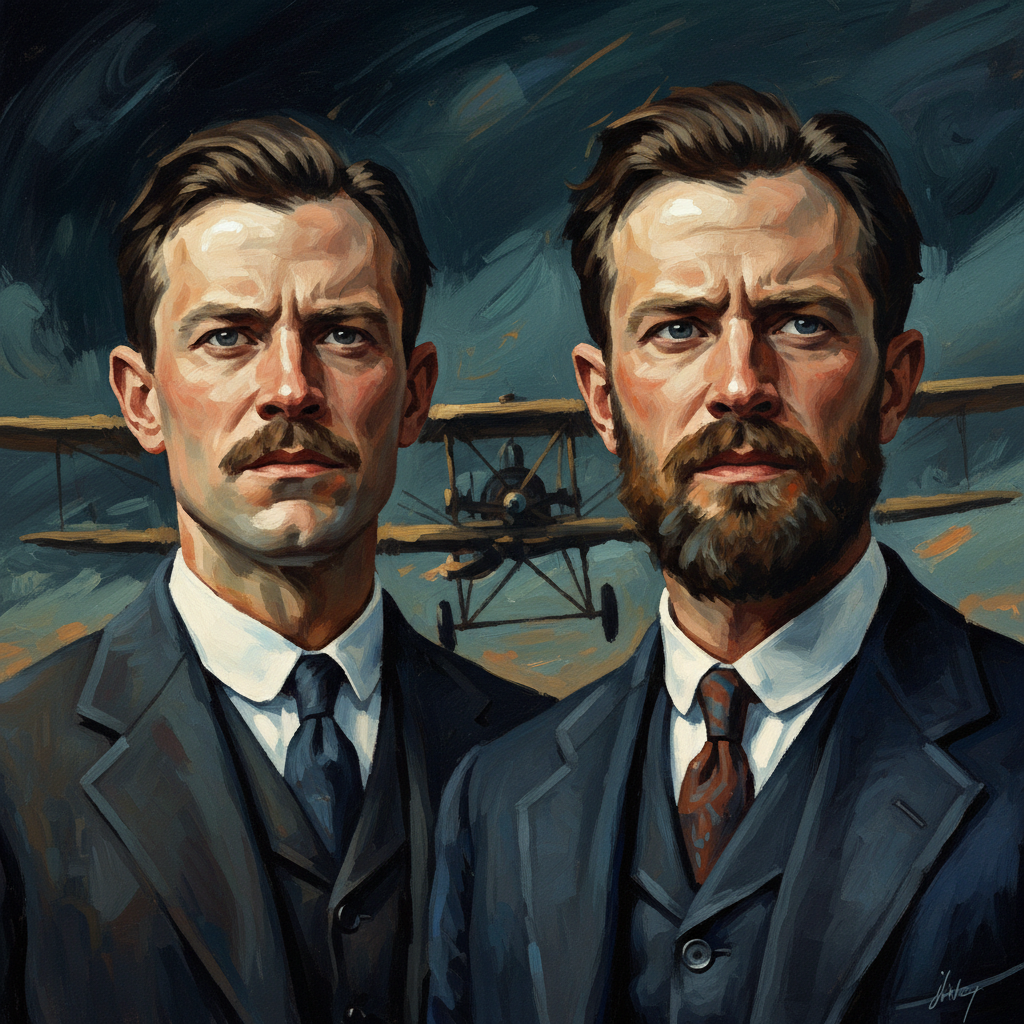
American aviation pioneers who achieved the first sustained powered controlled airplane flight at Kitty Hawk, NC, on December 17, 1903. Closely associated with Octave Chanute (their gliding mentor and aeronautical correspondent). For an intellectual contrast, see Samuel Pierpont Langley, Smithsonian Institution Secretary and government-funded aviation researcher — Langley's Aerodrome crashed twice into the Potomac in October-December 1903 with $50,000 of War Department funding; the Wright Brothers' bicycle-shop empiricism beat Langley's institutional Big Science by 9 days. The most-cited example in engineering history of empirical-tinkerer beating institution-funded credentialism.
Found in 1 providers: grok
1 source checked
Building something truly new demands far more effort and mental strain than outsiders can grasp. Anyone looking at a finished invention sees only the result, not the countless hours of problem-solving, failed attempts, sleepless nights, and gnawing uncertainty behind it. The speakers are saying that the hidden labor and anxiety of pioneering work stay invisible to everyone except the people who lived through it.
Orville and Wilbur Wright spent years as self-funded bicycle mechanics teaching themselves aerodynamics, building their own wind tunnel, and crashing gliders at Kitty Hawk before their 1903 powered flight. Without formal engineering training or outside backing, every component was hand-fabricated and every theory tested on their own bodies. The quote captures their frustration that observers saw only the twelve-second flight, not the four grueling years of calculation, carpentry, and near-injury that produced it.
In the early 1900s, powered flight was widely dismissed as fantasy, with Scientific American and the press mocking aviation attempts. Samuel Langley's government-funded Aerodrome had just failed spectacularly in 1903, reinforcing public skepticism. The Wrights worked in obscurity in Dayton, Ohio, funded by their bicycle shop, while a skeptical world and disbelieving reporters ignored their Kitty Hawk success for years, forcing them to prove their claims repeatedly before being believed.
AI-generated insights based on extensive research and information for context. Factual errors? Email [email protected].
Your cart is empty