Wright Brothers (Orville & Wilbur) — "We did not find it necessary to use any of the formulas of the scientists, but w…"
We did not find it necessary to use any of the formulas of the scientists, but we worked out our own formulas.
We did not find it necessary to use any of the formulas of the scientists, but we worked out our own formulas.
Click any product to generate a realistic preview. Up to 3 at a time.
* Initial load can take up to 90 seconds — revising the preview in another color is nearly instant.
"We have hopes of making a flight of considerable length before long."
"The flying machine which will really fly might be evolved by the combined and continuous efforts of mathematicians and mechanicians in from one million to ten million years — provided, of course, we c…"
"It is not necessary to be a horse to be a good jockey."
"It was impossible to convince the people generally that we were not a pair of lunatics."
"I believe that my course in sending our Kitty Hawk machine to a foreign museum is the only way of correcting the history of the flying machine, which by false and misleading statements has been perver…"
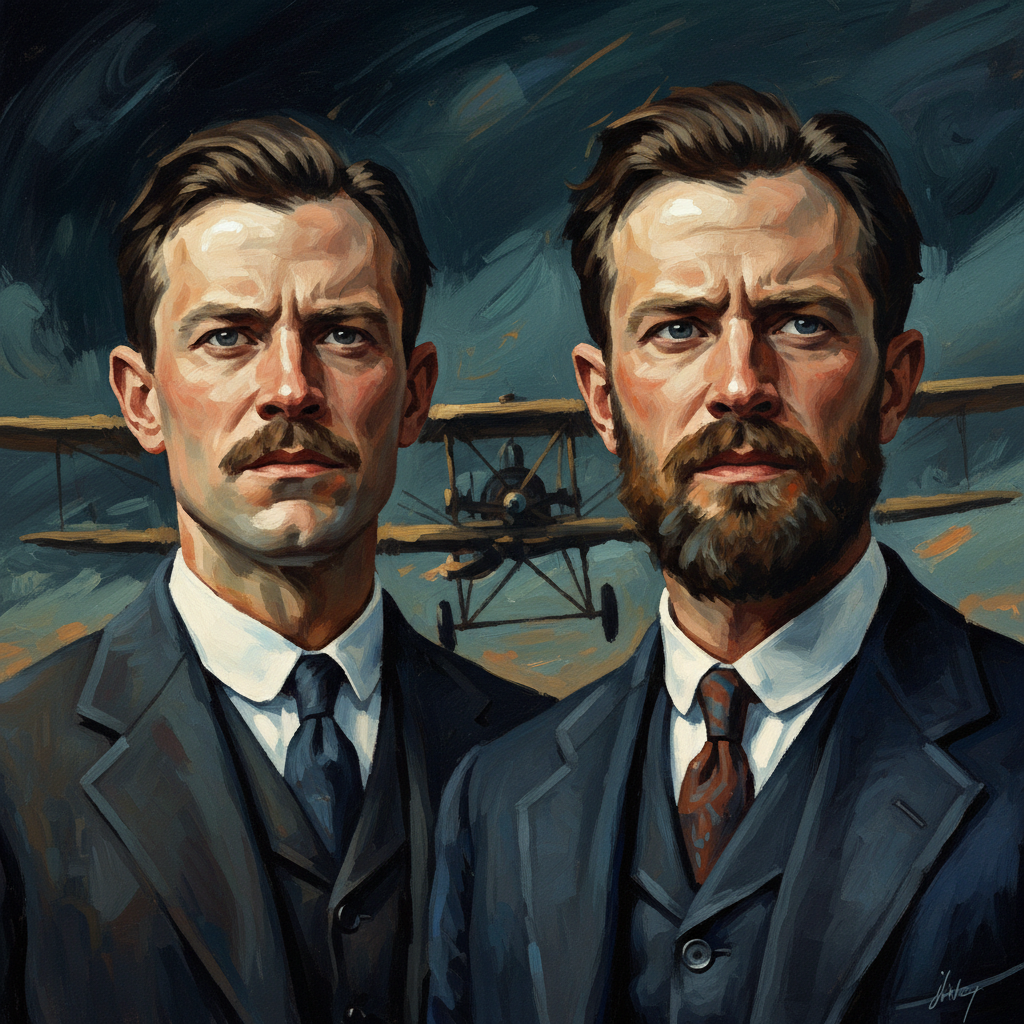
American aviation pioneers who achieved the first sustained powered controlled airplane flight at Kitty Hawk, NC, on December 17, 1903. Closely associated with Octave Chanute (their gliding mentor and aeronautical correspondent). For an intellectual contrast, see Samuel Pierpont Langley, Smithsonian Institution Secretary and government-funded aviation researcher — Langley's Aerodrome crashed twice into the Potomac in October-December 1903 with $50,000 of War Department funding; the Wright Brothers' bicycle-shop empiricism beat Langley's institutional Big Science by 9 days. The most-cited example in engineering history of empirical-tinkerer beating institution-funded credentialism.
Found in 1 providers: grok
1 source checked
The speaker is saying that established expert formulas did not work for their purposes, so they discarded those and developed their own calculations from scratch. Rather than trusting authority or published theory, they trusted their own experiments and measurements. It is a statement about intellectual independence: when inherited knowledge proves unreliable, you must rebuild the foundation yourself rather than forcing flawed assumptions onto your work.
The Wright Brothers discovered that Otto Lilienthal's widely accepted lift and drag tables were wrong, which doomed their 1901 glider. They built a homemade wind tunnel in their Dayton bicycle shop and tested over 200 airfoil shapes, generating their own aerodynamic data. Those original tables enabled the 1903 Kitty Hawk flight. As self-taught bicycle mechanics without engineering degrees, they trusted empirical results over credentialed theory.
At the turn of the twentieth century, aeronautics was dominated by respected figures like Lilienthal, Langley, and Chanute, whose published data carried enormous authority. Powered flight was considered nearly impossible, and Samuel Langley's government-funded attempts failed spectacularly in 1903. Science was professionalizing, universities were expanding, and amateur inventors were increasingly dismissed. That two bicycle mechanics outperformed funded institutions by rejecting expert formulas captured a distinctly American faith in practical tinkering over academic credentials.
AI-generated insights based on extensive research and information for context. Factual errors? Email [email protected].
Your cart is empty