What it means
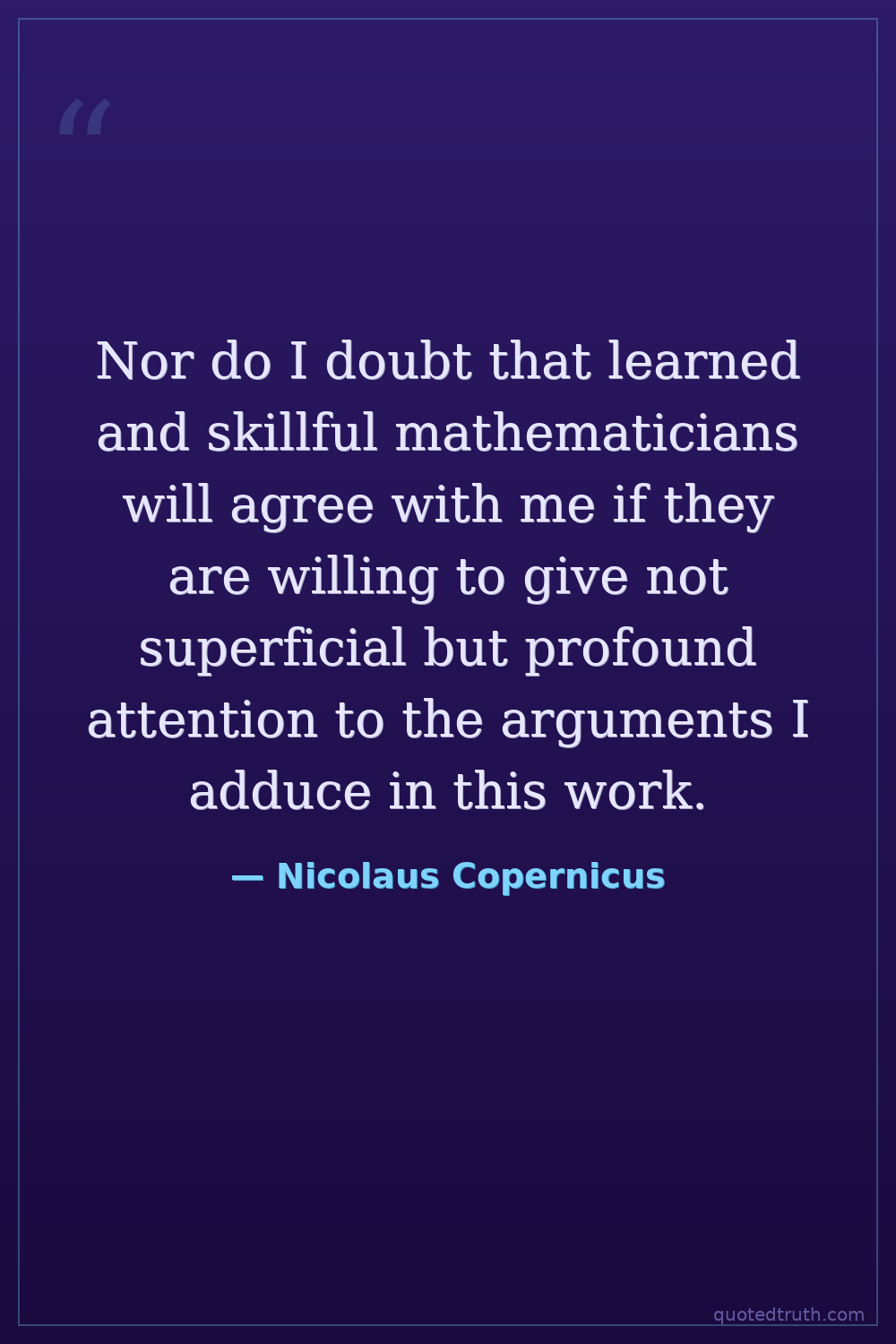
This expresses calm confidence that qualified experts who engage deeply with his mathematical arguments—rather than dismissing them reflexively—will reach the same conclusions. He distinguishes genuine intellectual effort from superficial rejection, implying resistance to his heliocentric model comes from unwillingness to think rigorously, not actual flaws in his logic. He singles out mathematicians as the right audience, signaling the work demands quantitative engagement, not casual or philosophical reading.
Relevance to Nicolaus Copernicus
Copernicus spent roughly thirty years refining his heliocentric model before publishing De revolutionibus in 1543, the year he died. Trained in mathematics and astronomy at Kraków, Bologna, and Padua, he grounded his challenge to Ptolemy in detailed calculations, not speculation. His caution and deference to mathematical proof over doctrine define his character. The quote reflects his belief that the math would vindicate him—and his awareness that most critics never engaged the actual calculations.
The era
In the early 1500s, European intellectual life was governed by Aristotle and Ptolemy, whose geocentric cosmology was doctrine in universities and aligned with Church teaching. Challenging it risked accusations of heresy and professional ruin. Scholars competed for patronage through classical commentary, not empirical innovation. Copernicus's appeal to mathematical proof was strategic—mathematics carried authority even within scholastic frameworks. His era rewarded learned caution, explaining both his thirty-year delay and his carefully diplomatic framing.
AI-generated insights based on extensive research and information for context. Factual errors? Email [email protected].