Werner Heisenberg — "Not only is the Universe stranger than we imagine, it is stranger than we *can* …"
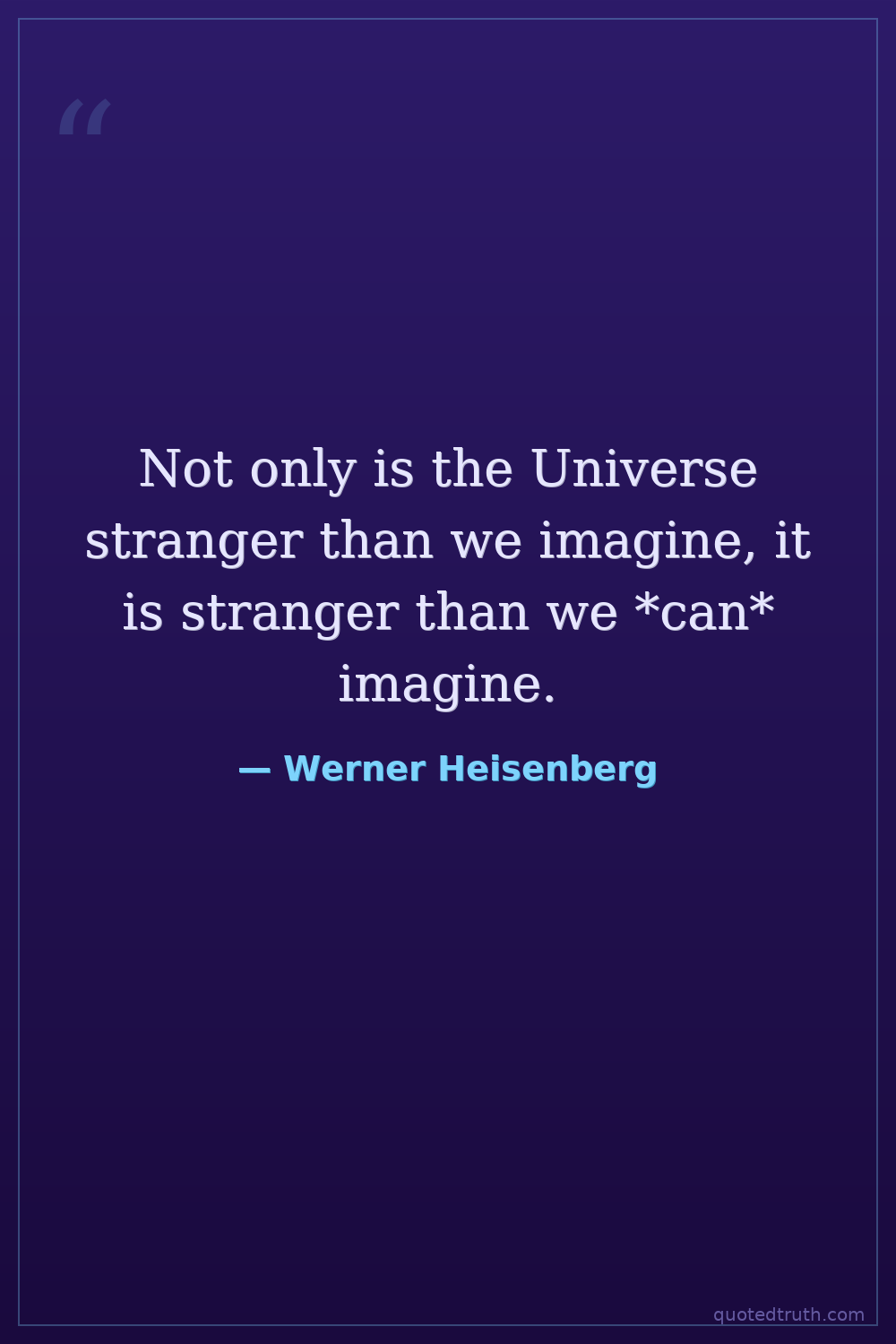
Not only is the Universe stranger than we imagine, it is stranger than we *can* imagine.
Not only is the Universe stranger than we imagine, it is stranger than we *can* imagine.
Click any product to generate a realistic preview. Up to 3 at a time.
* Initial load can take up to 90 seconds — revising the preview in another color is nearly instant.
"Natural science does not simply describe and explain nature; it is part of the interplay between nature and ourselves."
"The world of atoms is a world of possibilities and not a world of things."
"I was very much afraid of the consequences of the atom bomb, and I tried to delay its development."
"I was forced to find a new way of expressing the fundamental laws of nature, one which would not rely on the outdated concepts of classical physics."
"One can't say that one could equally well say that's the quickest way of ending the war."
Attributed, often cited as a summary of quantum mechanics
Date: Undated (likely post-1927)
Art & CreativityFound in 3 providers: grok,deepseek,gemini
3 sources checked
Reality exceeds not just our current knowledge but the very limits of human thought itself. We assume the universe is merely complicated, waiting to be figured out, but its actual nature may be fundamentally beyond what minds evolved for survival can grasp. Our intuitions, language, and mental models were built for a middle-sized world of rocks and predators, not for what lies beneath. Some truths might remain permanently inaccessible, not from lack of effort but from built-in cognitive limits.
Heisenberg discovered that electrons have no definite position and momentum simultaneously, a finding that shattered classical physics. His uncertainty principle showed measurement itself disturbs reality, suggesting nature refuses to fit human categories. He spent his career wrestling with whether quantum weirdness reflected nature or our descriptions, ultimately concluding the old picture of objective particles was simply wrong. His philosophical writings repeatedly returned to the idea that ordinary language breaks down at atomic scales.
Heisenberg worked during the 1920s-1970s, when physics underwent its most violent conceptual revolution. Einstein's relativity had already bent space and time, then quantum mechanics dissolved causality and objective reality. Scientists confronted particles that were also waves, cats both alive and dead, and measurements that created what they measured. World wars, atomic weapons, and collapsing certainties made humility about knowledge urgent. The Enlightenment dream of a fully comprehensible clockwork universe was dying, replaced by something genuinely alien.
AI-generated insights based on extensive research and information for context. Factual errors? Email [email protected].
Your cart is empty