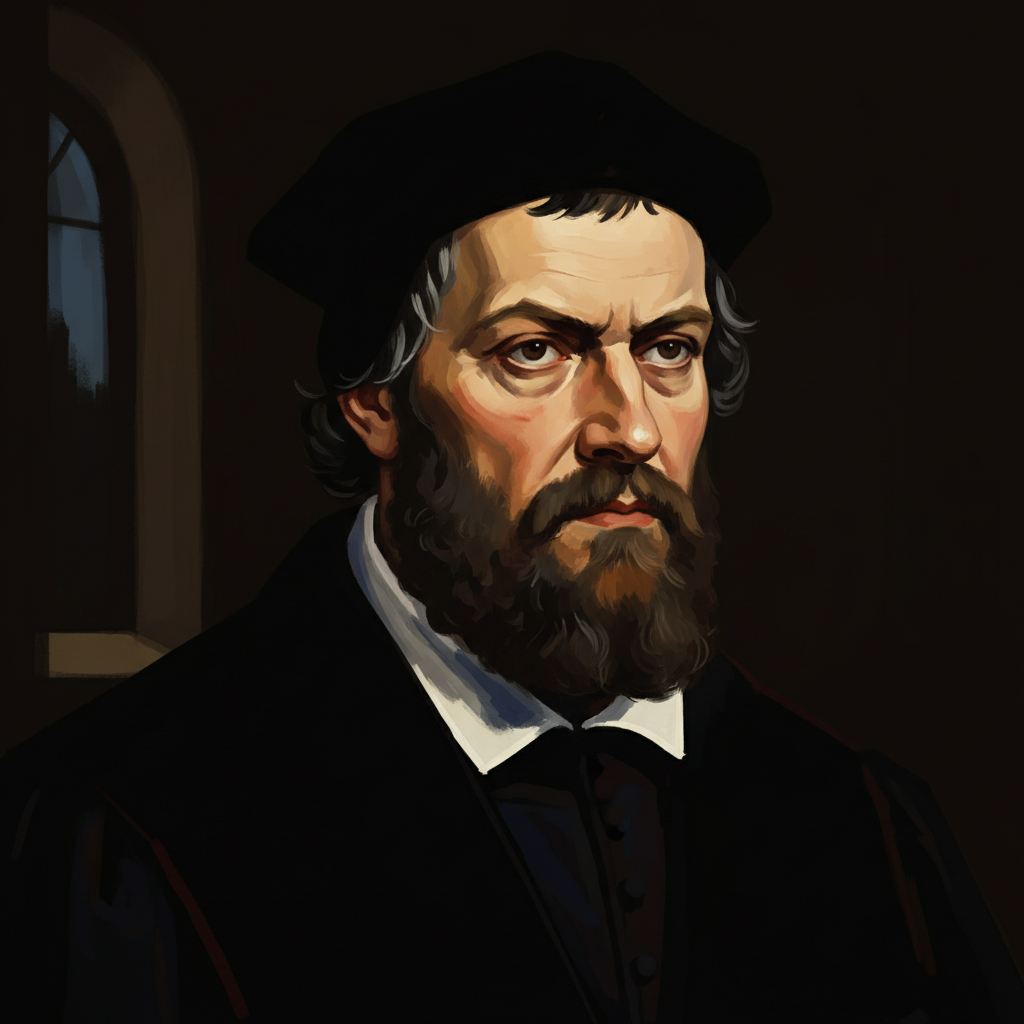
Martin Luther — "Peace if possible, truth at all costs."
Peace if possible, truth at all costs.
Peace if possible, truth at all costs.
Click any product to generate a realistic preview. Up to 3 at a time.
* Initial load can take up to 90 seconds — revising the preview in another color is nearly instant.
"God created the world, and he gave it to man, and he said, 'Be fruitful and multiply, and fill the earth and subdue it.'"
"The greater the sinner, the greater the grace."
"Their prayer books and Talmudic writings, in which such idolatry, lies, cursing, and blasphemy are taught, should be taken from them."
"I would have all Christians educated enough to be able to read the Bible. It is not for priests alone, but for all."
"If I had to baptize a Jew, I would take him to the bridge of the Elbe, hang a stone around his neck and push him over with the words 'I baptize thee in the name of Abraham.'"
German theologian whose 95 Theses (1517) launched the Protestant Reformation and broke the Catholic Church's monopoly on Western Christianity. Closely associated with Philipp Melanchthon (Lutheran systematizer) and John Calvin (later Reformer who built on Luther's break). For an intellectual contrast, see Pope Leo X, Renaissance pope (1513-1521) — Leo X's indulgence sales triggered Luther's break and Leo excommunicated him in 1521 — Luther's entire Reformation is structured as a direct answer to the indulgence-funded Vatican Leo represented.
Found in 2 providers: gemini,deepseek
2 sources checked
This saying argues that getting along with others is valuable, but honesty and genuine conviction matter more. When forced to choose between keeping the peace and speaking what you believe is true, you should always choose truth, even if it causes conflict, division, or personal hardship. Harmony built on silence or compromise about real facts is a false peace not worth preserving.
Luther embodied this principle when he refused to recant his ninety-five theses at the Diet of Worms in 1521, reportedly declaring his conscience captive to Scripture. As a monk and theology professor, he shattered Western Christianity rather than soften critiques of indulgences, papal authority, and church corruption. His willingness to face excommunication and outlaw status rather than stay silent made truth-telling the defining act of his career.
The early modern period saw the Catholic Church dominate European political and spiritual life, with dissent punished by excommunication or execution. The printing press spread ideas rapidly, Renaissance humanism encouraged returning to original sources, and rulers increasingly resented Roman interference. Luther's 1517 protest ignited decades of religious wars, peasant revolts, and the splintering of Christendom, making public theological disagreement genuinely life-threatening yet newly possible.
AI-generated insights based on extensive research and information for context. Factual errors? Email [email protected].
Your cart is empty