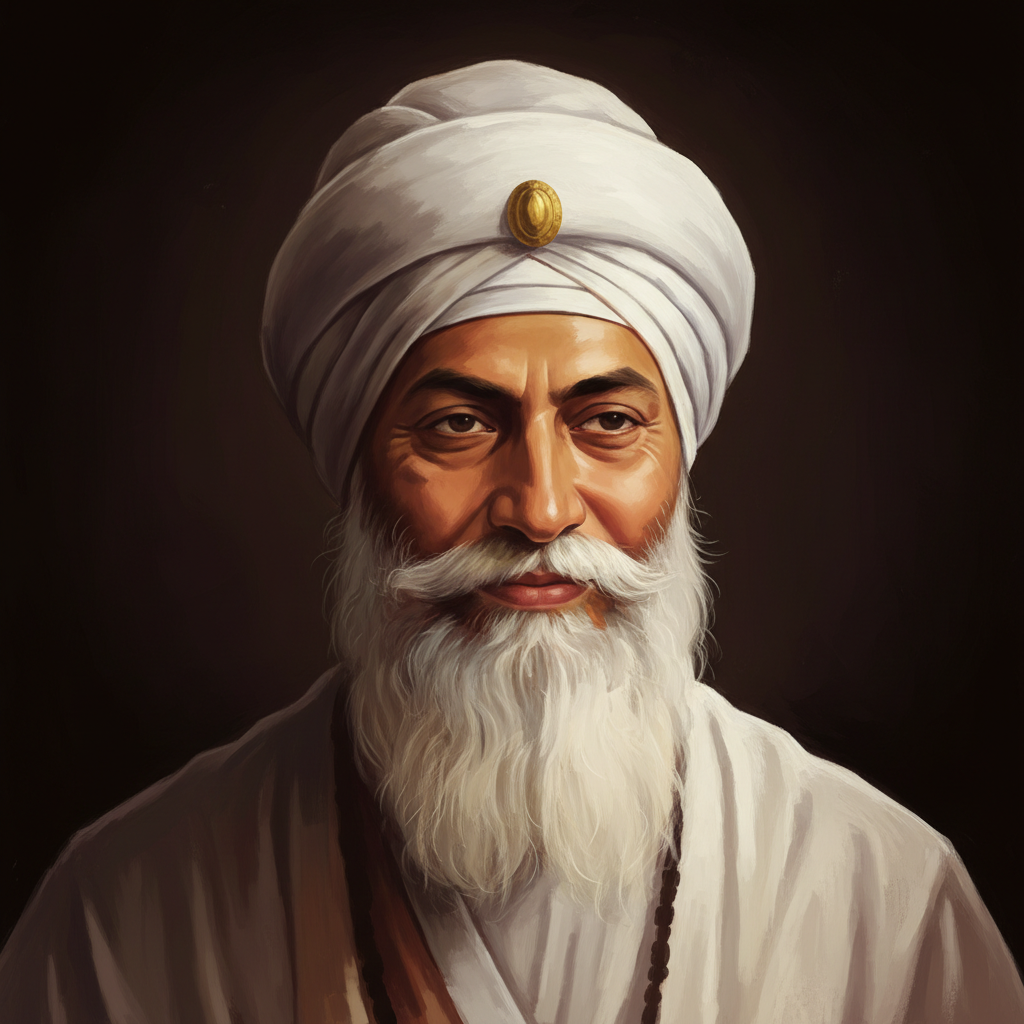
Guru Nanak — "There is but one God. And sometimes, He has a very subtle sense of humor."
There is but one God. And sometimes, He has a very subtle sense of humor.
There is but one God. And sometimes, He has a very subtle sense of humor.
Click any product to generate a realistic preview. Up to 3 at a time.
* Initial load can take up to 90 seconds — revising the preview in another color is nearly instant.
"The nights are wasted sleeping, and the days are wasted eating; the human spends his life in vain."
"When the corn is ripe, it is cut down; when the mortal becomes old, death dances over his head."
"Even if you have a hundred thousand friends, you are alone if you don't have a good cup of tea."
"That one plant should be sown and another be produced cannot happen; whatever seed is sown, a plant of that kind even comes forth."
"The Dhoop (burnt incense), lamps and the Naivaed (an offering of eatables presented to deity or idol. All of them become false) by smell. (Then, O Rabb!) If Your Poojaa can be done only with these thi…"
Founder of Sikhism and the first of the Ten Sikh Gurus, whose teachings of one universal God and rejection of caste shaped Punjab. Closely associated with Kabir (mystical poet whose verses appear in the Sikh Guru Granth Sahib). For an intellectual contrast, see Brahmanical orthodoxy, the Hindu caste-and-ritual establishment of his era — Sikhism was founded as a deliberate alternative to both Hindu ritual hierarchy and Islamic exclusivism — Nanak's universalism was a structural rejection of caste and priestly mediation.
A modern, humorous interpretation of Sikh theology, not a direct quote.
Date: Modern
GeneralFound in 1 providers: grok
1 source checked
The quote asserts absolute monotheism — one singular divine reality beneath all existence — while acknowledging that God's workings often appear paradoxical or ironic to human minds. It pairs theological conviction with humility: even the devout must accept that divine logic confounds human expectation. The phrase 'subtle sense of humor' softens doctrine into wisdom, suggesting the universe operates on a plane humans cannot fully predict or control.
Guru Nanak built Sikhism on Ik Onkar — 'One God' — making the first clause his foundational creed. Yet he was equally known for wit and storytelling; his sacred hymns used irony and paradox to expose religious hypocrisy. He challenged priests, rulers, and merchants with humor-laced truths. This quote reflects both his unshakeable monotheism and his personality as a teacher who used gentle irreverence to illuminate the divine rather than intimidate followers.
Guru Nanak lived (1469–1539) in the Punjab amid fierce Hindu-Muslim tension, where priests exploited the poor through ritualism and caste-based exclusion while claiming monopoly on divine access. Asserting one universal God, reachable by all, was revolutionary. The notion of God's 'subtle humor' carried extra weight in an era where religious systems produced tragic irony daily: the devout oppressed, the corrupt elevated, and orthodoxy consistently serving power over genuine spiritual truth.
AI-generated insights based on extensive research and information for context. Factual errors? Email [email protected].
Your cart is empty