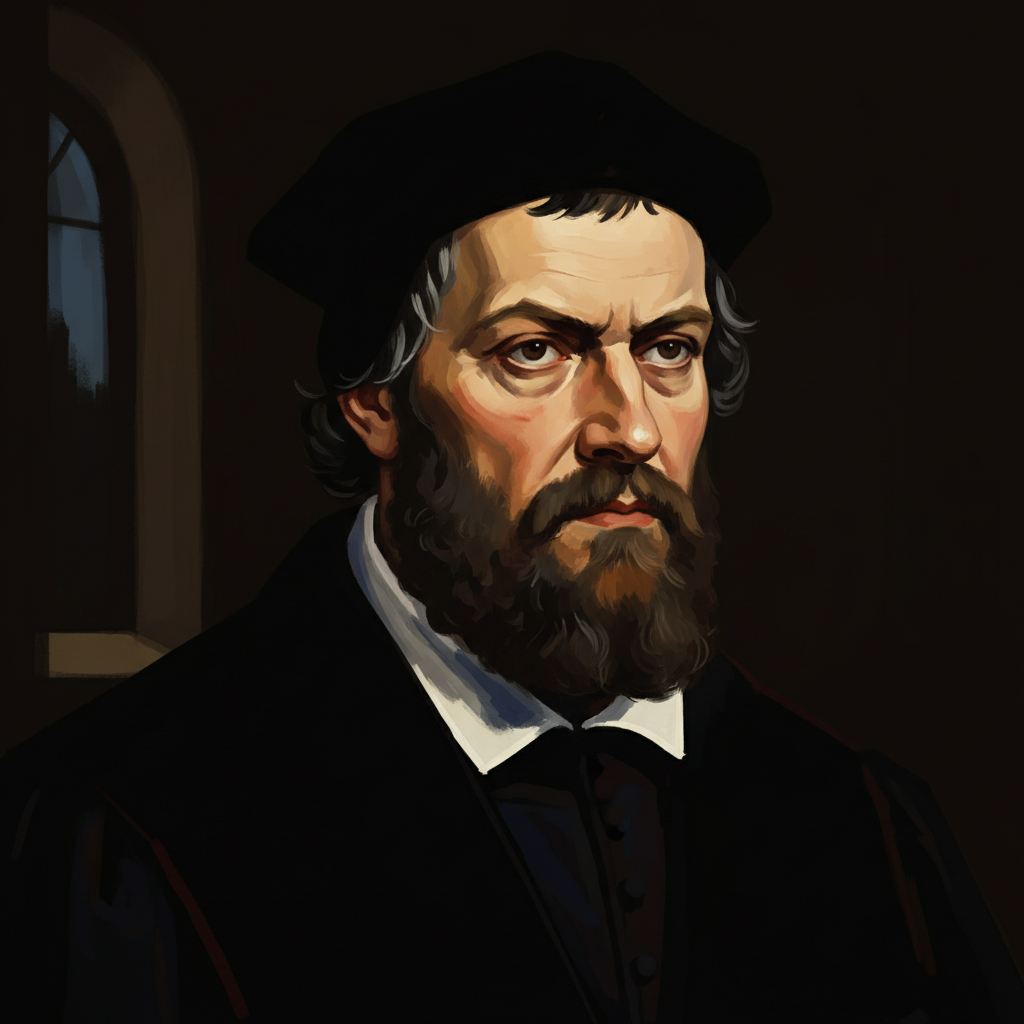
Martin Luther — "Reason is the greatest enemy that faith has."
Reason is the greatest enemy that faith has.
Reason is the greatest enemy that faith has.
Click any product to generate a realistic preview. Up to 3 at a time.
* Initial load can take up to 90 seconds — revising the preview in another color is nearly instant.
"The Devil is a great artist, but he has no colors."
"Faith is a living, daring confidence in God's grace, so sure and certain that a man could stake his life on it a thousand times."
"I am more afraid of my own heart than of the pope and all his cardinals."
"The pope is the Antichrist."
"What is worse, the Jews, in their synagogues, curse our Lord Jesus Christ and Mary His mother, and call her a whore, and Christ a mamzer [bastard], that is, a son of a whore."
German theologian whose 95 Theses (1517) launched the Protestant Reformation and broke the Catholic Church's monopoly on Western Christianity. Closely associated with Philipp Melanchthon (Lutheran systematizer) and John Calvin (later Reformer who built on Luther's break). For an intellectual contrast, see Pope Leo X, Renaissance pope (1513-1521) — Leo X's indulgence sales triggered Luther's break and Leo excommunicated him in 1521 — Luther's entire Reformation is structured as a direct answer to the indulgence-funded Vatican Leo represented.
Found in 1 providers: deepseek
1 source checked
Luther argues that human logic and rational analysis actively work against religious belief. When people try to understand God, salvation, or scripture through reasoning alone, they reach conclusions that contradict faith. Trust in divine truth requires setting aside the mind's demand for proof and coherence. Reason asks questions faith cannot answer on logic's terms, so the two stand opposed, with rational scrutiny corroding spiritual conviction rather than supporting it.
Luther, an Augustinian monk and theology professor, built his entire Reformation on sola fide, justification by faith alone, not works or intellect. He rejected scholastic theology that used Aristotelian logic to systematize Christianity, famously calling reason a harlot when it challenged scripture. His own crisis came from rationally examining indulgences, yet he grounded his answer in faith, trusting Romans 1:17 over philosophical tradition and papal authority.
In early-modern Europe around 1517-1546, scholasticism dominated universities, marrying Aristotle with Catholic doctrine. The Renaissance revived classical reasoning, humanists scrutinized texts critically, and printing spread ideas rapidly. Against this rising intellectualism, Luther defended scripture's authority over human philosophy. The Reformation split Christendom, and debates at Leipzig and Worms pitted rational tradition against conscience-bound faith. His suspicion of reason pushed back on Rome's logical defenses of indulgences, purgatory, and sacramental theology.
AI-generated insights based on extensive research and information for context. Factual errors? Email [email protected].
Your cart is empty