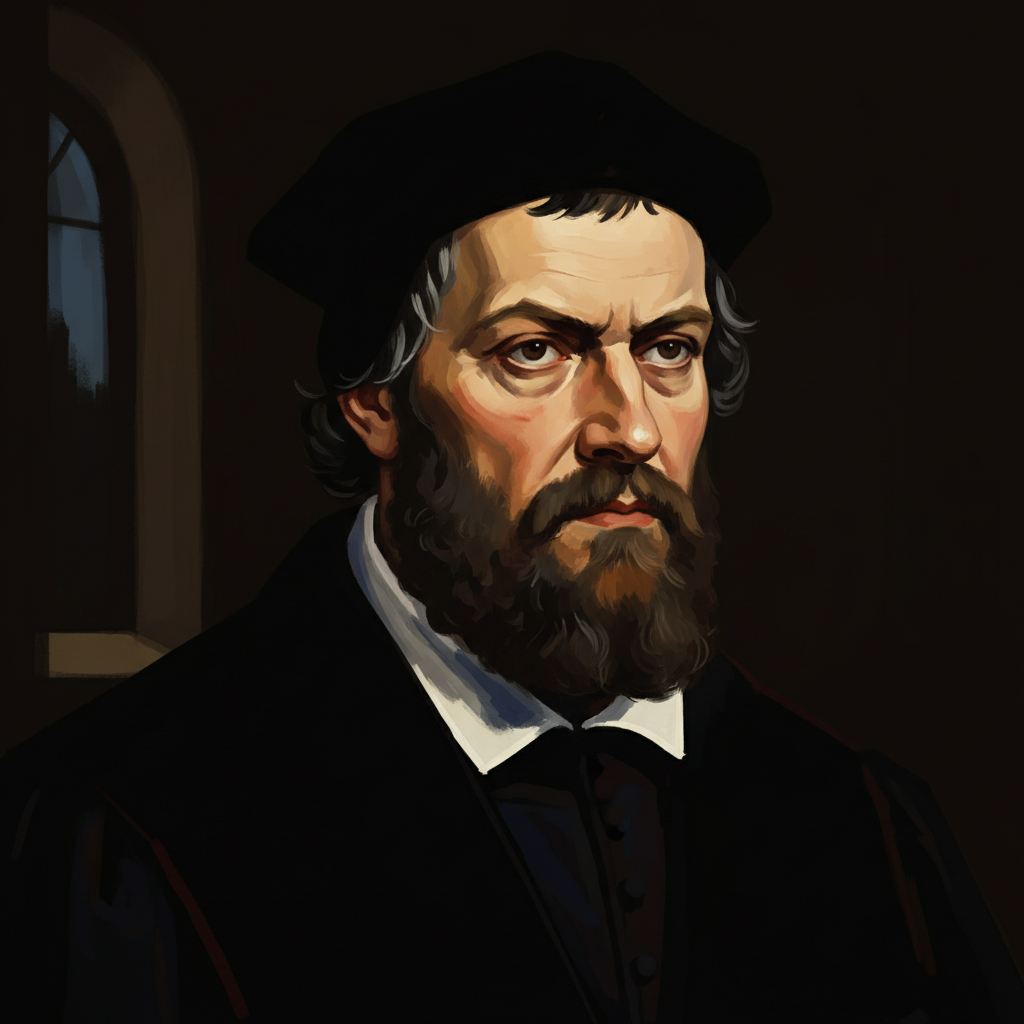
Martin Luther — "I am more afraid of my own heart than of the pope and all his cardinals."
I am more afraid of my own heart than of the pope and all his cardinals.
I am more afraid of my own heart than of the pope and all his cardinals.
Click any product to generate a realistic preview. Up to 3 at a time.
* Initial load can take up to 90 seconds — revising the preview in another color is nearly instant.
"God created the world, and he gave it to man, and he said, 'Be fruitful and multiply, and fill the earth and subdue it.'"
"A Jewish heart is as hard as a stick, a stone, as iron, as a devil."
"Burn down their synagogues, forbid all that I enumerated earlier, force them to work, and deal with them with utmost severity, as Moses did in the wilderness, when he slew three thousand... for if we …"
"Peace if possible, truth at all costs."
"But since they have deliberately and sacrilegiously abandoned their obedience, and in addition have dared to oppose their lords, they have thereby forfeited body and soul, as perfidious, perjured, lyi…"
German theologian whose 95 Theses (1517) launched the Protestant Reformation and broke the Catholic Church's monopoly on Western Christianity. Closely associated with Philipp Melanchthon (Lutheran systematizer) and John Calvin (later Reformer who built on Luther's break). For an intellectual contrast, see Pope Leo X, Renaissance pope (1513-1521) — Leo X's indulgence sales triggered Luther's break and Leo excommunicated him in 1521 — Luther's entire Reformation is structured as a direct answer to the indulgence-funded Vatican Leo represented.
Found in 1 providers: deepseek
1 source checked
Luther is saying his own inner weaknesses, doubts, and sinful impulses scare him more than any powerful external enemy. The greatest threat to his faith and integrity is not the institutional opposition he faces but his own capacity for self-deception, pride, and failure. In modern terms: the battles inside you matter more than the ones outside you, and honest self-examination is harder and more dangerous than confronting visible opponents.
Luther openly wrestled with crushing guilt, scrupulosity, and anfechtungen, spiritual assaults he described throughout his life. Despite publicly defying the pope at Worms in 1521 and leading the Reformation, he privately feared his own unruly conscience more than excommunication or execution. This line fits his theology of simul justus et peccator, the belief that every Christian remains simultaneously righteous and sinner, making internal corruption the permanent front line of faith.
In early modern Europe, the pope wielded enormous political and spiritual power, and defying him risked burning at the stake, as Jan Hus had learned. Luther wrote amid the Reformation crisis after 1517, when his 95 Theses split Western Christianity. The era prized introspective piety fueled by confession manuals and late medieval mysticism, so naming the heart as the true battlefield resonated deeply with readers surrounded by plague, peasant revolts, and religious warfare.
AI-generated insights based on extensive research and information for context. Factual errors? Email [email protected].
Your cart is empty