What it means
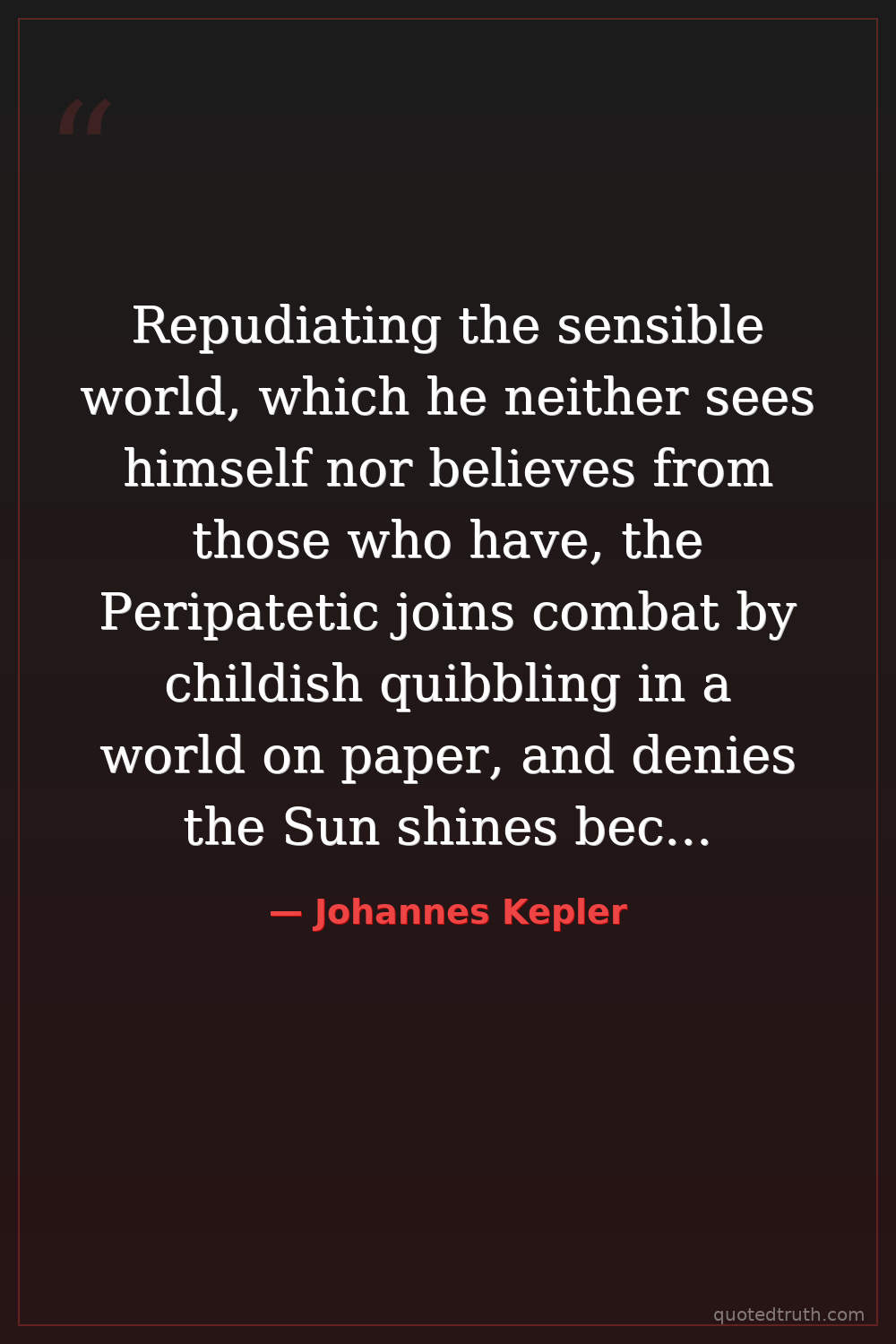
Kepler attacks people who reject real-world evidence they could verify themselves, instead clinging to abstract textbook arguments. He compares them to a blind man denying the sun shines simply because he cannot see it. Rather than looking through a telescope or observing nature directly, these critics nitpick words and logic on the page. Their refusal to engage with actual observation becomes willful ignorance dressed up as sophisticated debate.
Relevance to Johannes Kepler
Kepler built his career on meticulous observation, using Tycho Brahe's precise data to derive his three laws of planetary motion. He defended Galileo's telescopic discoveries and championed Copernican heliocentrism against Aristotelian scholars who refused to look through telescopes. As both mathematician and empiricist, Kepler embodied the shift from textual authority to observational evidence, making this jab at 'Peripatetics' deeply personal to his scientific method.
The era
During the early 1600s, universities still taught Aristotelian (Peripatetic) physics as orthodoxy, while Galileo's telescope revealed moons, phases, and sunspots contradicting ancient cosmology. The Catholic Church was moving toward condemning heliocentrism, and scholars often dismissed new instruments rather than risk their worldview. Kepler wrote amid this Counter-Reformation tension, the Thirty Years' War, and widespread resistance to empirical astronomy, making his defense of direct observation both scientifically radical and politically dangerous.
AI-generated insights based on extensive research and information for context. Factual errors? Email [email protected].