What it means
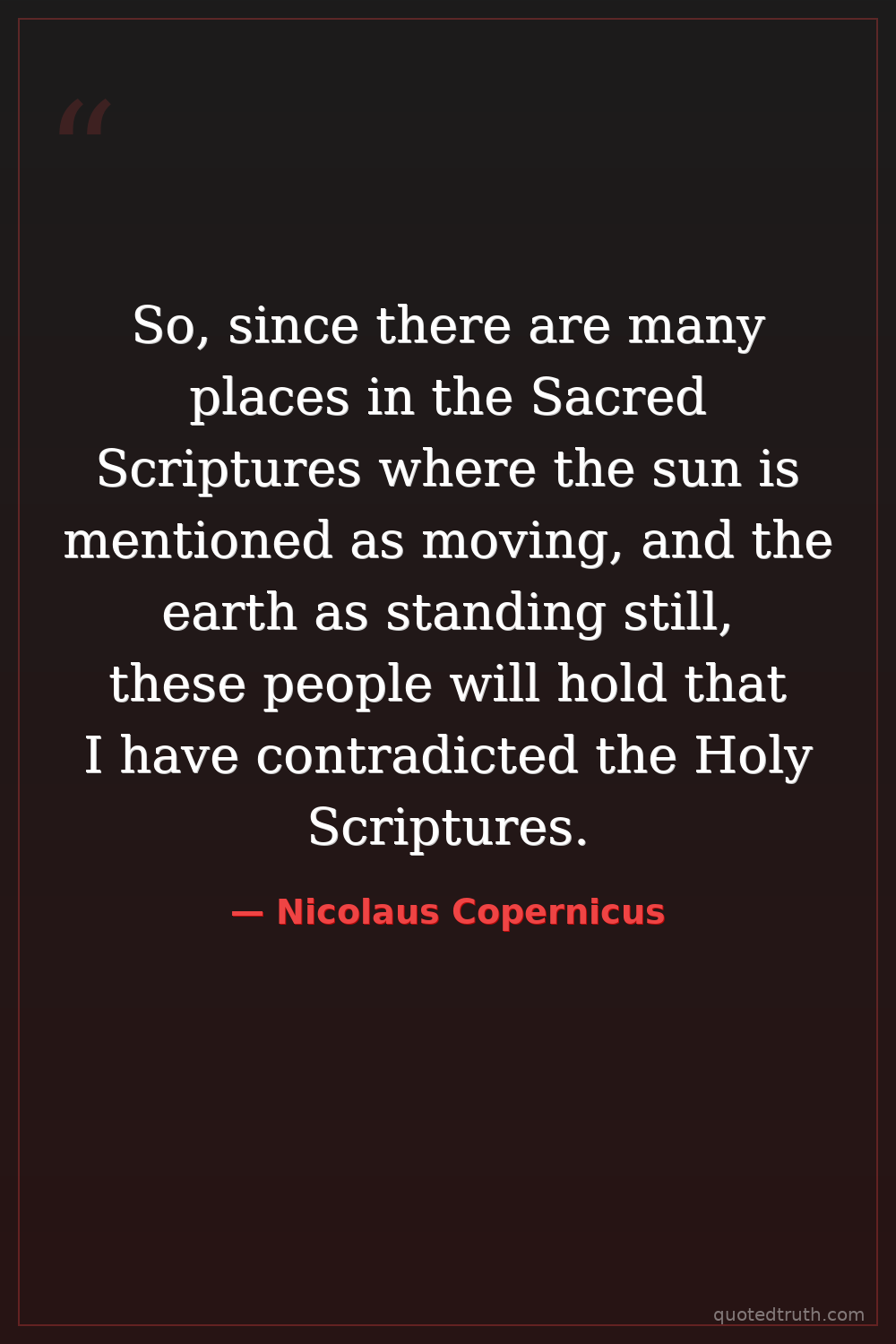
Copernicus acknowledges that biblical passages describe the sun moving and Earth standing still, and anticipates critics will claim his heliocentric model directly contradicts Scripture. He is not dismissing the objection—he is preemptively naming it. The quote reveals intellectual courage tempered by realism: he knew placing Earth in motion around the sun would be read as heresy by those interpreting the Bible literally rather than allegorically.
Relevance to Nicolaus Copernicus
Copernicus spent his career as a Catholic canon in Warmia, Poland—a church administrator, not a rebel. He withheld De revolutionibus for years, acutely aware of religious and professional risks. He dedicated it to Pope Paul III hoping to deflect censure. His preemptive acknowledgment of scriptural objections reflects a man who deeply understood church authority and chose his words with extreme care to protect both his revolutionary work and himself.
The era
In the 1540s, the Reformation had fractured Christian Europe, making biblical interpretation intensely political. Both Catholic and Protestant authorities increasingly policed doctrine. Geocentrism, rooted in Aristotle and Ptolemy, was reinforced by passages in Joshua and Psalms and treated as settled truth. Scripture was read literally by most clergy. Within decades, Galileo faced the Inquisition for advancing Copernican ideas, proving Copernicus's apprehension was accurate prophecy, not mere paranoia.
AI-generated insights based on extensive research and information for context. Factual errors? Email [email protected].