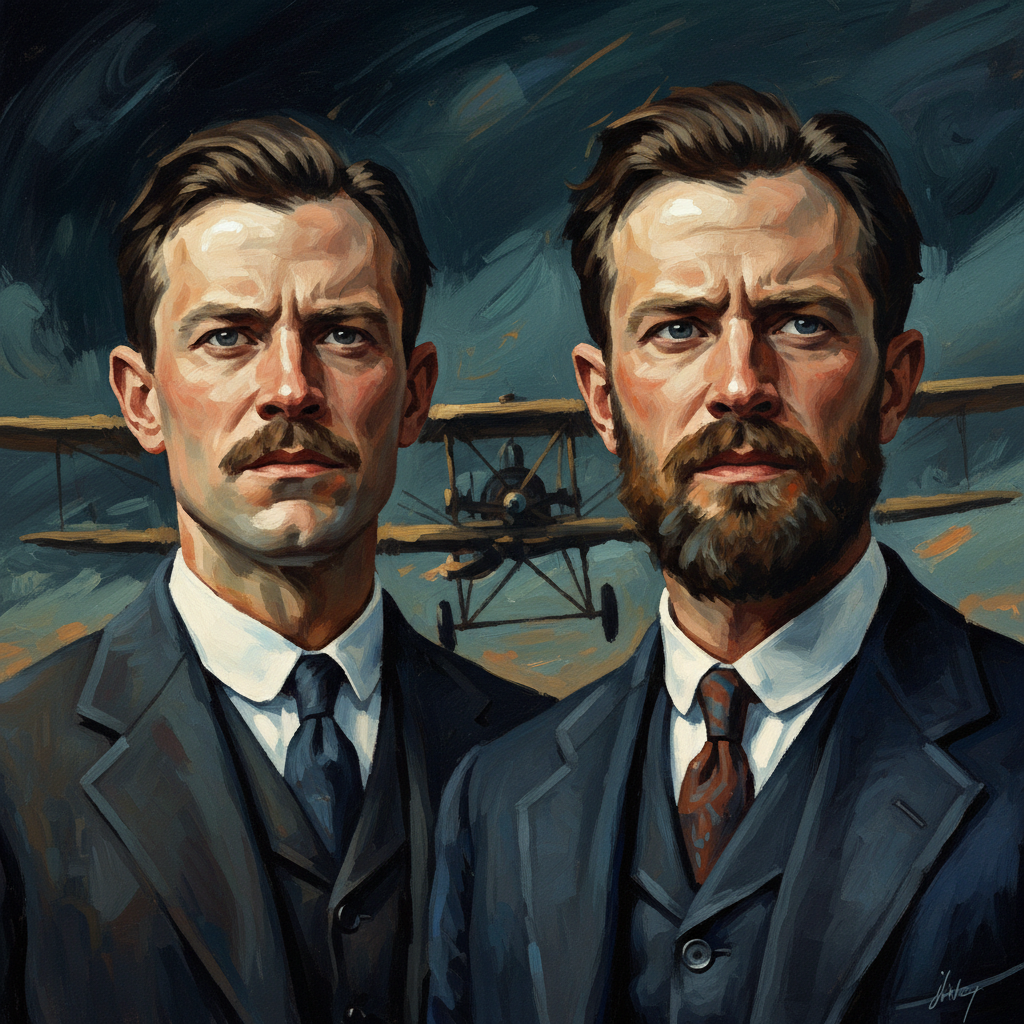
Wright Brothers (Orville & Wilbur) — "We had to be our own mechanics, our own engineers, and our own scientists."
We had to be our own mechanics, our own engineers, and our own scientists.
We had to be our own mechanics, our own engineers, and our own scientists.
Click any product to generate a realistic preview. Up to 3 at a time.
* Initial load can take up to 90 seconds — revising the preview in another color is nearly instant.
"Often, after an hour or so of heated argument, we would discover that we were as far from agreement as when we started, but that each had changed to the other's original position."
"We are trying to arrange a demonstration in Europe."
"The desire to fly is an idea handed down to us by our ancestors who, in their weary journeys over endless plains, yearned for a swifter and less laborious mode of travel."
"The Wright brothers flew right through the smoke screen of impossibility."
"We had taken up the invention of the flying machine as a sport."
American aviation pioneers who achieved the first sustained powered controlled airplane flight at Kitty Hawk, NC, on December 17, 1903. Closely associated with Octave Chanute (their gliding mentor and aeronautical correspondent). For an intellectual contrast, see Samuel Pierpont Langley, Smithsonian Institution Secretary and government-funded aviation researcher — Langley's Aerodrome crashed twice into the Potomac in October-December 1903 with $50,000 of War Department funding; the Wright Brothers' bicycle-shop empiricism beat Langley's institutional Big Science by 9 days. The most-cited example in engineering history of empirical-tinkerer beating institution-funded credentialism.
Found in 1 providers: grok
1 source checked
Building something genuinely new means you cannot outsource the hard parts. When no expert exists for what you are attempting, you must learn every discipline yourself, from fixing machines to calculating lift to testing theories. The quote captures the reality of pioneering work: you wear every hat because there is no one ahead of you on the path to hand you answers or ready-made tools.
The Wrights ran a bicycle shop with no formal engineering degrees, yet they built their own wind tunnel, machined their own engine when no manufacturer would supply one light enough, and derived corrected lift tables after discovering Lilienthal's data was wrong. They hand-carved propellers using original aerodynamic theory. Every component of the 1903 Flyer, from airframe to control system, came from their own shop in Dayton, Ohio.
At the turn of the twentieth century, aeronautics was a fringe pursuit littered with failures and fatalities. No universities taught flight, no textbooks existed, and respected scientists like Lord Kelvin declared heavier-than-air flying machines impossible. Government-funded efforts by Samuel Langley collapsed spectacularly. Self-taught tinkerers working in home workshops, not credentialed institutions, drove the mechanical revolution of bicycles, automobiles, and eventually aircraft.
AI-generated insights based on extensive research and information for context. Factual errors? Email [email protected].
Your cart is empty