Wright Brothers (Orville & Wilbur) — "The machine is capable of carrying a passenger."
The machine is capable of carrying a passenger.
The machine is capable of carrying a passenger.
Click any product to generate a realistic preview. Up to 3 at a time.
* Initial load can take up to 90 seconds — revising the preview in another color is nearly instant.
"The problem of flight was not one of power, but of control."
"It was impossible to convince the people generally that we were not a pair of lunatics."
"We have been able to keep the machine in the air for longer periods than ever before."
"The greatest obstacle to progress is not ignorance, but the illusion of knowledge."
"No airship will ever fly from New York to Paris. That seems to me to be impossible. What limits the flight is the motor. No known motor can run at the requisite speed for four days without stopping, a…"
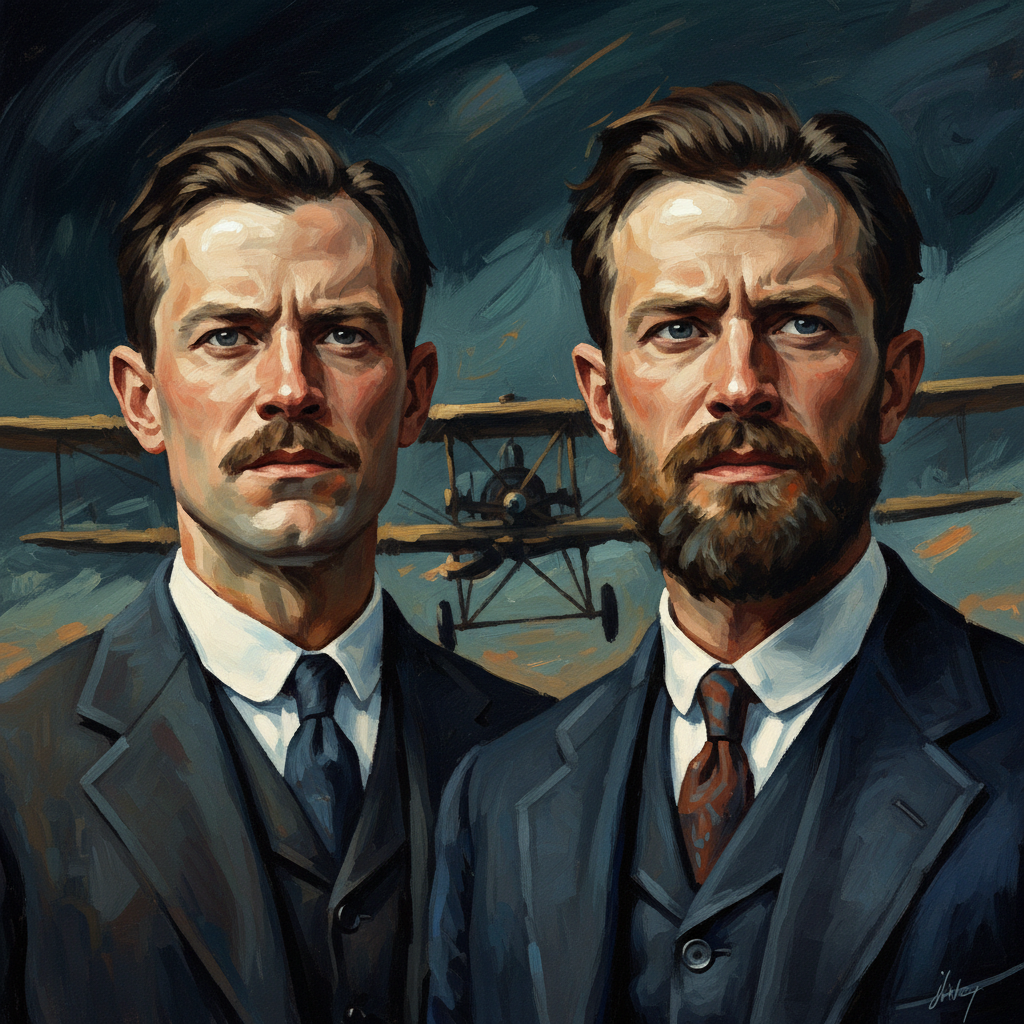
American aviation pioneers who achieved the first sustained powered controlled airplane flight at Kitty Hawk, NC, on December 17, 1903. Closely associated with Octave Chanute (their gliding mentor and aeronautical correspondent). For an intellectual contrast, see Samuel Pierpont Langley, Smithsonian Institution Secretary and government-funded aviation researcher — Langley's Aerodrome crashed twice into the Potomac in October-December 1903 with $50,000 of War Department funding; the Wright Brothers' bicycle-shop empiricism beat Langley's institutional Big Science by 9 days. The most-cited example in engineering history of empirical-tinkerer beating institution-funded credentialism.
Found in 1 providers: grok
1 source checked
A simple engineering declaration: the aircraft they built is structurally and mechanically sound enough to carry a human being safely. Not a dream or a theory — a tested, repeatable fact. The word 'capable' carries the weight of engineering confidence earned through methodical experiment. In modern terms: we built something that works and a person can ride in it. Short, matter-of-fact, and historically enormous.
Orville and Wilbur were bicycle mechanics from Dayton, Ohio — self-taught engineers who solved flight through systematic testing, not formal education. Their language always matched their character: precise, understated, and factual. By 1908, Wilbur was flying observers in France while Orville demonstrated at Fort Myer, Virginia. This statement captures their core belief that flight was an engineering problem to be solved methodically, not a miracle to be witnessed.
In 1903–1908, powered flight was brand new and deeply distrusted. The public, press, and even the U.S. Army dismissed the Wright Brothers' claims for years. Europe remained skeptical until Wilbur's 1908 French demonstrations silenced doubters. No commercial aviation existed; railroads and steamships moved the world. Announcing that a machine could carry a passenger was a quiet, direct refutation of every expert who insisted human flight was impossible.
AI-generated insights based on extensive research and information for context. Factual errors? Email [email protected].
Your cart is empty