Wright Brothers (Orville & Wilbur) — "The machine had scarcely cleared the ground when it began to turn up, and the ne…"
The machine had scarcely cleared the ground when it began to turn up, and the next instant it darted into the ground.
The machine had scarcely cleared the ground when it began to turn up, and the next instant it darted into the ground.
Click any product to generate a realistic preview. Up to 3 at a time.
* Initial load can take up to 90 seconds — revising the preview in another color is nearly instant.
"The machine was kept in the air for 59 seconds and traveled 852 feet."
"We were very much surprised at the ease with which the machine was controlled."
"The airplane stays up because it doesn’t have the time to fall."
"We have been very busy with the demonstrations of our machine."
"The machine is under perfect control and can be turned in any direction at will."
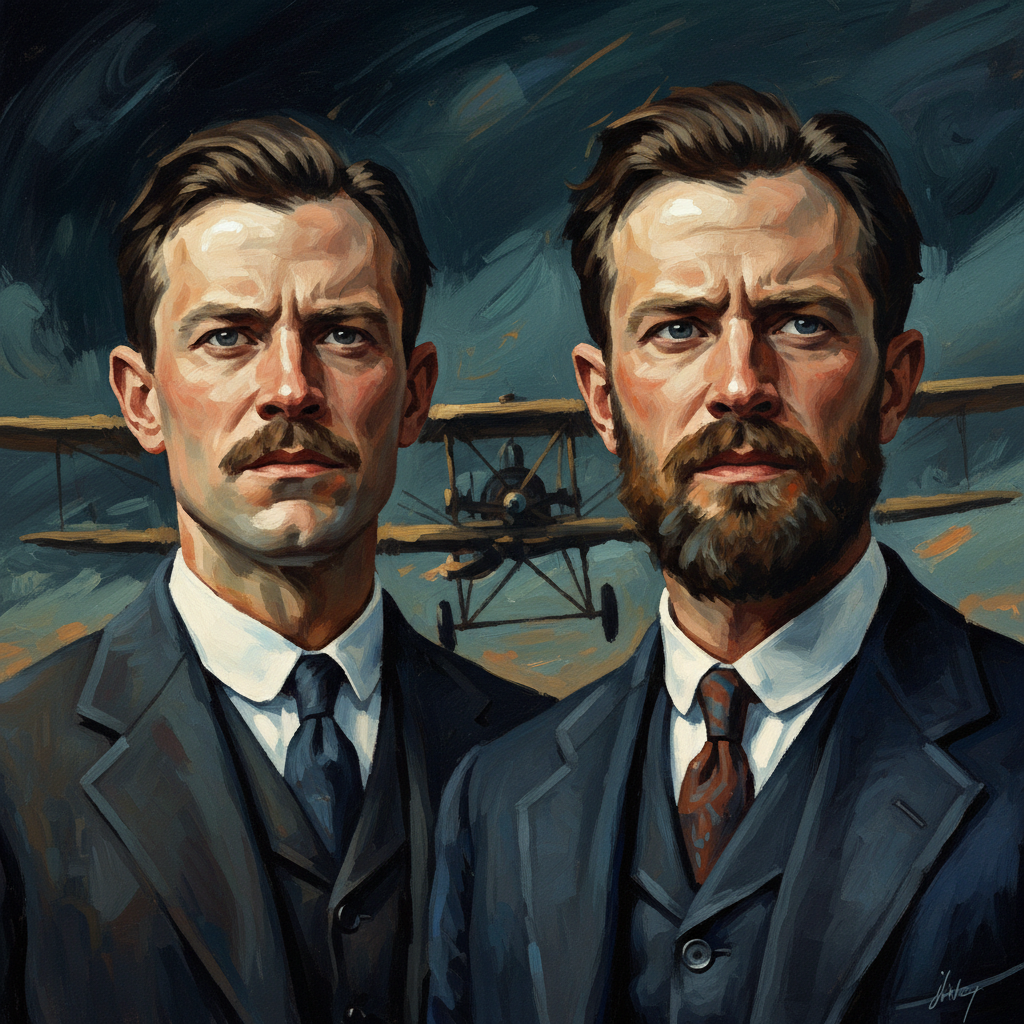
American aviation pioneers who achieved the first sustained powered controlled airplane flight at Kitty Hawk, NC, on December 17, 1903. Closely associated with Octave Chanute (their gliding mentor and aeronautical correspondent). For an intellectual contrast, see Samuel Pierpont Langley, Smithsonian Institution Secretary and government-funded aviation researcher — Langley's Aerodrome crashed twice into the Potomac in October-December 1903 with $50,000 of War Department funding; the Wright Brothers' bicycle-shop empiricism beat Langley's institutional Big Science by 9 days. The most-cited example in engineering history of empirical-tinkerer beating institution-funded credentialism.
Found in 1 providers: grok
1 source checked
A powered aircraft barely lifts off the ground before the nose pitches sharply upward and the machine slams back into the earth within seconds. It captures the brutal unpredictability of early flight — the gap between liftoff and catastrophic failure measured in fractions of a second. The plain, mechanical language conveys both the precision of an engineering mind and how little control existed in those first precarious moments above the ground.
This is the Wright Brothers' own technical language drawn from their meticulously kept flight diaries. The quote almost certainly describes Wilbur's failed attempt on December 14, 1903 — three days before Orville's successful 12-second flight at Kitty Hawk. As bicycle mechanics turned self-taught aeronautical engineers, they treated every crash as diagnostic data. Their systematic documentation of pitch instability and control lag was precisely what distinguished them from rivals who abandoned experiments after failure.
In late 1903, powered flight was widely considered impossible or decades away. The U.S. government had just watched Samuel Langley's well-funded Aerodrome crash into the Potomac River in October. Otto Lilienthal's glider death in 1896 haunted the field. The Wright Brothers were unknown bicycle shop owners from Dayton competing without government backing against credentialed scientists. Each crash they survived and studied kept them in the race when better-funded contemporaries had already quit.
AI-generated insights based on extensive research and information for context. Factual errors? Email [email protected].
Your cart is empty