Wright Brothers (Orville & Wilbur) — "The airplane is a crazy idea, but I don’t care."
The airplane is a crazy idea, but I don’t care.
The airplane is a crazy idea, but I don’t care.
Click any product to generate a realistic preview. Up to 3 at a time.
* Initial load can take up to 90 seconds — revising the preview in another color is nearly instant.
"The machine has been working very nicely and we have been making several flights each day."
"I think it will be a long time yet before anyone will be flying at any great height or speed."
"We were not looking for fame, but we were looking for knowledge."
"The aeroplane will be a great factor in bringing together the different nations of the earth."
"The airplane is a machine that makes the world a smaller place."
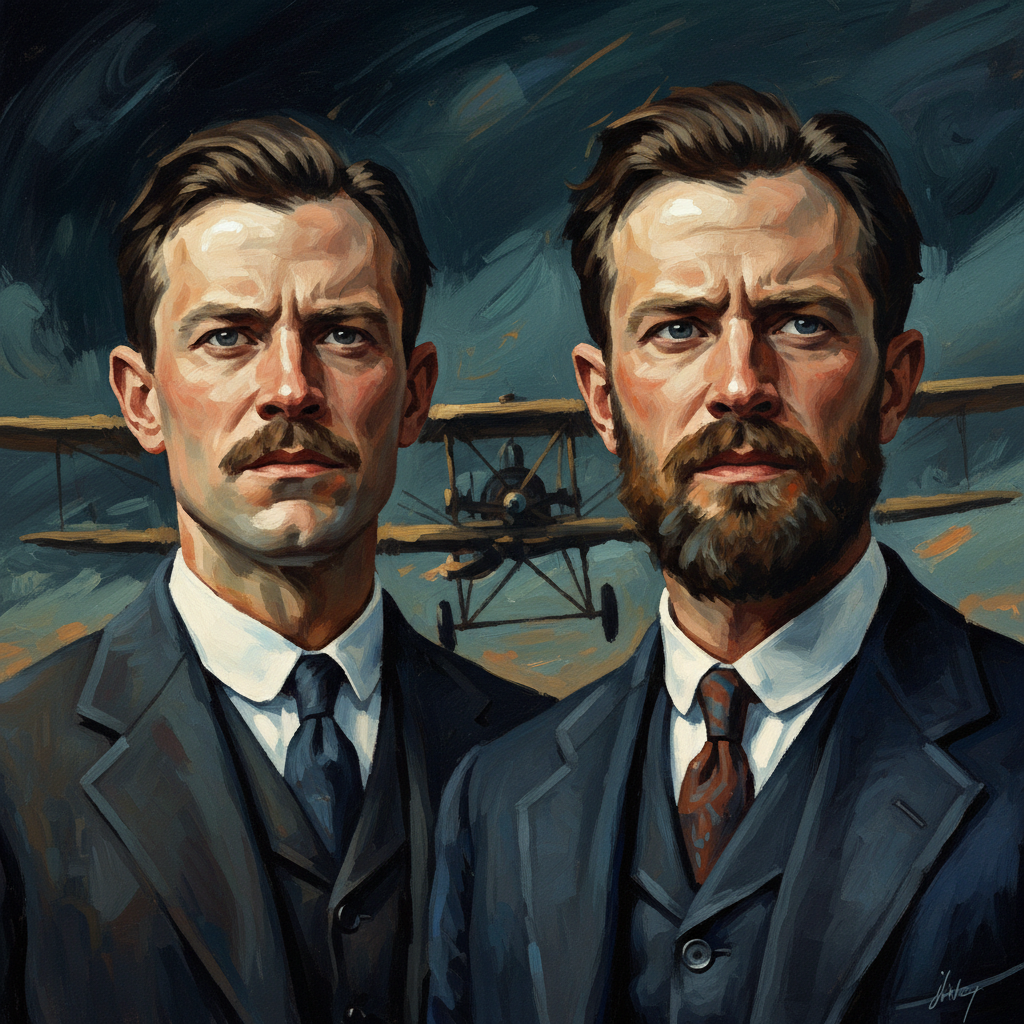
American aviation pioneers who achieved the first sustained powered controlled airplane flight at Kitty Hawk, NC, on December 17, 1903. Closely associated with Octave Chanute (their gliding mentor and aeronautical correspondent). For an intellectual contrast, see Samuel Pierpont Langley, Smithsonian Institution Secretary and government-funded aviation researcher — Langley's Aerodrome crashed twice into the Potomac in October-December 1903 with $50,000 of War Department funding; the Wright Brothers' bicycle-shop empiricism beat Langley's institutional Big Science by 9 days. The most-cited example in engineering history of empirical-tinkerer beating institution-funded credentialism.
Found in 1 providers: deepseek
1 source checked
When everyone around you calls your dream impossible or ridiculous, you push forward anyway. This captures the mindset of someone who has separated conviction from crowd opinion. The 'I don't care' isn't arrogance—it's focus. What others label crazy simply doesn't factor into whether you continue. Belief in the idea outweighs the social cost of being dismissed or mocked by peers and experts alike.
Orville and Wilbur were Dayton bicycle mechanics without engineering degrees, competing against Samuel Langley, who had a Smithsonian Institution salary and government funding. Newspapers openly mocked heavier-than-air flight ambitions. The brothers self-funded experiments, working methodically and quietly for years. Their December 17, 1903 success at Kitty Hawk—twelve seconds of sustained powered flight—proved that stubborn persistence and systematic experimentation could defeat credentialed skepticism and institutional dismissal.
In the early 1900s, respected scientists including Lord Kelvin declared powered flight impossible. Samuel Langley's government-funded Aerodrome crashed spectacularly into the Potomac River twice—the second failure just nine days before Kitty Hawk—reinforcing public ridicule. The U.S. War Department had dismissed flight proposals as impractical. Steam power and railroads defined serious transportation. Aviation existed only in Jules Verne fiction, making any serious pursuit of heavier-than-air flight culturally extraordinary.
AI-generated insights based on extensive research and information for context. Factual errors? Email [email protected].
Your cart is empty