Wright Brothers (Orville & Wilbur) — "The airplane stays up because it doesn’t have the time to fall."
The airplane stays up because it doesn’t have the time to fall.
The airplane stays up because it doesn’t have the time to fall.
Click any product to generate a realistic preview. Up to 3 at a time.
* Initial load can take up to 90 seconds — revising the preview in another color is nearly instant.
"We do not believe that the difficulties are insurmountable, and we are confident that we shall yet succeed."
"The desire for flight is the expression of a deep-seated human instinct."
"The fact that the machine did not fall apart at the first gust of wind was a great encouragement."
"No flying machine will ever fly from New York to Paris."
"If birds can glide for long periods of time, then why can't we?"
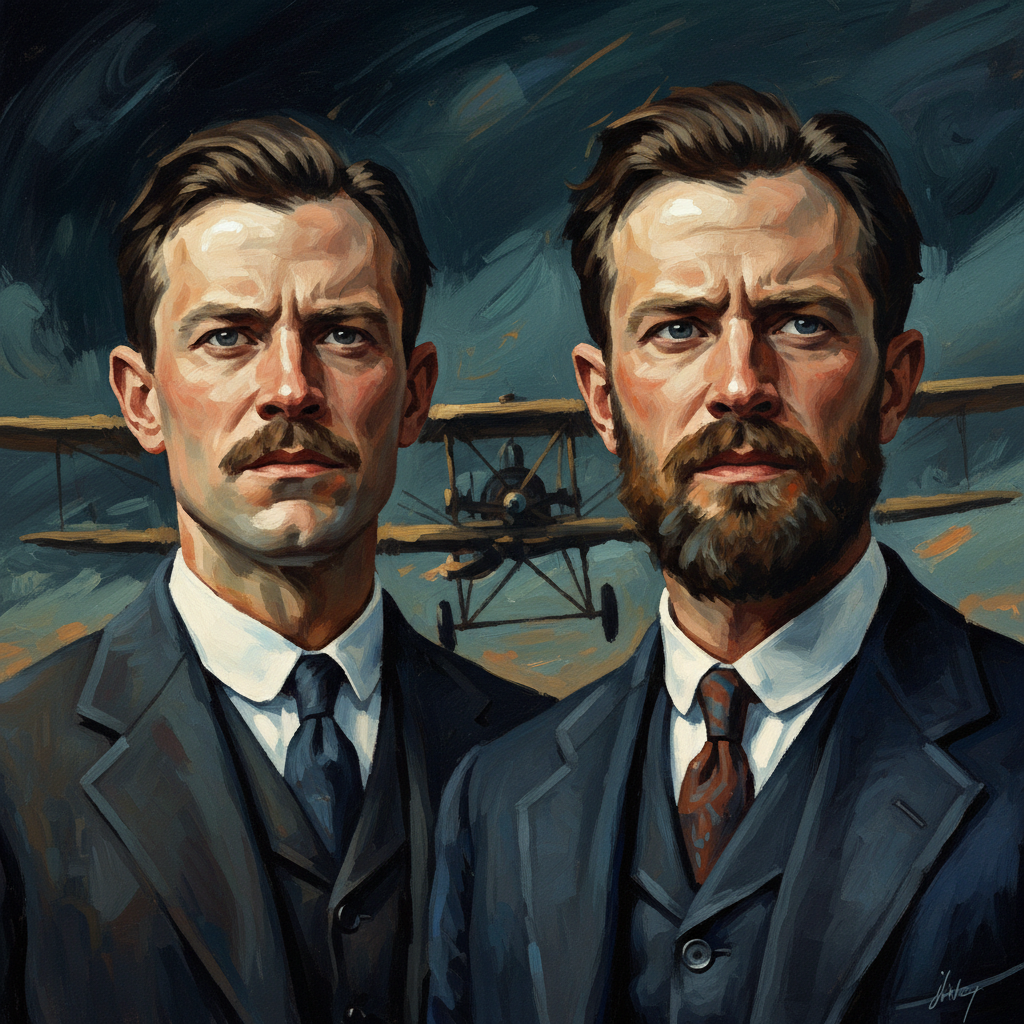
American aviation pioneers who achieved the first sustained powered controlled airplane flight at Kitty Hawk, NC, on December 17, 1903. Closely associated with Octave Chanute (their gliding mentor and aeronautical correspondent). For an intellectual contrast, see Samuel Pierpont Langley, Smithsonian Institution Secretary and government-funded aviation researcher — Langley's Aerodrome crashed twice into the Potomac in October-December 1903 with $50,000 of War Department funding; the Wright Brothers' bicycle-shop empiricism beat Langley's institutional Big Science by 9 days. The most-cited example in engineering history of empirical-tinkerer beating institution-funded credentialism.
Found in 1 providers: deepseek
1 source checked
An airplane doesn't stay airborne through magic or brute force against gravity — it stays up because its forward speed continuously generates lift faster than gravity can pull it down. Stop moving forward and it falls immediately. The quote reframes flight as a dynamic, ongoing process rather than a stable condition. It's a wry, honest acknowledgment that flight is a fragile balance of momentum and physics, not a conquest of gravity.
Orville and Wilbur were bicycle mechanics who understood machines through motion and momentum, not abstract theory. They built their own wind tunnel, tested hundreds of wing profiles, and grasped flight as a control problem requiring constant forward energy. Their 1903 Kitty Hawk flight lasted 12 seconds — barely enough time to fall. This quote reflects their hands-on, empirical mindset: explain what actually happens mechanically, not what sounds impressive.
In 1903, Lord Kelvin and leading scientists had publicly declared heavier-than-air flight impossible. The industrial age was peaking — steam ceding to gasoline, electricity reshaping cities, and inventors everywhere challenging expert consensus. The Wright Brothers' success arrived precisely by ignoring theoretical gatekeepers and focusing on observable mechanics. This quote's dry wit captured the era's self-made inventor ethos: the impossible becomes obvious once you stop theorizing and start moving forward.
AI-generated insights based on extensive research and information for context. Factual errors? Email [email protected].
Your cart is empty