Carl Linnaeus — "The American is obstinate, contented, free. He paints himself with red lines and…"
The American is obstinate, contented, free. He paints himself with red lines and is regulated by custom.
The American is obstinate, contented, free. He paints himself with red lines and is regulated by custom.
Click any product to generate a realistic preview. Up to 3 at a time.
* Initial load can take up to 90 seconds — revising the preview in another color is nearly instant.
"I was born on a farm, and I have always loved the countryside."
"Without names, knowledge is lost."
"All species of the same genus form a natural group, and all genera of the same order form a natural group."
"The whole world is a museum, and all its inhabitants are specimens."
"The African is lazy, crafty, negligent, and governed by caprice."
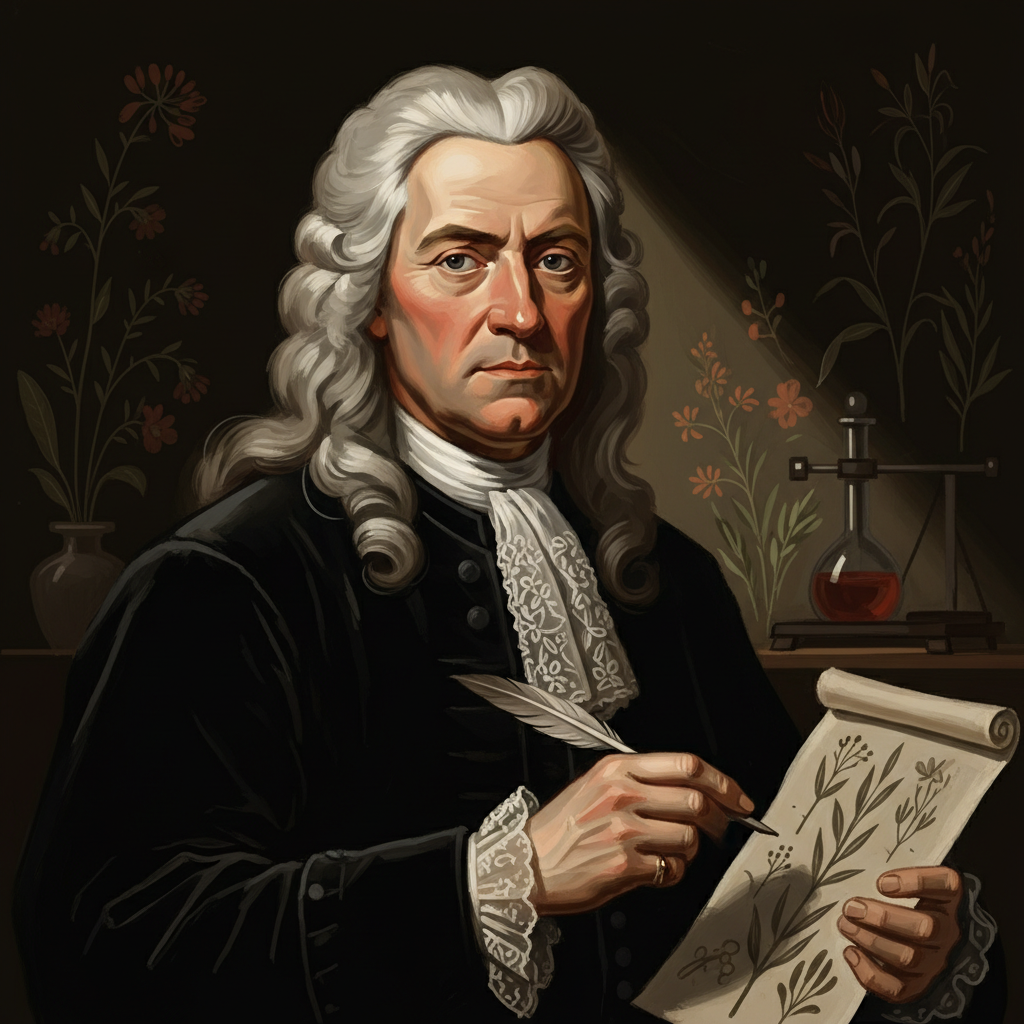
Swedish botanist and the father of modern taxonomy whose Systema Naturae (1735) introduced binomial nomenclature for naming all species. Closely associated with Joseph Banks (British naturalist who carried Linnaean classification on Cook's voyages). For an intellectual contrast, see Comte de Buffon, French naturalist and Histoire Naturelle author (1749-1788) — Buffon explicitly attacked Linnaean fixed-categories taxonomy as artificial and rejected the binomial system; his gradualist, environment-shaped natural history was the explicit alternative. Anticipates the fixed-species-vs-evolution debate Darwin would later resolve.
Found in 1 providers: deepseek
1 source checked
This describes a Native American as independent, self-sufficient, and governed by inherited tradition rather than written law or reason. The red body paint signals cultural identity and belonging. "Obstinate" implies stubborn resistance to outside influence. The portrait is ethnographic but filtered through European assumptions, framing indigenous life as static and customary rather than rational or progressive by Enlightenment standards of law-based governance.
Linnaeus published this in Systema Naturae (1758), classifying Homo sapiens into four geographic varieties — Americanus, Europaeus, Asiaticus, Afer — each assigned behavioral and moral traits alongside physical ones. His taxonomic drive to categorize all life extended to humans. Though revolutionary as a naturalist, his human typology drew on secondhand colonial reports and embedded European bias, inserting racial stereotypes into the scientific record under the guise of objective classification.
Eighteenth-century Enlightenment science pushed naturalists to catalog the entire natural world, including human diversity. European colonial expansion generated traveler accounts about indigenous peoples that naturalists incorporated uncritically. The "noble savage" concept circulated alongside fears of barbarism. Classifying humans by geography and temperament seemed scientifically legitimate before modern genetics challenged such categories. Linnaeus's typology became structural scaffolding for 19th-century racial science, amplifying consequences far beyond his original taxonomic intent.
AI-generated insights based on extensive research and information for context. Factual errors? Email [email protected].
Your cart is empty