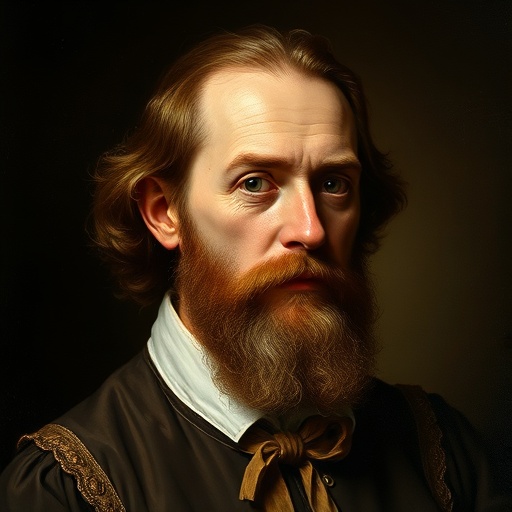
William Harvey — "The greatest pleasure is to be found in the contemplation of truth."
The greatest pleasure is to be found in the contemplation of truth.
The greatest pleasure is to be found in the contemplation of truth.
Click any product to generate a realistic preview. Up to 3 at a time.
* Initial load can take up to 90 seconds — revising the preview in another color is nearly instant.
"Nature is the best teacher."
"The blood carries nourishment to all parts of the body."
"The knowledge of man is the knowledge of God."
"The body is a microcosm of the universe."
"All animals, even man himself, are produced from an egg."
English physician whose On the Motion of the Heart and Blood in Animals (1628) demonstrated blood circulation, overturning 1,400 years of Galenic medicine. Closely associated with Francis Bacon (his contemporary in the new English empiricism). For an intellectual contrast, see Galenic medicine, the 2nd-century Greek medical tradition (humors, blood-as-consumed-fuel) — Harvey calculated that the heart pumps more blood per hour than the body could possibly produce as fuel — a single quantitative observation that demolished the entire Galenic-Aristotelian medical worldview. The cleanest example in medical history of arithmetic disproving 14 centuries of authority.
A philosophical statement on the intrinsic reward of scientific discovery.
Date: Uncertain (attributed)
WisdomFound in 1 providers: gemini
1 source checked
True and lasting satisfaction comes not from wealth, fame, or power, but from the act of understanding how things actually work. The deepest human fulfillment lies in discovering what is genuinely real — seeing through appearances to underlying principles. This is a defense of intellectual curiosity as life's highest reward, valuing the journey of inquiry itself over any practical outcome it might produce.
Harvey spent decades methodically dissecting animals and corpses to prove blood circulates continuously — a theory ridiculed by contemporaries defending Galen's 1,400-year-old model. His reward was not immediate acclaim but the private certainty of having solved one of medicine's great mysteries. This quote reflects the patience required to pursue unpopular truth against institutional resistance, sustained purely by the satisfaction of knowing.
The early modern period saw natural philosophers like Galileo, Kepler, and Harvey overturn ancient Greek authorities through direct observation. The Scientific Revolution demanded personal courage — Harvey's circulation theory contradicted Galenic medicine taught in every European university. In an era where truth-seeking could invite professional ruin or worse, framing contemplation as pleasure was both a personal creed and a quiet justification for empirical inquiry over received tradition.
AI-generated insights based on extensive research and information for context. Factual errors? Email [email protected].
Your cart is empty