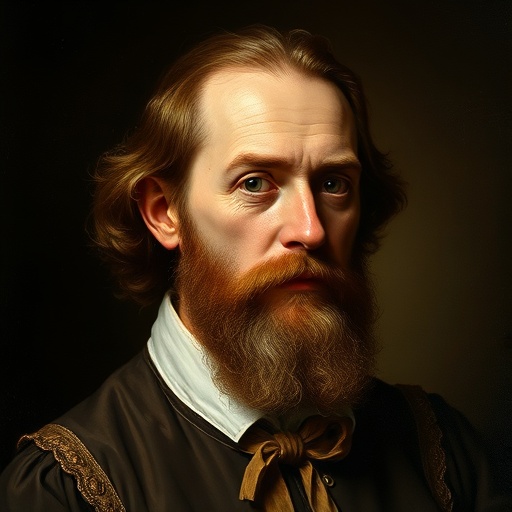
William Harvey — "The circulation of the blood is a miracle of nature."
The circulation of the blood is a miracle of nature.
The circulation of the blood is a miracle of nature.
Click any product to generate a realistic preview. Up to 3 at a time.
* Initial load can take up to 90 seconds — revising the preview in another color is nearly instant.
"The whole world is a theatre, and all the men and women merely players."
"To search for truth is to search for God."
"The blood in the arteries is of a more florid colour than that in the veins."
"There is no perfect knowledge which can be entitled ours, that is innate; none but what has been obtained from experience, or derived in some way from our senses."
"The senses are the primary source of all knowledge."
English physician whose On the Motion of the Heart and Blood in Animals (1628) demonstrated blood circulation, overturning 1,400 years of Galenic medicine. Closely associated with Francis Bacon (his contemporary in the new English empiricism). For an intellectual contrast, see Galenic medicine, the 2nd-century Greek medical tradition (humors, blood-as-consumed-fuel) — Harvey calculated that the heart pumps more blood per hour than the body could possibly produce as fuel — a single quantitative observation that demolished the entire Galenic-Aristotelian medical worldview. The cleanest example in medical history of arithmetic disproving 14 centuries of authority.
An expression of awe and wonder at his own discovery.
Date: c. 1628 (from 'De Motu Cordis')
BiblicalFound in 1 providers: gemini
1 source checked
The movement of blood through the body follows a continuous, closed loop driven by the heart — a process so precise and elegant that it inspires awe. Blood does not simply slosh or consume itself as previously believed; it circulates endlessly, delivering nutrients and removing waste, sustaining every organ. Recognizing this as miraculous acknowledges both its complexity and the wonder of discovering something hidden in plain sight within every living creature.
Harvey spent decades dissecting animals, timing heartbeats, and conducting meticulous experiments before publishing his landmark 1628 work De Motu Cordis. As a physician trained at Padua and serving King James I, he overturned Galenic dogma held for over a millennium. His reverence for this discovery reflects both his scientific rigor and his genuine astonishment that such an elegant mechanical truth had gone unrecognized by centuries of learned medicine.
In the early seventeenth century, Galen's 1,400-year-old model — that the liver produced blood consumed by organs — was medical orthodoxy taught across Europe's universities. Harvey worked during the Scientific Revolution, when Galileo was challenging astronomy and Bacon was formalizing empirical method. Challenging Galenic anatomy risked professional ruin; calling circulation miraculous was partly strategic, framing a radical mechanical discovery within language that acknowledged divine design and softened theological objection.
AI-generated insights based on extensive research and information for context. Factual errors? Email [email protected].
Your cart is empty