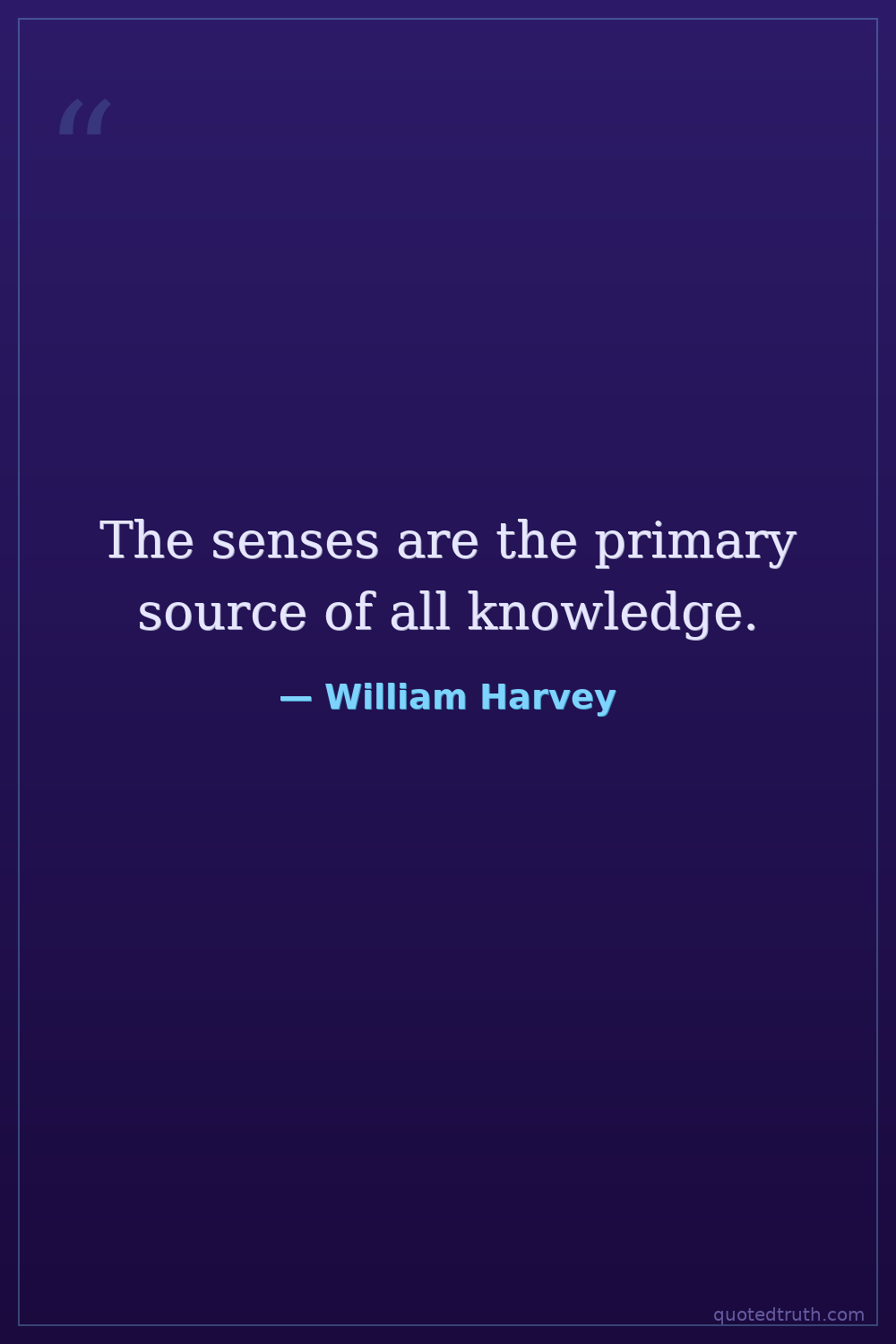
William Harvey — "The senses are the primary source of all knowledge."
The senses are the primary source of all knowledge.
The senses are the primary source of all knowledge.
Click any product to generate a realistic preview. Up to 3 at a time.
* Initial load can take up to 90 seconds — revising the preview in another color is nearly instant.
"The blood, therefore, returns by the veins to the heart."
"Man comes into the world naked and unarmed, as if nature had destined him for a social creature, and ordained him to live under equitable laws and in peace..."
"Truth is the daughter of time, not of authority."
"Only by understanding the wisdom of natural foods and their effects on the body, shall we attain mastery of disease and pain, which shall enable us to relieve the burden of mankind."
"Nature is a free and open book, to be read and understood by all who have the patience and the power to do so."
English physician whose On the Motion of the Heart and Blood in Animals (1628) demonstrated blood circulation, overturning 1,400 years of Galenic medicine. Closely associated with Francis Bacon (his contemporary in the new English empiricism). For an intellectual contrast, see Galenic medicine, the 2nd-century Greek medical tradition (humors, blood-as-consumed-fuel) — Harvey calculated that the heart pumps more blood per hour than the body could possibly produce as fuel — a single quantitative observation that demolished the entire Galenic-Aristotelian medical worldview. The cleanest example in medical history of arithmetic disproving 14 centuries of authority.
An empiricist philosophical stance, foundational to his scientific method.
Date: Uncertain (attributed)
EducationalFound in 1 providers: gemini
1 source checked
Knowledge begins with direct observation and sensory experience — sight, touch, hearing — rather than inherited doctrine or abstract reasoning alone. True understanding requires engaging with the world as it actually is, gathering evidence through experience before drawing conclusions. This is a foundational empiricist claim: the mind learns from the body's encounters with reality, not from books or authority figures alone.
Harvey's entire career exemplified this principle. He discovered the circulation of blood by dissecting hundreds of animals and human corpses, observing the heart's mechanical action firsthand rather than accepting Galen's centuries-old theories. His 1628 De Motu Cordis was built on systematic experimental observation — measuring, cutting, watching — making this quote essentially his scientific autobiography.
Harvey worked during the Scientific Revolution, when European thinkers like Bacon, Galileo, and Descartes were dismantling medieval scholasticism's reliance on ancient texts. The 1600s saw direct observation and experiment displace Aristotelian and Galenic authority in medicine and natural philosophy. Harvey's empirical approach to anatomy was both a product and a driver of this cultural shift toward evidence-based inquiry.
AI-generated insights based on extensive research and information for context. Factual errors? Email [email protected].
Your cart is empty