What it means
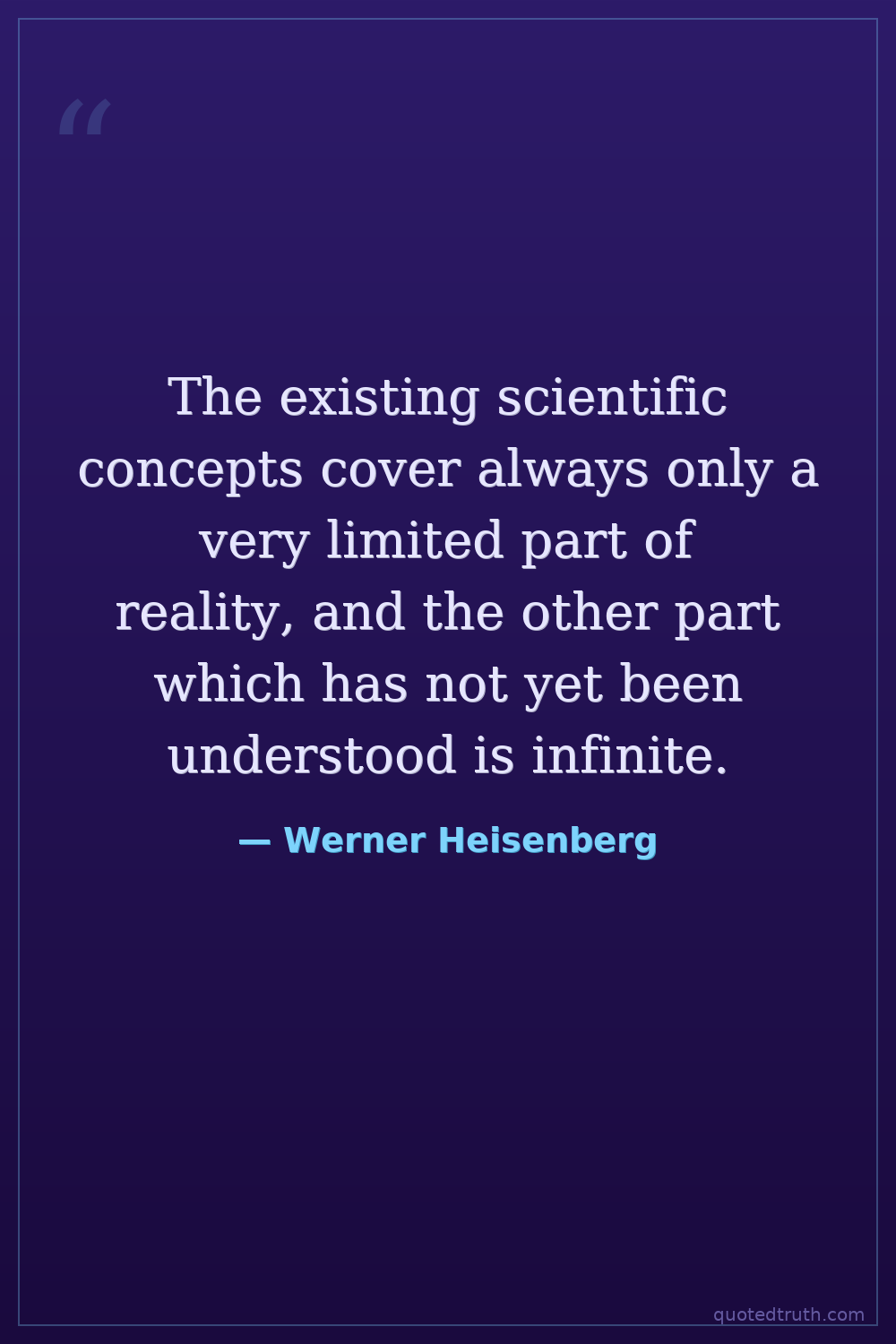
Science only ever maps a small portion of what is real. Every theory, equation, or framework we develop explains a narrow slice of nature, while what remains unexplained stretches on without end. No matter how much knowledge accumulates, the unknown is not a shrinking gap we will eventually close but a vast territory that dwarfs everything we currently understand about the world.
Relevance to Werner Heisenberg
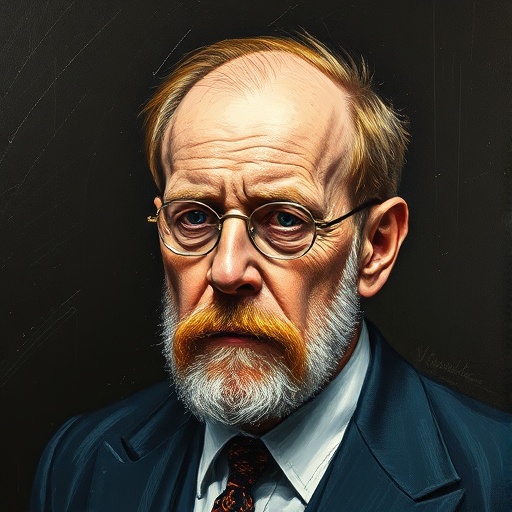
Heisenberg founded quantum mechanics and formulated the uncertainty principle in 1927, proving measurement itself has fundamental limits. He watched Newtonian certainty dissolve into probability waves and complementarity. Having personally overturned classical physics, he knew firsthand that today's complete theory becomes tomorrow's special case. His philosophical writings consistently emphasized the boundaries of scientific language and the irreducible mystery beyond any formal system he helped build.
The era
Heisenberg worked through the 20th century's scientific revolutions: relativity, quantum theory, nuclear fission, and the atomic bomb. Classical determinism collapsed between 1905 and 1930. Post-WWII, physicists grappled with the moral weight of their discoveries and the realization that deeper probing revealed stranger, not simpler, foundations. Particle physics kept uncovering new layers, reinforcing that each answered question opened several unanswered ones in an expanding frontier.
AI-generated insights based on extensive research and information for context. Factual errors? Email [email protected].