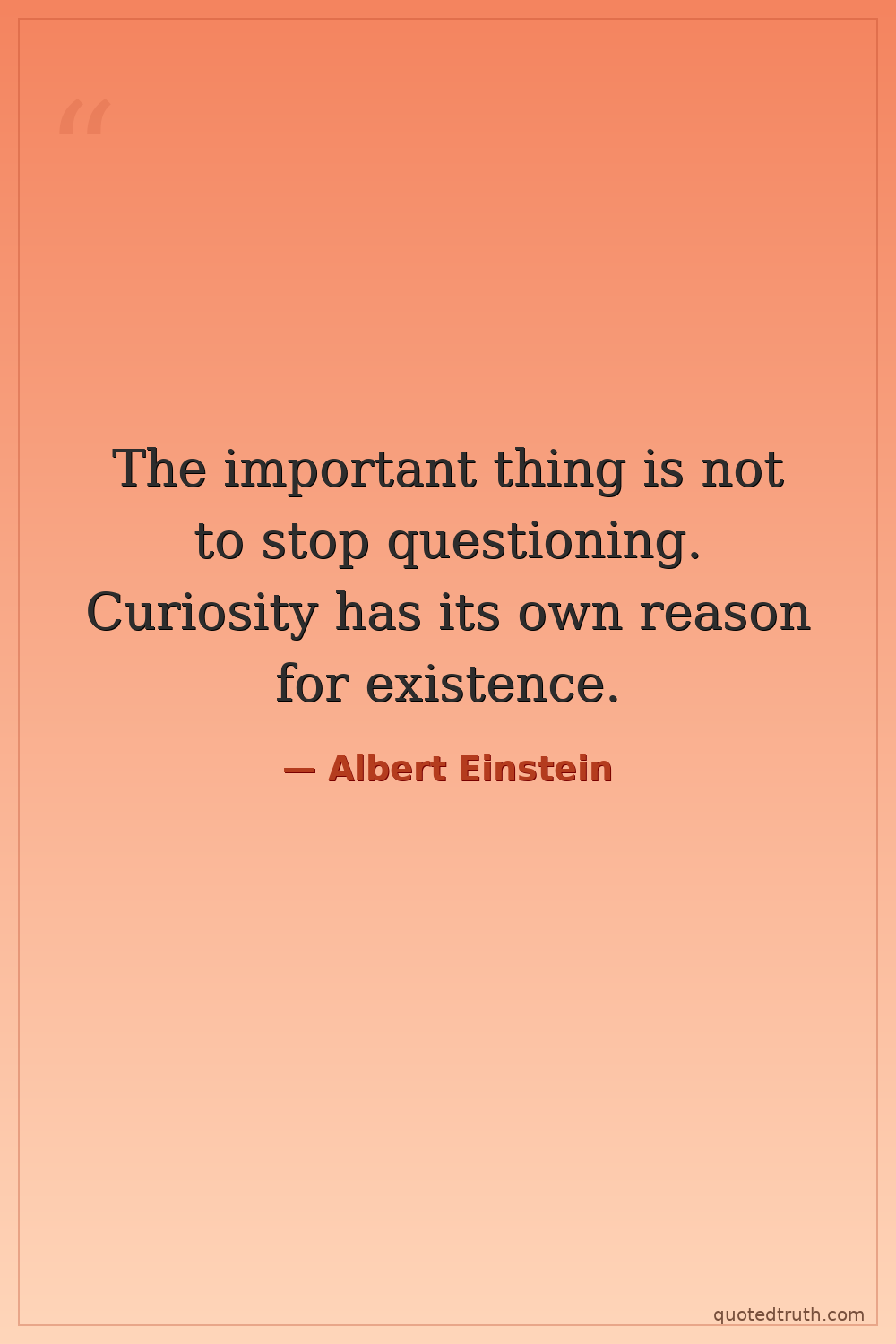
Albert Einstein — "The important thing is not to stop questioning. Curiosity has its own reason for…"
The important thing is not to stop questioning. Curiosity has its own reason for existence.
The important thing is not to stop questioning. Curiosity has its own reason for existence.
Click any product to generate a realistic preview. Up to 3 at a time.
* Initial load can take up to 90 seconds — revising the preview in another color is nearly instant.
"It is not enough to teach a man a specialty. Through it he may become a kind of useful machine but not a harmoniously developed personality."
"It has become appallingly obvious that our technology has exceeded our humanity."
"Only two things are infinite, the universe and human stupidity, and I'm not sure about the former."
"Strange is our situation here on Earth. Each of us comes for a short visit, not knowing why, yet sometimes seeming to divine a purpose."
"I am by heritage a Jew, by citizenship a Swiss, and by temperament a human being, and only a human being, without any special attachment to any state or national entity whatsoever."
Found in 1 providers: grok
1 source checked
Never let your curiosity die. Questioning things isn't just a means to an end — the drive to wonder and seek understanding is valuable in itself. You don't need a practical reason to ask why something works the way it does. Intellectual restlessness, the refusal to accept the world at face value, is a fundamental human quality worth protecting and nurturing throughout life.
Einstein spent decades questioning assumptions that everyone else accepted as settled — Newtonian mechanics, the constancy of time, the nature of light. His special and general relativity theories emerged precisely because he refused to stop asking 'what if?' He famously conducted thought experiments as a child, imagining riding alongside a beam of light. Curiosity wasn't a tool for Einstein; it was his defining characteristic and the engine behind his greatest breakthroughs.
Einstein lived through early 20th-century physics revolutions, two World Wars, and the rise of totalitarian regimes that systematically suppressed free inquiry. Nazi Germany burned books and expelled Jewish scientists. The McCarthy era later created climates of intellectual fear. Against this backdrop, Einstein's defense of curiosity as intrinsically valuable was a political and moral statement — a direct rebuke to systems demanding conformity and punishing independent thought.
AI-generated insights based on extensive research and information for context. Factual errors? Email [email protected].
Your cart is empty