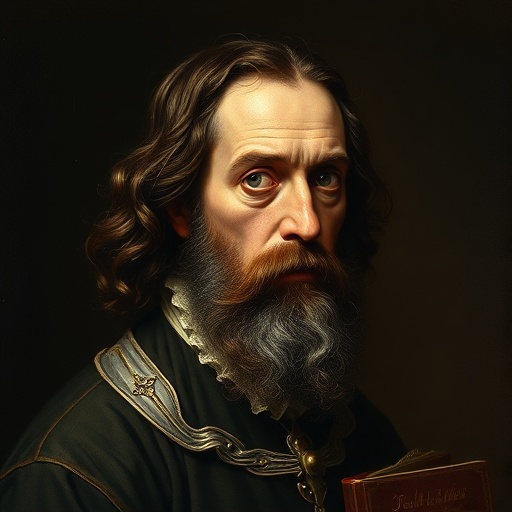
Johannes Kepler — "The Earth has a soul, and it is sick with melancholy."
The Earth has a soul, and it is sick with melancholy.
The Earth has a soul, and it is sick with melancholy.
Click any product to generate a realistic preview. Up to 3 at a time.
* Initial load can take up to 90 seconds — revising the preview in another color is nearly instant.
"I measured the heavens, and I measured the shadows, but I did not measure my own soul."
"Provide ship or sails adapted to the heavenly breezes, and there will be some who will not fear even that void [of space]… . So, for those who will come shortly to attempt this journey, let us establi…"
"Repudiating the sensible world, which he neither sees himself nor believes from those who have, the Peripatetic joins combat by childish quibbling in a world on paper, and denies the Sun shines becaus…"
"God gives every animal the means of saving its life—why object if he gives astrology to the astronomer?"
"The road to truth is long and difficult."
Found in 1 providers: deepseek
1 source checked
The planet itself is a living being with feelings, and right now it is suffering from deep sadness. Rather than treating Earth as a lifeless rock, the saying imagines it as a conscious entity experiencing emotional pain. It suggests something is wrong with the world at a fundamental, almost spiritual level, and that the ground beneath us shares in grief rather than remaining indifferent to what happens on its surface.
Kepler genuinely believed celestial bodies possessed souls, a view he inherited from Neoplatonic and Pythagorean traditions. While mapping planetary motion mathematically, he also wrote about the Earth having a vegetative anima that responded to planetary alignments, influencing weather and tides. His mother was tried as a witch, his patron Tycho Brahe died suddenly, and he lost children to illness, giving the melancholy framing personal weight beyond mere metaphor.
Early modern Europe straddled mysticism and emerging science. The Thirty Years War devastated German lands during Kepler's later life, spreading famine and plague. Astrology and astronomy were not yet separate disciplines, and scholars routinely attributed animate qualities to planets and elements. Protestant-Catholic religious conflict, witch trials, and cosmic anxiety from the Copernican upheaval coexisted with breakthrough mathematics, making an ensouled, suffering Earth a coherent idea rather than poetic flourish.
AI-generated insights based on extensive research and information for context. Factual errors? Email [email protected].
Your cart is empty