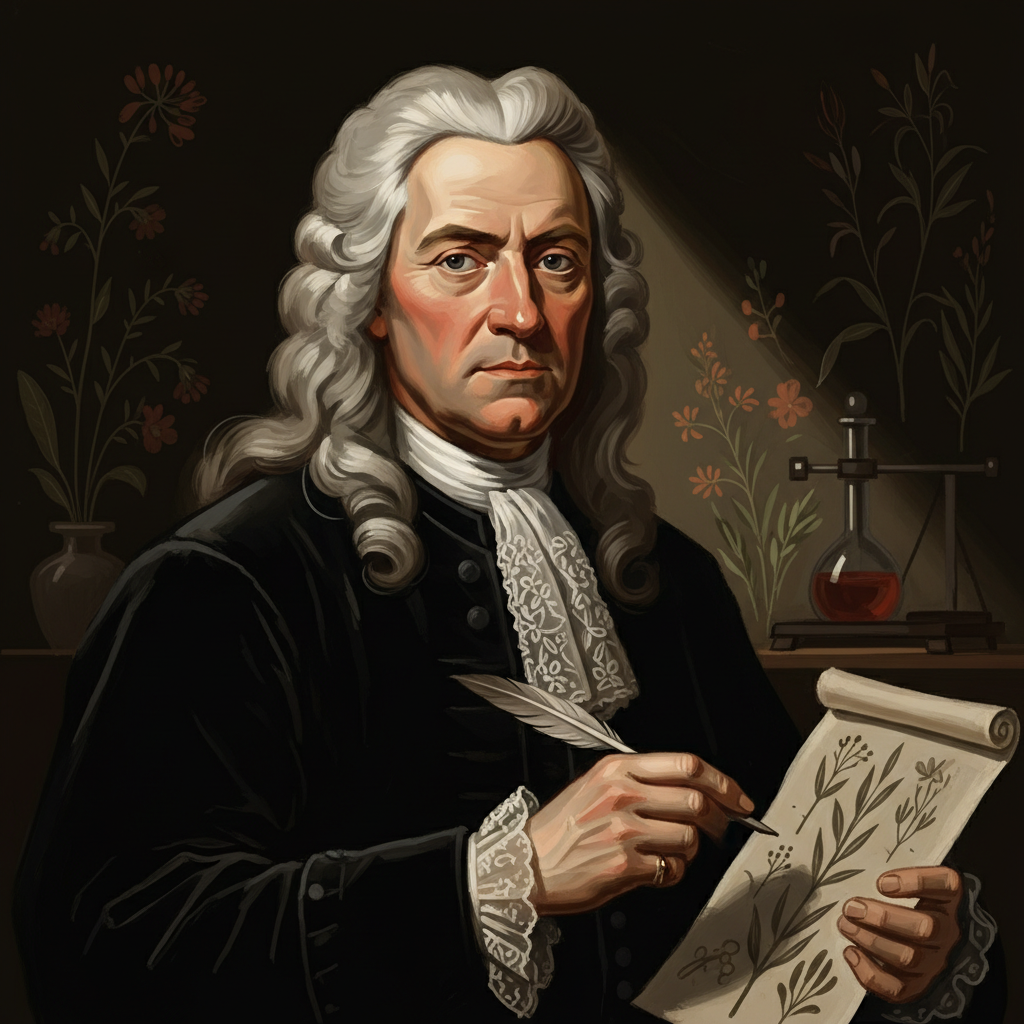
Carl Linnaeus — "The whole earth is a garden, and man is its gardener."
The whole earth is a garden, and man is its gardener.
The whole earth is a garden, and man is its gardener.
Click any product to generate a realistic preview. Up to 3 at a time.
* Initial load can take up to 90 seconds — revising the preview in another color is nearly instant.
"It is not the business of a botanist to know all the plants, but to know how to find out what they are."
"If you want to know yourself, study nature."
"The whole creation is a song of praise to the Creator."
"The stinking corpse flower smells like a rotting corpse to attract carrion beetles and flesh flies, which are its pollinators. Nature is both beautiful and repulsive."
"Whoever wishes to be a good botanist must be a good observer."
Swedish botanist and the father of modern taxonomy whose Systema Naturae (1735) introduced binomial nomenclature for naming all species. Closely associated with Joseph Banks (British naturalist who carried Linnaean classification on Cook's voyages). For an intellectual contrast, see Comte de Buffon, French naturalist and Histoire Naturelle author (1749-1788) — Buffon explicitly attacked Linnaean fixed-categories taxonomy as artificial and rejected the binomial system; his gradualist, environment-shaped natural history was the explicit alternative. Anticipates the fixed-species-vs-evolution debate Darwin would later resolve.
A metaphorical statement on humanity's role and responsibility towards nature.
Date: Uncertain (attributed)
Nature & WorldFound in 1 providers: gemini
1 source checked
The entire planet functions like a garden, and humanity carries responsibility as its caretaker. We are not passive inhabitants but active stewards who shape what lives, spreads, and disappears. The gardening metaphor implies deliberate care and selection — humans determine which species flourish and which decline. It frames our relationship with nature as one of agency and duty rather than mere occupation of space.
Linnaeus spent his career cataloging and ordering all living organisms — a form of intellectual gardening. He created the binomial nomenclature system giving humans taxonomic authority over nature's full diversity. As a botanist who directed Uppsala University's botanical garden and dispatched students worldwide to collect specimens, he personally embodied the gardener role. Linnaeus believed in a divinely ordered nature with humans at its apex, responsible for understanding and stewarding creation.
Linnaeus worked during the Enlightenment, when European powers were actively exploring and cataloging global biodiversity through colonial expeditions. Natural theology held that God created a rational, ordered world that human reason could comprehend and classify. Botanical gardens flourished as symbols of mastery over nature. The era's confidence in science and reason made humanity's role as nature's steward feel not just plausible but divinely sanctioned and morally essential.
AI-generated insights based on extensive research and information for context. Factual errors? Email [email protected].
Your cart is empty