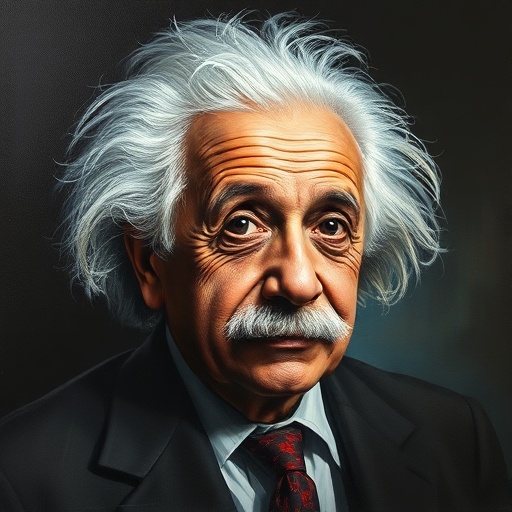
Albert Einstein — "The faster you go, the shorter you are."
The faster you go, the shorter you are.
The faster you go, the shorter you are.
Click any product to generate a realistic preview. Up to 3 at a time.
* Initial load can take up to 90 seconds — revising the preview in another color is nearly instant.
"I am against any form of violence, for I know that violence only leads to more violence."
"Sometimes one has to look at the world from a distance to appreciate its beauty."
"The most beautiful thing we can experience is the mysterious. It is the source of all true art and all science. He to whom this emotion is a stranger, who can no longer pause to wonder and stand rapt …"
"The more I learn, the more I realize how much I don't know."
"Imagination is more important than knowledge. For knowledge is limited, whereas imagination embraces the entire world, stimulating progress, giving birth to evolution."
A simplified explanation of length contraction in special relativity, often used in conversations.
Date: Undetermined
WisdomFound in 1 providers: grok
1 source checked
At speeds approaching light, an object's physical length shrinks along its direction of travel—a real phenomenon called length contraction. This isn't an optical illusion; it reflects how space itself behaves at extreme velocities. The effect is negligible at everyday speeds but becomes dramatic near light speed. It challenges the intuition that objects have fixed, absolute dimensions, revealing instead that length is relative to the observer's frame of reference.
Einstein introduced length contraction as a core prediction in his 1905 Special Relativity paper, building on Lorentz transformations. Working as a patent clerk in Bern, he revolutionized physics through thought experiments rather than laboratory equipment. His insistence that light speed is constant for all observers forced this counterintuitive conclusion about space. The quote distills a complex mathematical result into one paradoxical sentence—quintessentially Einstein's gift for making abstract physics feel almost conversational.
In 1905, Newtonian mechanics faced a crisis: the Michelson-Morley experiment showed light traveled at identical speed regardless of Earth's motion, defying classical expectations. Physicists proposed an undetectable luminiferous ether as a desperate fix. Einstein discarded the ether entirely, accepting light's constant speed as a foundational postulate. Length contraction emerged as an unavoidable consequence. This era saw physics abandon absolute space and time, upending two centuries of assumptions and launching modern theoretical science.
AI-generated insights based on extensive research and information for context. Factual errors? Email [email protected].
Your cart is empty