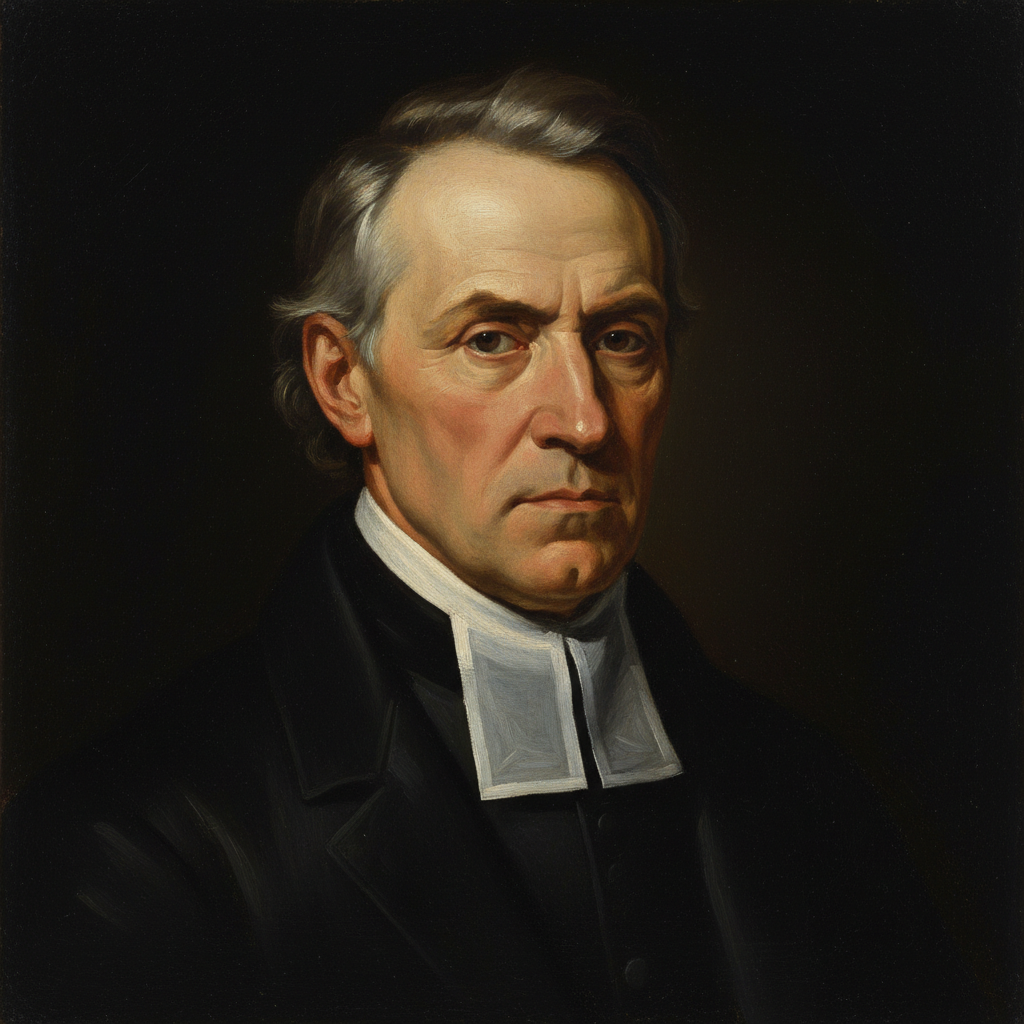
John Wesley — "The first thing that I would advise you to do, is, to get a clear and distinct n…"
The first thing that I would advise you to do, is, to get a clear and distinct notion of the state of the world.
The first thing that I would advise you to do, is, to get a clear and distinct notion of the state of the world.
Click any product to generate a realistic preview. Up to 3 at a time.
* Initial load can take up to 90 seconds — revising the preview in another color is nearly instant.
"I should be glad if I could spend my whole life in reading and writing."
"My hair is much whiter than it was a year ago; but my eyes are not much dimmer, nor my natural strength much abated."
"I cannot but observe, that the Methodists are not a people who are fond of novelties."
"I am as much a High-Churchman as ever I was. And I hope to live and die so."
"The Lord is at hand; therefore fear not."
English Anglican cleric and founder of Methodism, whose open-air preaching and class-meeting structure created the largest 18th-century evangelical revival. Closely associated with Charles Wesley (his hymn-writing brother) and George Whitefield (early co-revivalist, later doctrinal opponent). For an intellectual contrast, see George Whitefield, Calvinist evangelical revivalist — Whitefield's predestinarian Calvinism vs Wesley's free-grace Arminian theology split the early Methodist movement permanently in the 1739-41 break. The founding evangelical Calvinist-Arminian schism — the two parallel evangelical traditions American Christianity descends from.
Found in 1 providers: grok
1 source checked
This quote urges readers to first develop an accurate, grounded understanding of the world before acting on it. Stop assuming and start observing — know the real conditions people face, what forces shape society, what is actually true. Wesley frames clear-eyed awareness as the essential prerequisite to meaningful action. Without it, effort is wasted on misread situations. Understanding reality honestly is the starting point for any genuine change or moral purpose.
Wesley traveled over 250,000 miles preaching and kept meticulous journals documenting poverty, illness, and social conditions across Britain and colonial America. His Methodist movement was intensely practical — he established free clinics, schools, and anti-slavery campaigns rooted in firsthand observation of suffering. A trained Oxford scholar, Wesley believed faith required engagement with reality. This call to understand the world's state reflects his conviction that effective Christian ministry demanded empirical clarity about human need, not abstract theology.
Wesley lived through Britain's early Industrial Revolution and Enlightenment (1703–1791), an era of profound social disruption. Factories uprooted rural communities, creating urban slums thick with poverty and disease. The Enlightenment simultaneously elevated reason, empirical observation, and systematic inquiry. The Church of England largely ignored the laboring poor. Wesley's Methodist revival responded directly to these conditions — his advice to grasp the world's true state was both Enlightenment epistemology and urgent Christian social conscience.
AI-generated insights based on extensive research and information for context. Factual errors? Email [email protected].
Your cart is empty