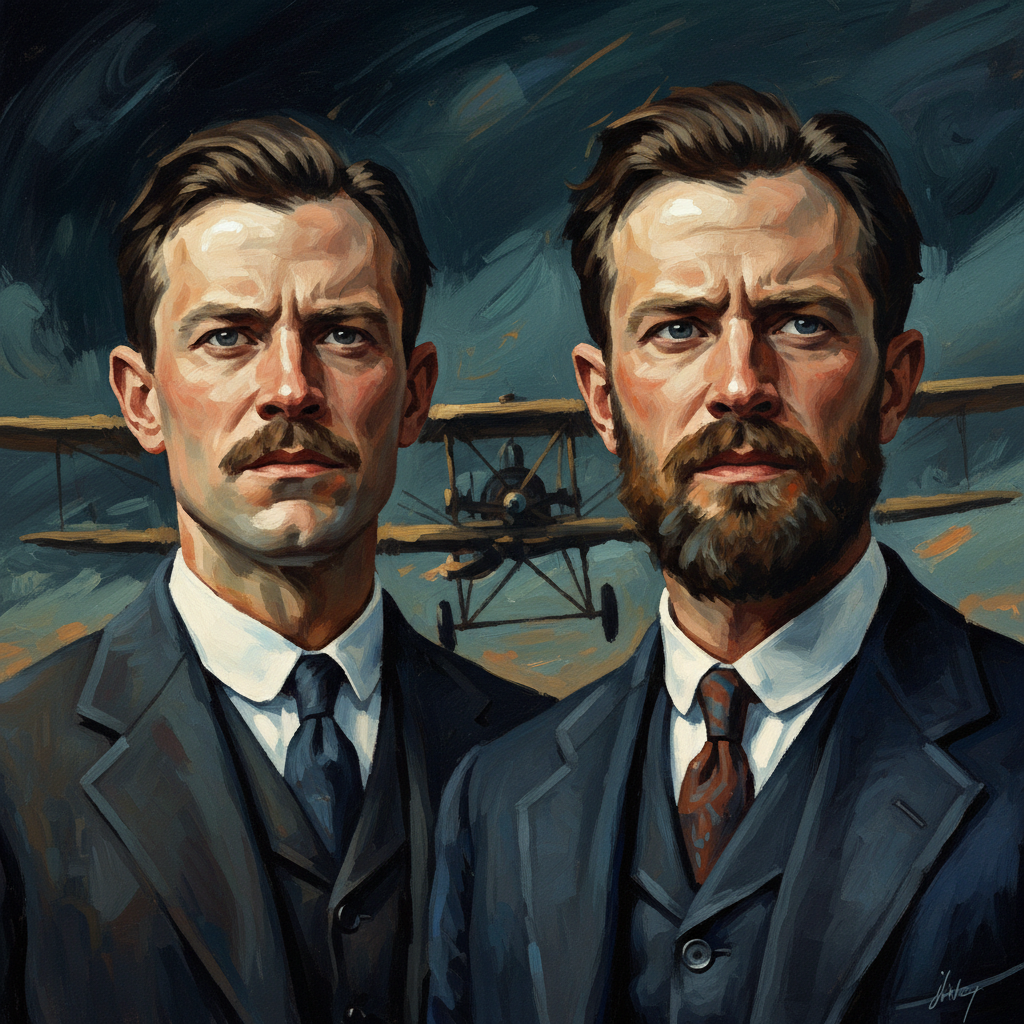
Wright Brothers (Orville & Wilbur) — "The flying machine is a thing of the future, and it is a thing that will change …"
The flying machine is a thing of the future, and it is a thing that will change the world.
The flying machine is a thing of the future, and it is a thing that will change the world.
Click any product to generate a realistic preview. Up to 3 at a time.
* Initial load can take up to 90 seconds — revising the preview in another color is nearly instant.
"We have had considerable difficulty in getting the engine to work properly."
"We have not been able to do much with the machine on account of the bad weather."
"It is not necessary to be a genius to be an inventor."
"The fact that the machine was controlled in all directions was a feature which had never been approached in any earlier flight of which we have any knowledge."
"Often, after an hour or so of heated argument, we would discover that we were as far from agreement as when we started, but that each had changed to the other's original position."
American aviation pioneers who achieved the first sustained powered controlled airplane flight at Kitty Hawk, NC, on December 17, 1903. Closely associated with Octave Chanute (their gliding mentor and aeronautical correspondent). For an intellectual contrast, see Samuel Pierpont Langley, Smithsonian Institution Secretary and government-funded aviation researcher — Langley's Aerodrome crashed twice into the Potomac in October-December 1903 with $50,000 of War Department funding; the Wright Brothers' bicycle-shop empiricism beat Langley's institutional Big Science by 9 days. The most-cited example in engineering history of empirical-tinkerer beating institution-funded credentialism.
Found in 1 providers: grok
1 source checked
The speaker predicts that a working aircraft is not just a novelty but an inevitable technology that will reshape society. They are asserting confidence that powered human flight will arrive and, once it does, it will transform how people travel, trade, fight wars, and view the world. It is a forward-looking claim staking everything on aviation mattering.
The Wrights were bicycle mechanics from Dayton who self-funded their aeronautical experiments, methodically solving control problems others ignored. On December 17, 1903 at Kitty Hawk, they achieved the first sustained powered flight. This quote captures their stubborn conviction during years when the press mocked aviation as impossible, a belief that drove them through glider tests, wind tunnel work, and patent battles to prove heavier-than-air flight was practical.
At the turn of the 20th century, industrial optimism was peaking: automobiles, telephones, and electric lights were reshaping daily life. Yet most scientists and newspapers dismissed powered flight as a crank pursuit after Samuel Langley's public failures. Predicting aviation would change the world was a bold minority claim. Within two decades it was vindicated by World War I airpower, airmail, and transatlantic flight, confirming the Wrights' foresight during an era hungry for mechanical breakthroughs.
AI-generated insights based on extensive research and information for context. Factual errors? Email [email protected].
Your cart is empty