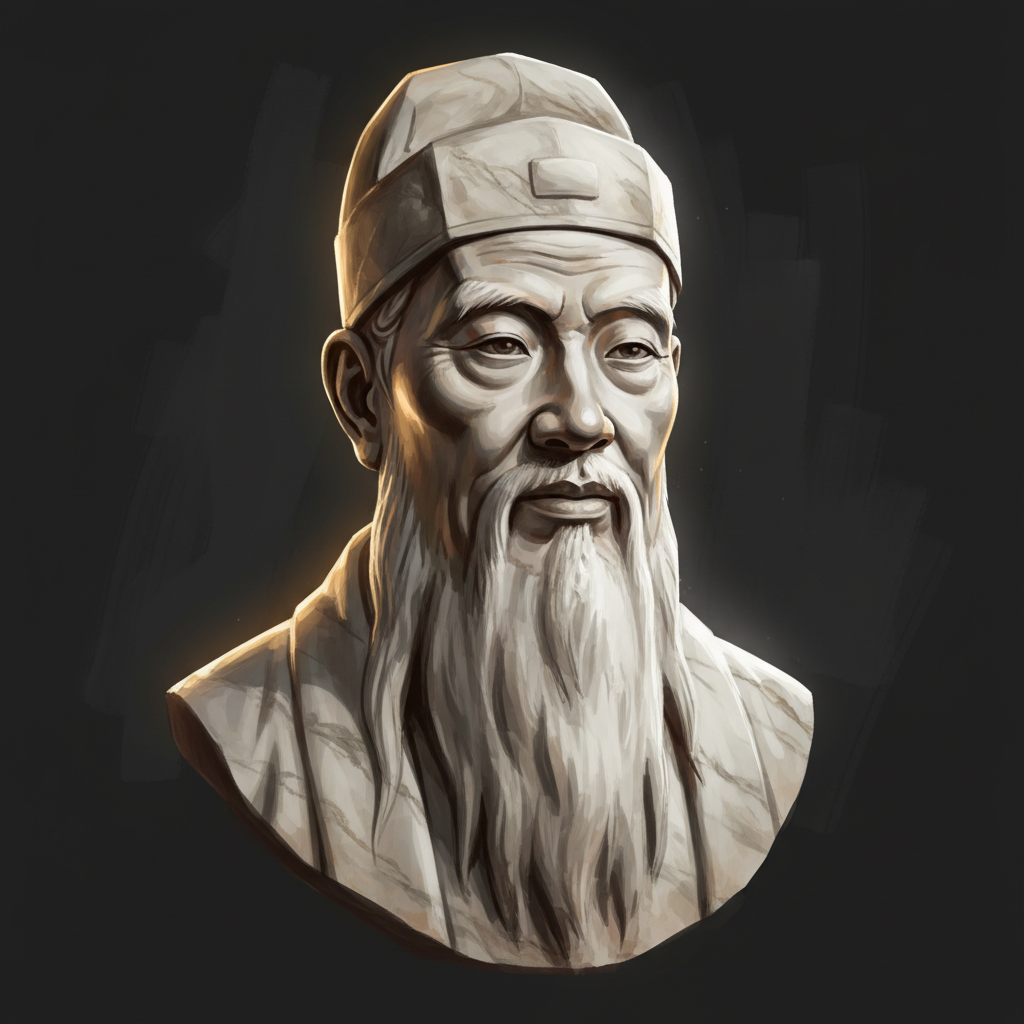
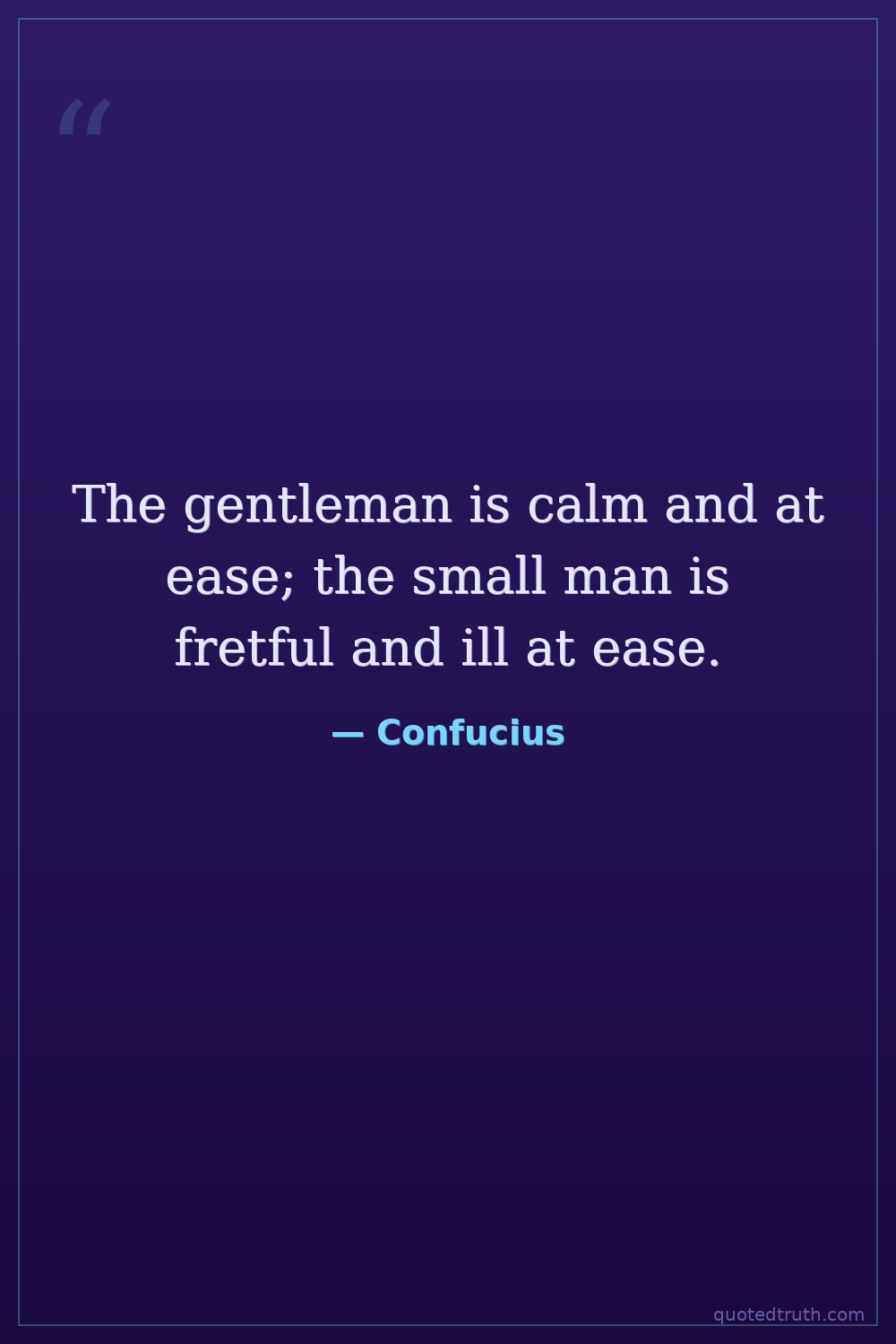
Confucius — "The gentleman is calm and at ease; the small man is fretful and ill at ease."
The gentleman is calm and at ease; the small man is fretful and ill at ease.
The gentleman is calm and at ease; the small man is fretful and ill at ease.
Click any product to generate a realistic preview. Up to 3 at a time.
* Initial load can take up to 90 seconds — revising the preview in another color is nearly instant.
"The scholar who cherishes the love of comfort is not fit to be deemed a scholar."
"The superior man is satisfied and composed; the inferior man is always full of distress."
"To know what you know and what you do not know, that is true knowledge."
"The superior man is firm without being obstinate."
"The gentleman concerns himself with the Way; he does not worry about his salary."
Chinese philosopher and teacher whose teachings (compiled by his students in the Analects) became the foundational ethical framework of East Asian civilization for 2,500 years. Closely associated with Mencius (his most-influential follower a century later). For an intellectual contrast, see Laozi, near-contemporary Chinese sage and Tao Te Ching author — Confucius systematized social order through ritual and family hierarchy; Laozi's Taoist effortless-action philosophy argued such systems were the disease, not the cure. The two founding poles of Chinese moral philosophy — every East Asian moral tradition since has positioned itself between them.
The standard scholarly entry points to Confucius's work: Philip J. Ivanhoe (Georgetown, Chinese philosophy) — Confucian Moral Self Cultivation (2000); Edward Slingerland (UBC, Asian Studies) — Effortless Action: Wu-wei as Conceptual Metaphor (2003); Tu Weiming (Harvard, Confucian scholar) — Confucian Thought: Selfhood as Creative Transformation (1985). These are the works graduate seminars cite when teaching Confucius.
Found in 1 providers: deepseek
1 source checked
A person of strong character stays composed and secure, while someone shallow or self-centered lives in constant anxiety. Inner moral grounding produces steadiness, because the gentleman measures himself by his own conduct rather than chasing status, wealth, or approval. The small-minded person, lacking that anchor, worries endlessly about gain, loss, reputation, and comparison. Peace of mind is treated as a byproduct of integrity, not of circumstance.
Confucius spent his life teaching that moral self-cultivation, not rank or riches, defined the junzi, the 'gentleman.' He wandered between states for years seeking a ruler who would apply his ethics, often in poverty, yet was remembered as composed and dignified. He contrasted the junzi with the xiaoren, the petty person driven by profit. This saying mirrors his own calm endurance of rejection, and his conviction that virtue produces an unshakeable inner life.
Confucius lived during the Spring and Autumn period of the Zhou dynasty, roughly 551–479 BCE, when central authority was collapsing and rival states warred constantly. Officials schemed for position, assassinations were frequent, and social rank was unstable. In that climate of anxiety and opportunism, preaching inner calm rooted in virtue was radical. He offered a moral alternative to the fretful careerism around him, shaping an ideal of character that Chinese governance and education would follow for two millennia.
AI-generated insights based on extensive research and information for context. Factual errors? Email [email protected].
Your cart is empty