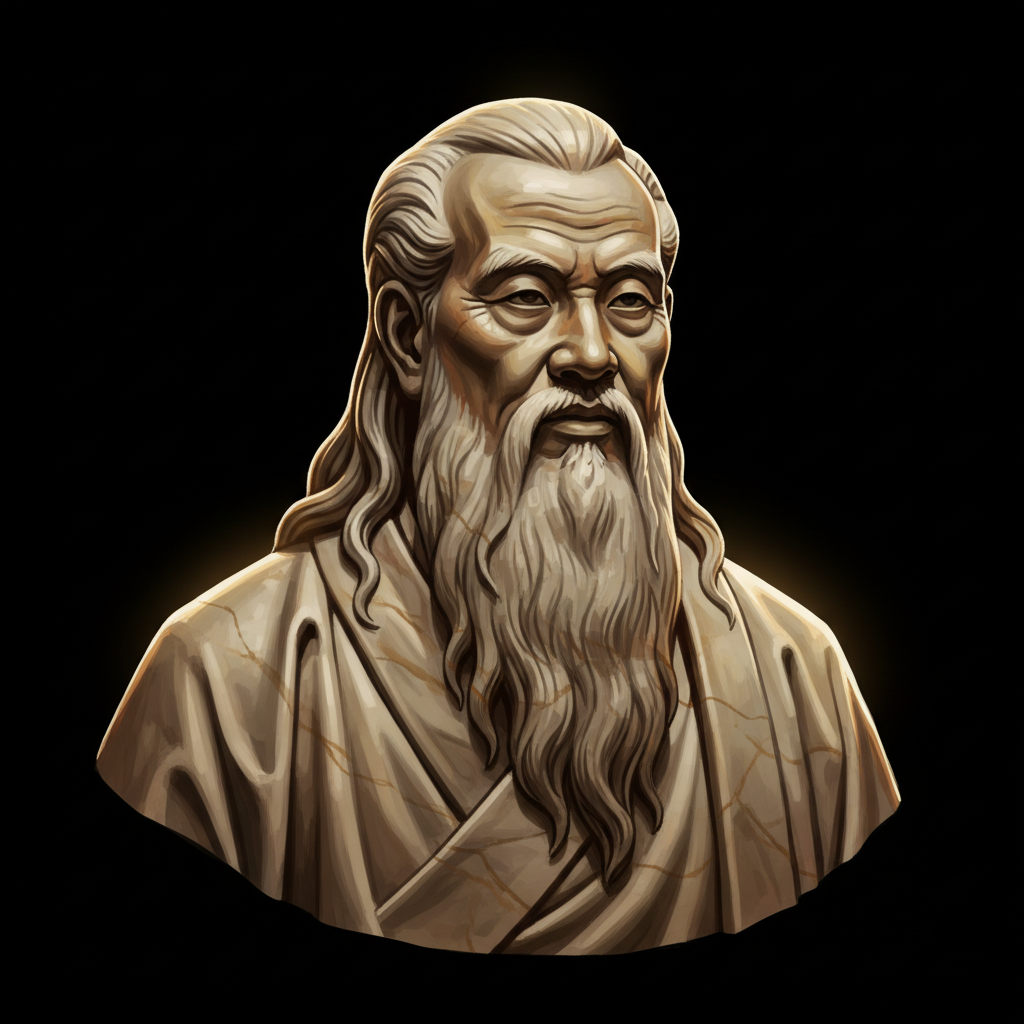
Laozi — "The greatest flaw is to desire more."
The greatest flaw is to desire more.
The greatest flaw is to desire more.
Click any product to generate a realistic preview. Up to 3 at a time.
* Initial load can take up to 90 seconds — revising the preview in another color is nearly instant.
"The sage is sharp but does not cut, pointed but does not pierce, forthright but does not offend, bright but does not dazzle."
"He who is attached to things will suffer much."
"Keep your mouth shut, guard your senses, and you will be free from trouble. Open your mouth, always be busy, and you will be beyond hope."
"Do not exalt the talented, so that people will not be contentious. Do not value rare treasures, so that people will not steal. Do not display what is desirable, so that people will not be confused."
"Abandon sageliness and discard wisdom, and the people will benefit a hundredfold. Abandon benevolence and discard righteousness, and the people will return to filial piety and paternal love. Abandon s…"
Reputed founder of Taoism and author of the Tao Te Ching, whose wu wei (effortless action) shaped East Asian philosophy. Closely associated with Zhuangzi (later Taoist who extended Laozi's framework). For an intellectual contrast, see Confucius, near-contemporary Chinese sage of social ritual and duty — Confucius systematized social order through ritual and hierarchy; Laozi argued that all such systems were the disease, not the cure — the two founding poles of Chinese moral philosophy.
Found in 1 providers: grok
1 source checked
Wanting more than you have is the root problem in life. The constant craving for additional possessions, status, or experiences creates suffering and prevents contentment. Even people with abundance feel poor when they focus on what they lack. Reducing desire, not increasing supply, is the path to satisfaction. The hunger itself, not the missing object, is the real defect that needs addressing.
Laozi reportedly served as keeper of royal archives in the Zhou court, witnessing officials chase rank and wealth before he abandoned the post and rode west into obscurity. His teaching of wu wei, effortless action, and his praise of simplicity, humility, and few possessions run through the Tao Te Ching. This saying matches his recorded choice to walk away from prestige rather than accumulate it.
Laozi lived during the late Zhou dynasty, around the 6th century BCE, as feudal lords waged constant war and competed for territory, tribute, and titles. The Hundred Schools of Thought debated how to restore order, with Confucians urging ritual and ambition for social roles. Against this backdrop of grasping rulers and collapsing stability, a teaching that named desire itself as the flaw cut against the dominant pursuit of expansion.
AI-generated insights based on extensive research and information for context. Factual errors? Email [email protected].
Your cart is empty