Wright Brothers (Orville & Wilbur) — "The greatest thing in either of our lives has been the privilege of working toge…"
The greatest thing in either of our lives has been the privilege of working together.
The greatest thing in either of our lives has been the privilege of working together.
Click any product to generate a realistic preview. Up to 3 at a time.
* Initial load can take up to 90 seconds — revising the preview in another color is nearly instant.
"The public is very enthusiastic about our machine."
"I confess that in 1901 I said to my brother Orville that man would not fly for 50 years. Ever since I have distrusted myself and trusted him."
"I have not the time for both a wife and an airplane."
"It is not necessary to be a horse to be a good jockey."
"In its campaign to discredit others in the flying art, the Smithsonian has issued scores of these false and misleading statements."
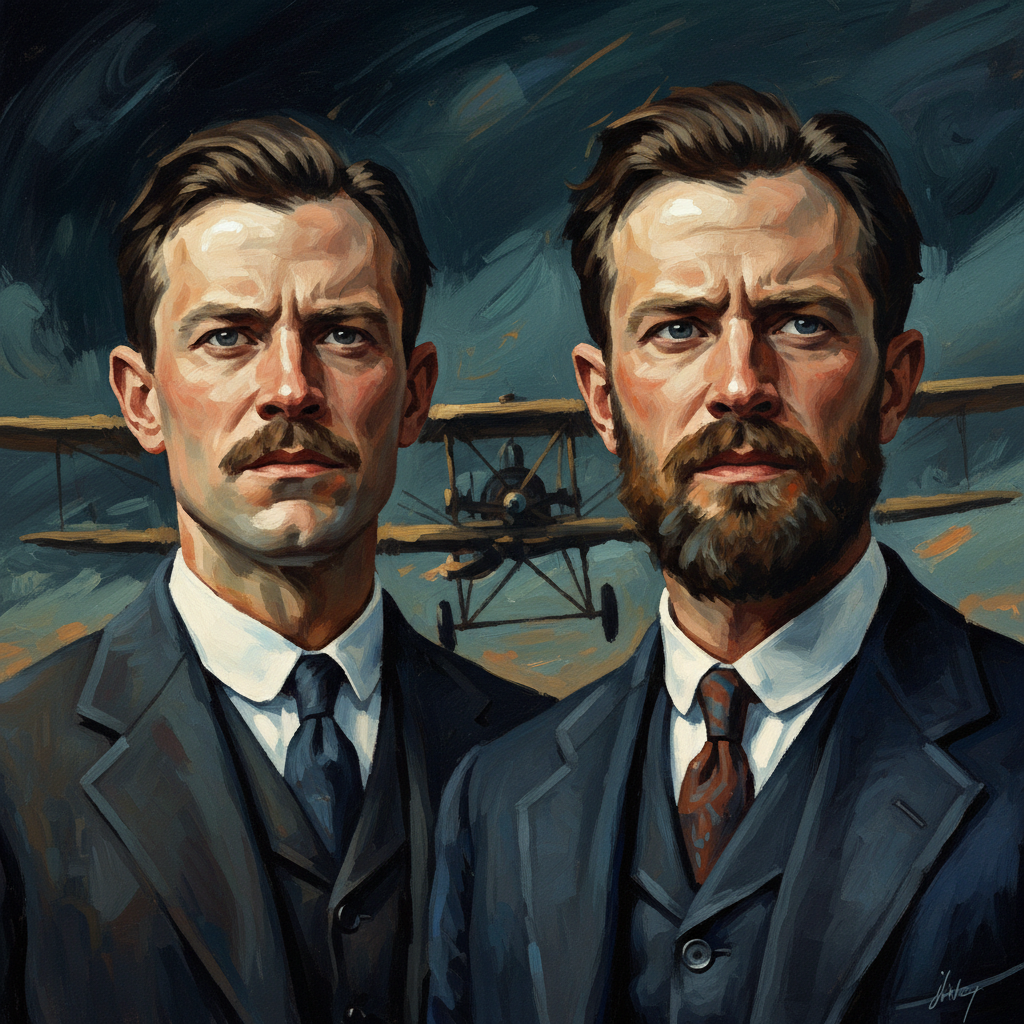
American aviation pioneers who achieved the first sustained powered controlled airplane flight at Kitty Hawk, NC, on December 17, 1903. Closely associated with Octave Chanute (their gliding mentor and aeronautical correspondent). For an intellectual contrast, see Samuel Pierpont Langley, Smithsonian Institution Secretary and government-funded aviation researcher — Langley's Aerodrome crashed twice into the Potomac in October-December 1903 with $50,000 of War Department funding; the Wright Brothers' bicycle-shop empiricism beat Langley's institutional Big Science by 9 days. The most-cited example in engineering history of empirical-tinkerer beating institution-funded credentialism.
Found in 1 providers: grok
1 source checked
Nothing in life mattered more than the chance to collaborate as partners. The speaker values the shared work itself above any achievement, recognition, or personal milestone. Working side by side with someone who complements your thinking, challenges your ideas, and shares your ambition is treated as the highest form of fulfillment. Success is meaningful because it was built together, not accomplished alone.
Orville and Wilbur were inseparable collaborators who ran a bicycle shop, funded their own aeronautical research, and solved controlled flight through constant argument and iteration. Neither married; they shared a home, a business, and every technical breakthrough. Wilbur credited their habit of shouting counter-positions at each other as the engine of their progress. After Wilbur died in 1912, Orville said the partnership itself was their greatest accomplishment, greater than Kitty Hawk.
At the turn of the twentieth century, inventors like Edison were celebrated as lone geniuses, and patent fights were brutal. The Wrights worked from Dayton, Ohio, outside academic and government circles, self-funding experiments while rivals like Langley burned through Smithsonian grants. Their 1903 Kitty Hawk flight came during an industrial era that prized individual credit, yet they insisted on dual authorship of every paper, patent, and public statement throughout their careers.
AI-generated insights based on extensive research and information for context. Factual errors? Email [email protected].
Your cart is empty