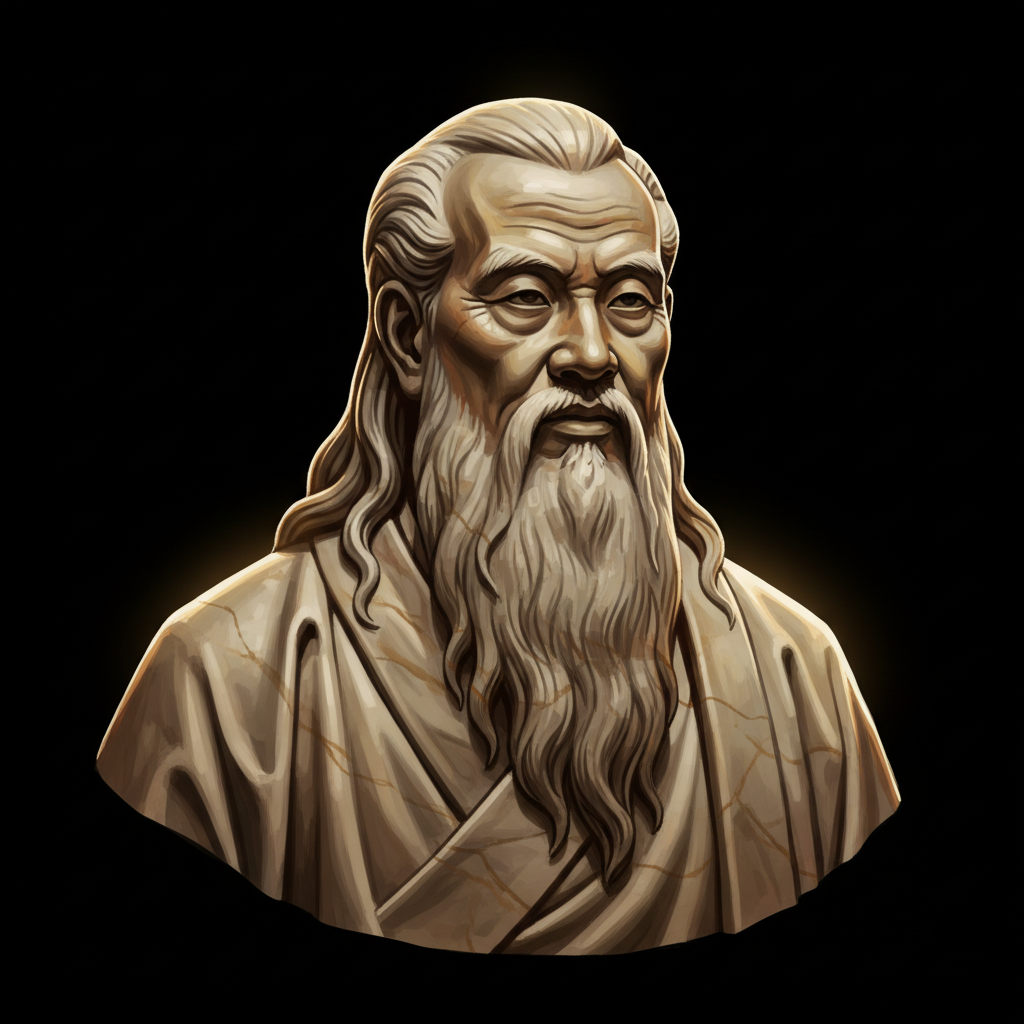
Laozi — "The greatest victory is that which requires no battle."
The greatest victory is that which requires no battle.
The greatest victory is that which requires no battle.
Click any product to generate a realistic preview. Up to 3 at a time.
* Initial load can take up to 90 seconds — revising the preview in another color is nearly instant.
"The greatest conquest is to conquer oneself."
"The greatest villain is the one who tries to do good."
"When the great way falls into disuse, there are benevolence and rectitude."
"Without going out of the door, one can know the whole world. Without peeping through the window, one can see the Way of Heaven. The further one goes, the less one knows."
"The soft and the weak overcome the hard and the strong."
Reputed founder of Taoism and author of the Tao Te Ching, whose wu wei (effortless action) shaped East Asian philosophy. Closely associated with Zhuangzi (later Taoist who extended Laozi's framework). For an intellectual contrast, see Confucius, near-contemporary Chinese sage of social ritual and duty — Confucius systematized social order through ritual and hierarchy; Laozi argued that all such systems were the disease, not the cure — the two founding poles of Chinese moral philosophy.
Found in 1 providers: gemini
1 source checked
True success comes from resolving conflicts without fighting. Winning through force costs resources, lives, and goodwill, while winning through wisdom, persuasion, or positioning the situation so opposition dissolves leaves everyone intact. The smartest move is arranging circumstances so the fight never needs to happen, whether in war, business, or personal disputes. Avoiding confrontation through foresight and skill beats overpowering an opponent after the damage is already done.
Laozi taught wu wei, effortless action, and believed the wise act through yielding rather than force. As a reputed archivist and philosopher who withdrew from court politics, he favored quiet influence over aggressive ambition. His Tao Te Ching repeatedly argues that soft overcomes hard and water wears down stone. This saying captures his conviction that rulers and generals who rely on violence have already failed, while true mastery shapes outcomes before swords are drawn.
Laozi lived during the Zhou dynasty's decline, likely the Spring and Autumn period preceding the brutal Warring States era, when rival Chinese kingdoms waged constant war and power shifted through betrayal and invasion. Philosophers competed to advise rulers on survival and statecraft, producing the Hundred Schools of Thought. Against this backdrop of endless bloodshed, Laozi's argument that the best victory avoids battle entirely was a radical critique of the militaristic logic dominating his age.
AI-generated insights based on extensive research and information for context. Factual errors? Email [email protected].
Your cart is empty