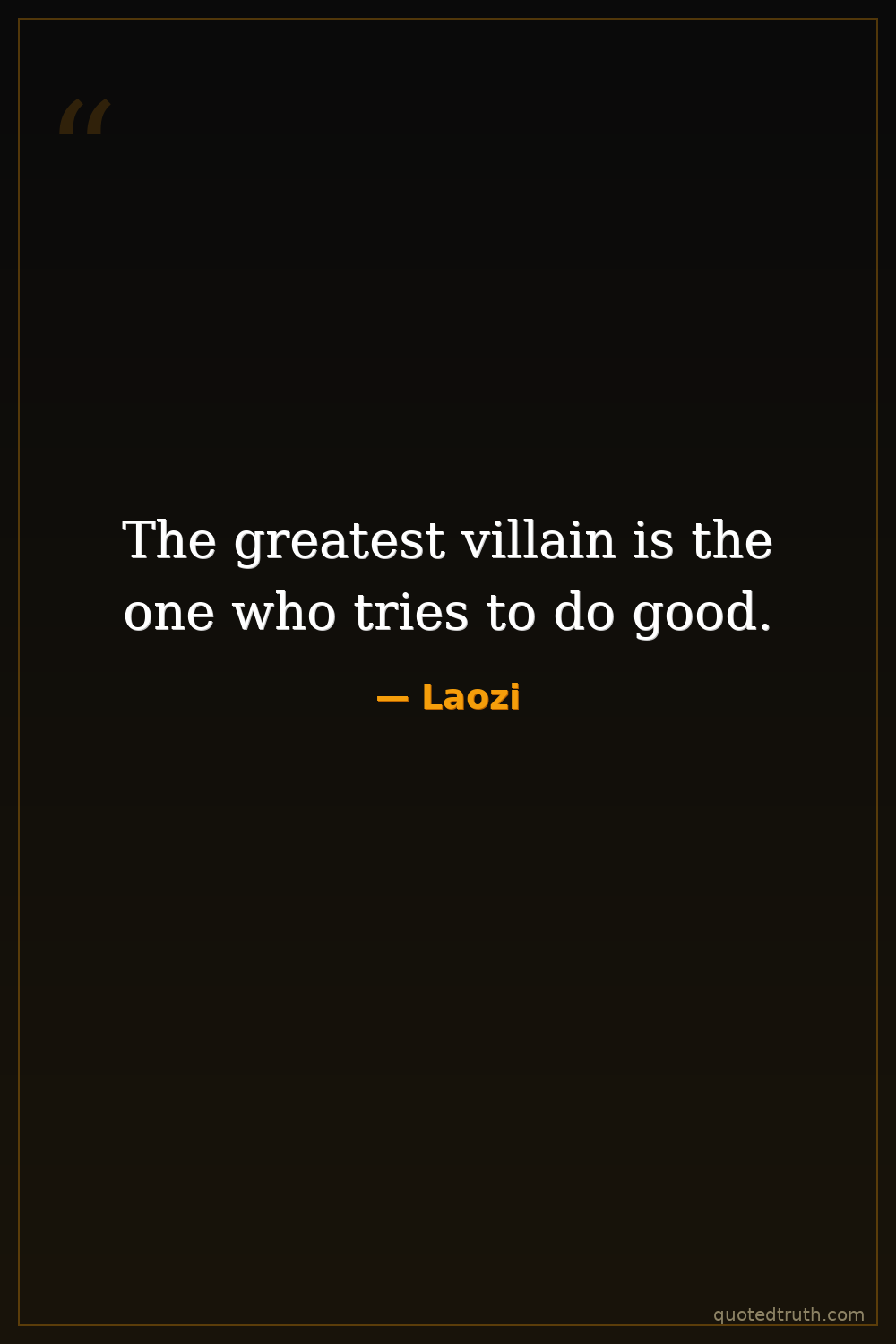
Laozi — "The greatest villain is the one who tries to do good."
The greatest villain is the one who tries to do good.
The greatest villain is the one who tries to do good.
Click any product to generate a realistic preview. Up to 3 at a time.
* Initial load can take up to 90 seconds — revising the preview in another color is nearly instant.
"To know that you do not know is the best. To think you know when you do not is a disease."
"Empty your mind of all thoughts. Let your heart be at peace. Watch the turmoil of the world, but let your serenity remain intact."
"Governing a large country is like cooking a small fish. Too much handling will spoil it."
"The five colors make one blind in the eyes; the five tones make one deaf in the ears."
"The best way to carve is not to split."
Reputed founder of Taoism and author of the Tao Te Ching, whose wu wei (effortless action) shaped East Asian philosophy. Closely associated with Zhuangzi (later Taoist who extended Laozi's framework). For an intellectual contrast, see Confucius, near-contemporary Chinese sage of social ritual and duty — Confucius systematized social order through ritual and hierarchy; Laozi argued that all such systems were the disease, not the cure — the two founding poles of Chinese moral philosophy.
Tao Te Ching (general interpretation of non-action)
Date: 6th century BCE (approximate)
ShockingFound in 1 providers: grok
1 source checked
Forcing goodness onto others often causes more harm than leaving things alone. When someone decides they know what is right and imposes it, they disrupt natural balance, override other people's judgment, and create resentment. The worst damage comes not from obvious wrongdoers but from crusaders convinced of their virtue, because their certainty blinds them to the suffering they cause. Restraint and humility prevent more harm than aggressive moral action.
Laozi built Taoism on wu wei, effortless non-action, warning that deliberate striving corrupts what it touches. As a court archivist watching rulers impose elaborate Confucian rites and reforms, he saw well-intentioned governance breed chaos. His Tao Te Ching repeatedly cautions against sages who meddle, favoring leaders who govern so lightly the people barely notice them. This saying crystallizes his conviction that forced virtue is itself a form of violence.
Laozi lived during the late Zhou dynasty, around the 6th century BCE, as China fractured into warring states and collapsing feudal order. Rival philosophers, especially Confucians, pushed rigid moral codes and ritual reforms to restore harmony. Rulers waged campaigns justified as righteous. Against this backdrop of ambitious moralizing and constant war waged for noble causes, Laozi's warning that crusading do-gooders cause the deepest damage landed as a direct rebuke of his era's reformers.
AI-generated insights based on extensive research and information for context. Factual errors? Email [email protected].
Your cart is empty