What it means
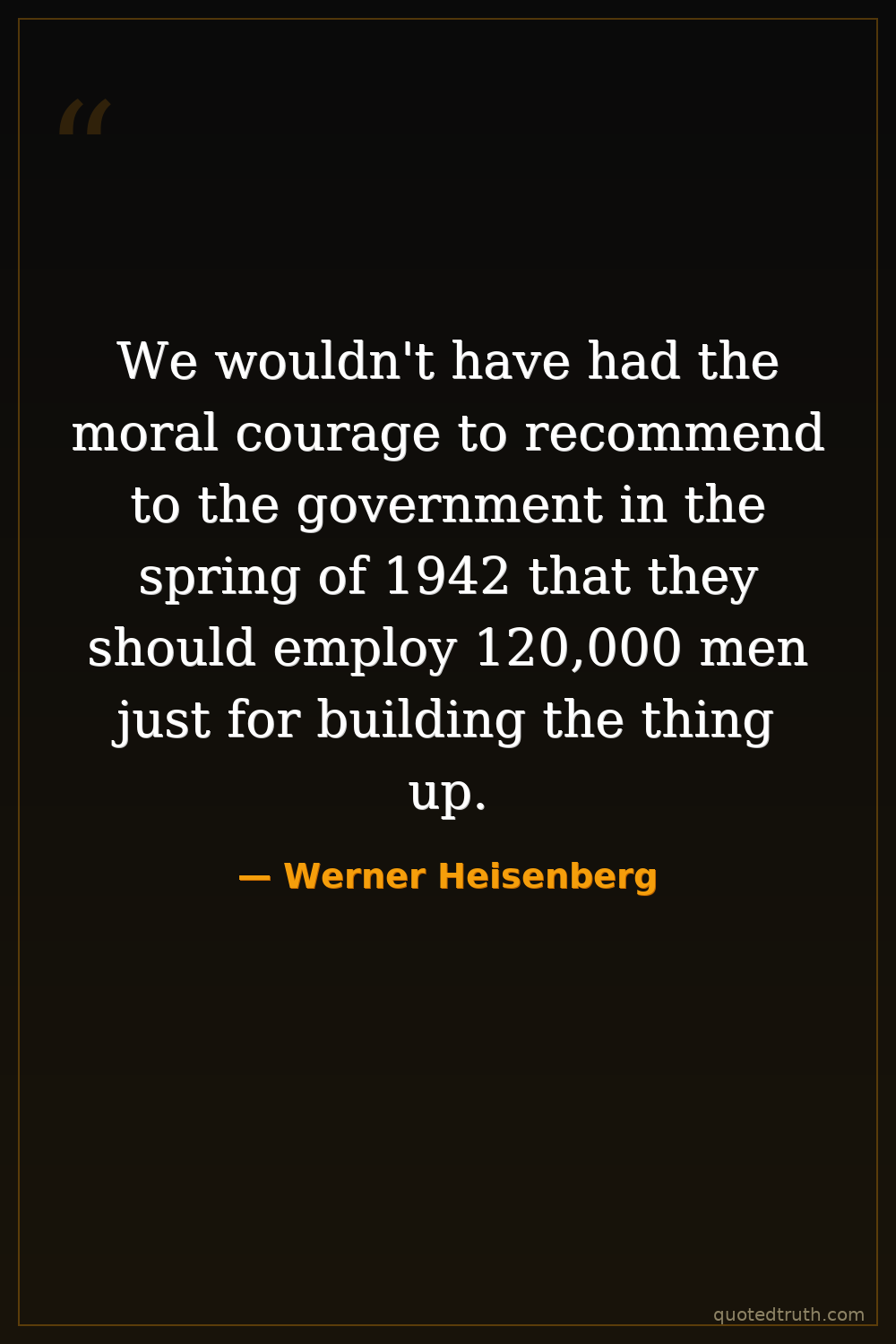
Heisenberg admits that even if building an atomic bomb had been scientifically possible, he and his colleagues lacked the nerve to urge their government to commit the enormous manpower and resources required. He frames the absence of a German bomb not purely as a technical failure but as a refusal—or inability—to push leaders into such a massive, consequential undertaking during wartime.
Relevance to Werner Heisenberg
Heisenberg led Germany's wartime nuclear research program and spent decades after the war defending his role. This remark reflects his postwar insistence that moral hesitation, not just scientific shortfall, limited the Nazi bomb effort. As the pioneer of the uncertainty principle and a Nobel laureate, he understood exactly what industrial-scale fission would demand and deflected blame toward the impracticality of asking Hitler's regime for such commitment.
The era
Spoken after Germany's 1945 defeat, when captured physicists at Farm Hall learned of Hiroshima. The US Manhattan Project had employed roughly 130,000 workers and cost $2 billion, dwarfing Germany's small uranium club. Allied interrogators and the scientific world were asking why Nazi Germany, which started ahead in nuclear physics, never built a bomb, and Heisenberg's answer shaped Cold War debates about scientists' moral responsibility.
AI-generated insights based on extensive research and information for context. Factual errors? Email [email protected].