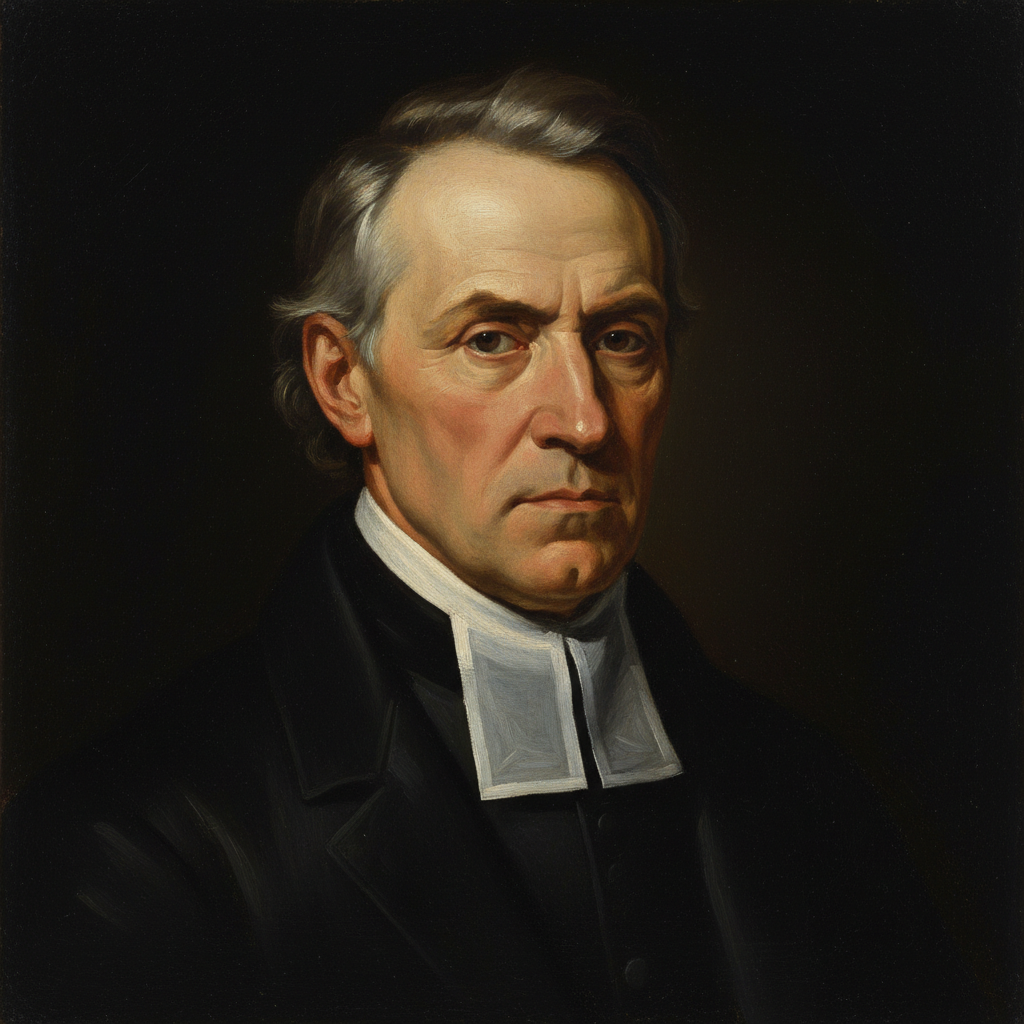
John Wesley — "I am not afraid of giving too much, but of giving too little."
I am not afraid of giving too much, but of giving too little.
I am not afraid of giving too much, but of giving too little.
Click any product to generate a realistic preview. Up to 3 at a time.
* Initial load can take up to 90 seconds — revising the preview in another color is nearly instant.
"I have not lost a day since I was born."
"I deny that I am an enthusiast in the common sense of the word. I am no visionary. I do not pretend to any new revelations, to any extraordinary gifts of the Holy Ghost, to any particular inspiration,…"
"It is a melancholy proof of the blindness and ignorance of mankind, that they are not aware of the evil of sin."
"Sing lustily and with a good courage. Beware of singing as if you were half dead, or half asleep; but lift up your voice with strength."
"We have nothing to do but to save souls."
English Anglican cleric and founder of Methodism, whose open-air preaching and class-meeting structure created the largest 18th-century evangelical revival. Closely associated with Charles Wesley (his hymn-writing brother) and George Whitefield (early co-revivalist, later doctrinal opponent). For an intellectual contrast, see George Whitefield, Calvinist evangelical revivalist — Whitefield's predestinarian Calvinism vs Wesley's free-grace Arminian theology split the early Methodist movement permanently in the 1739-41 break. The founding evangelical Calvinist-Arminian schism — the two parallel evangelical traditions American Christianity descends from.
Found in 1 providers: grok
1 source checked
Generosity should default toward excess, not restraint. The real moral failure isn't giving too much — it's holding back. This is a call to overcome the instinct to protect resources and instead give beyond comfort. Fear of over-giving is misplaced; the genuine risk is under-giving. True generosity requires courage to err on the side of abundance, treating stinginess — not extravagance — as the actual danger worth fearing.
Wesley famously earned considerable sums from his prolific writing and preaching but died with almost nothing, having given virtually all income away. His guiding principle — 'Earn all you can, save all you can, give all you can' — made giving a sacred duty. He organized Methodist societies to systematically aid the poor, visited prisons, established free schools, and distributed medicine. For Wesley, Christianity without radical giving was not Christianity at all.
Wesley preached in 18th-century England (1703–1791), a society convulsed by early industrialization and agricultural enclosures that stripped rural families of land and livelihoods. Extreme poverty was rampant, the Church of England was largely detached from the working poor, and no social safety net existed. Charity was the only buffer against destitution. Wesley's insistence on giving challenged comfortable Christianity and made Methodist charity networks a lifeline for England's dispossessed urban and rural poor.
AI-generated insights based on extensive research and information for context. Factual errors? Email [email protected].
Your cart is empty