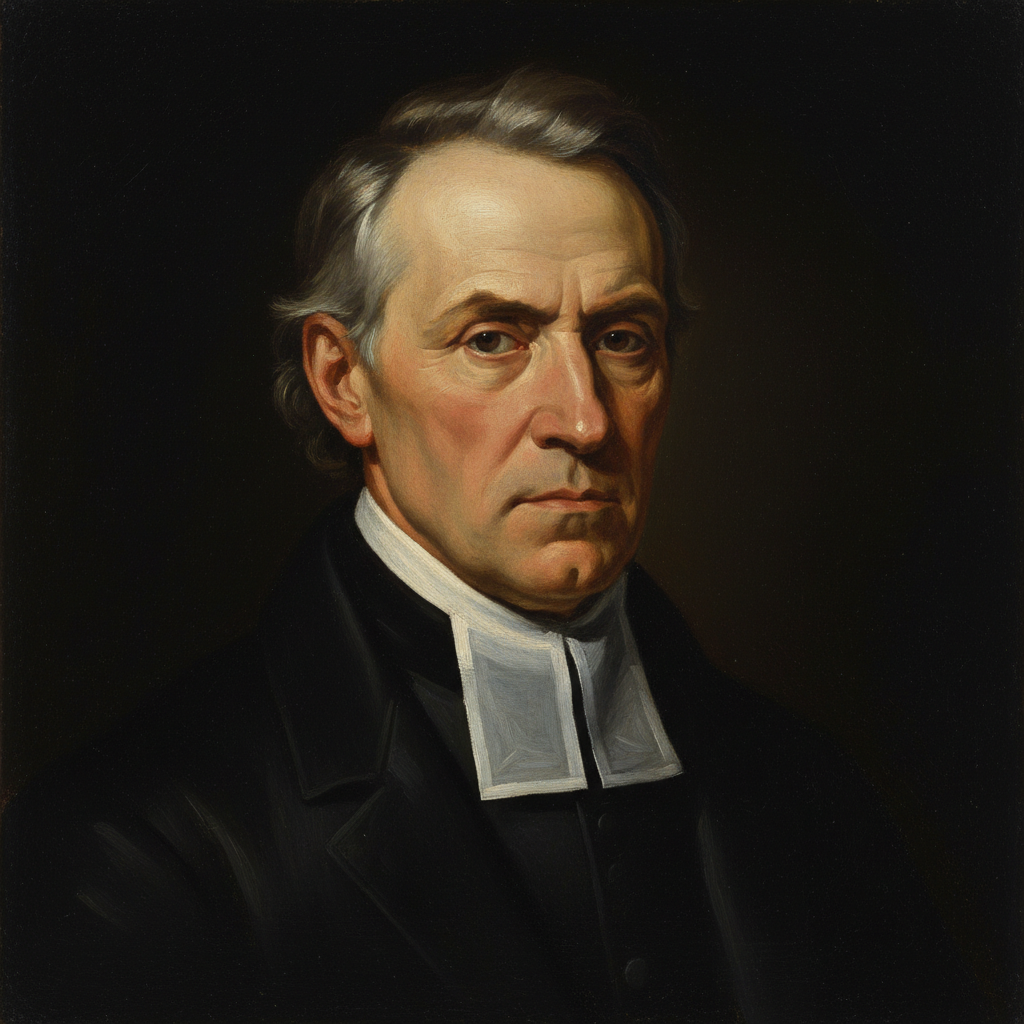
John Wesley — "What is the secret of your strength? I answer, the power of prayer."
What is the secret of your strength? I answer, the power of prayer.
What is the secret of your strength? I answer, the power of prayer.
Click any product to generate a realistic preview. Up to 3 at a time.
* Initial load can take up to 90 seconds — revising the preview in another color is nearly instant.
"I have found that the more I pray, the more I have to pray for."
"Holiness of heart and life is the one great end of all our preaching."
"Women's preaching is flatly contrary to the Bible."
"I am not afraid of the devil himself."
"I have often thought, that if I were to choose a way to travel, it should be on foot."
English Anglican cleric and founder of Methodism, whose open-air preaching and class-meeting structure created the largest 18th-century evangelical revival. Closely associated with Charles Wesley (his hymn-writing brother) and George Whitefield (early co-revivalist, later doctrinal opponent). For an intellectual contrast, see George Whitefield, Calvinist evangelical revivalist — Whitefield's predestinarian Calvinism vs Wesley's free-grace Arminian theology split the early Methodist movement permanently in the 1739-41 break. The founding evangelical Calvinist-Arminian schism — the two parallel evangelical traditions American Christianity descends from.
Found in 1 providers: grok
1 source checked
The source of genuine strength and effectiveness is not talent, strategy, or willpower alone, but consistent, earnest prayer. When asked how one accomplishes so much or endures so much, the honest answer points not to personal ability but to a sustained, disciplined communion with God that renews energy, provides clarity, and supplies courage beyond what human effort can generate.
Wesley famously rose at 4 AM daily to pray for two hours before beginning his work. He traveled 250,000 miles on horseback and preached over 40,000 sermons across his lifetime. His extraordinary output and resilience were inseparable from this prayer discipline, which he institutionalized in Methodist class meetings, making communal and private prayer the structural backbone of the entire movement.
Eighteenth-century Britain was industrializing rapidly, with masses of urban poor spiritually neglected by a complacent established Church of England. Wesley's field preaching reached those outside parish structures. In an era when rational Enlightenment thinking questioned religious enthusiasm, Wesley's insistence that prayer produced real transformative power was countercultural, grounding his revivalist movement in personal piety rather than institutional authority or intellectual argument.
AI-generated insights based on extensive research and information for context. Factual errors? Email [email protected].
Your cart is empty