Wright Brothers (Orville & Wilbur) — "The machine is now a commercial success."
The machine is now a commercial success.
The machine is now a commercial success.
Click any product to generate a realistic preview. Up to 3 at a time.
* Initial load can take up to 90 seconds — revising the preview in another color is nearly instant.
"The best thing about being a man of science is that you never have to be bored."
"The machine had scarcely cleared the ground when it began to turn up, and the next instant it darted into the ground."
"For some years I have been afflicted with the belief that flight is possible to man. My disease has progressed to an incurable stage."
"The desire to fly is an idea handed down to us by our ancestors who, in their dim terrestrial captivity, looked enviously on the birds soaring freely through space…"
"The desire to fly is an idea handed down to us by our ancestors who, in their monotonous lives, looked enviously on the birds soaring freely through space, at full speed, on the wings of the wind."
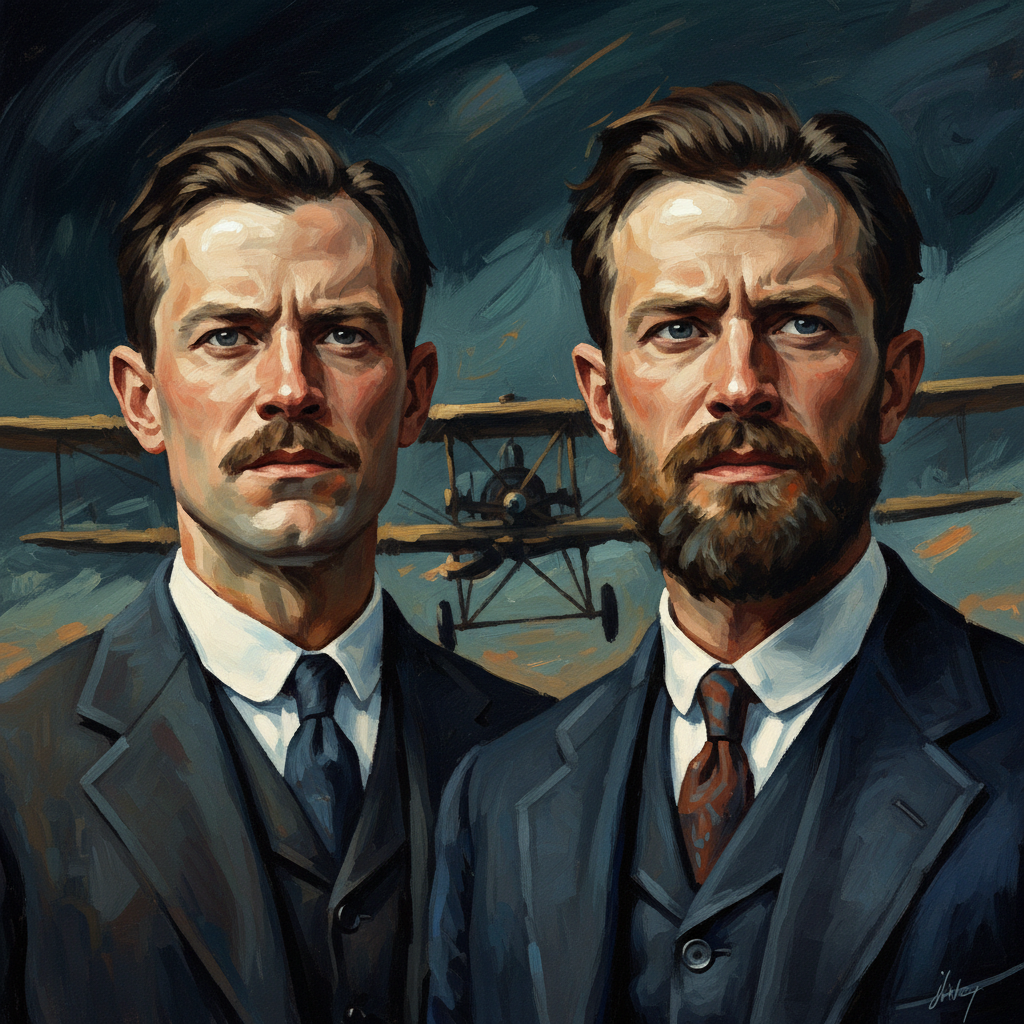
American aviation pioneers who achieved the first sustained powered controlled airplane flight at Kitty Hawk, NC, on December 17, 1903. Closely associated with Octave Chanute (their gliding mentor and aeronautical correspondent). For an intellectual contrast, see Samuel Pierpont Langley, Smithsonian Institution Secretary and government-funded aviation researcher — Langley's Aerodrome crashed twice into the Potomac in October-December 1903 with $50,000 of War Department funding; the Wright Brothers' bicycle-shop empiricism beat Langley's institutional Big Science by 9 days. The most-cited example in engineering history of empirical-tinkerer beating institution-funded credentialism.
Found in 1 providers: grok
1 source checked
Achievement isn't complete until it generates real value in the marketplace. This signals the moment an invention crosses from 'it works' to 'it pays' — validation that comes when something earns money, not just admiration. Commercial success means others see enough value to pay for it, transforming a personal obsession into a lasting enterprise that can sustain further innovation and growth.
After Kitty Hawk in 1903, the Wright Brothers spent years trying to sell their aircraft. They negotiated with the U.S. Army, formed the Wright Company in 1909, and battled patent wars with Glenn Curtiss. Orville and Wilbur were practical Midwestern mechanics first, dreamers second — getting paid mattered deeply. Wilbur died in 1912, just as the business was finally gaining real commercial traction.
The early 1900s were a period of intense commercialization — automobiles, telephones, and electricity were transitioning from novelties to industries. Investors were skeptical of aviation and governments cautious. The Wright Brothers lobbied militaries in multiple countries while fending off competitors. In an era that rewarded both invention and business savvy, proving commercial viability was as consequential as the technical achievement of flight itself.
AI-generated insights based on extensive research and information for context. Factual errors? Email [email protected].
Your cart is empty