Wright Brothers (Orville & Wilbur) — "The machine itself was a thing of beauty, a marvel of ingenuity and simplicity."
The machine itself was a thing of beauty, a marvel of ingenuity and simplicity.
The machine itself was a thing of beauty, a marvel of ingenuity and simplicity.
Click any product to generate a realistic preview. Up to 3 at a time.
* Initial load can take up to 90 seconds — revising the preview in another color is nearly instant.
"We were very much surprised at the ease with which the machine was controlled."
"The desire to fly is an idea handed down to us by our ancestors who, in their monotonous lives, looked enviously on the birds soaring freely through space, at full speed, on the wings of the wind."
"The machine has been proven to be a success beyond our most sanguine hopes."
"It is not necessary to be a horse to be a good jockey."
"We have been making flights of over an hour in length."
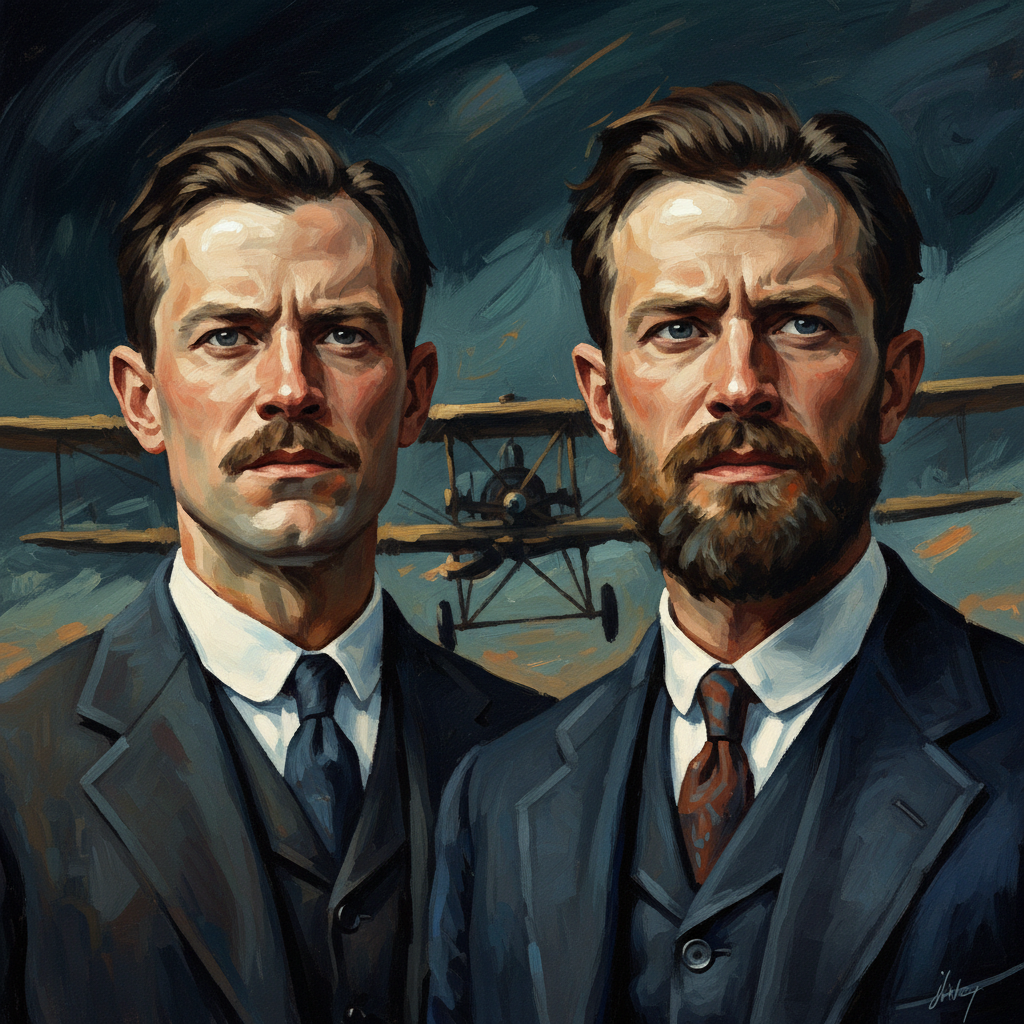
American aviation pioneers who achieved the first sustained powered controlled airplane flight at Kitty Hawk, NC, on December 17, 1903. Closely associated with Octave Chanute (their gliding mentor and aeronautical correspondent). For an intellectual contrast, see Samuel Pierpont Langley, Smithsonian Institution Secretary and government-funded aviation researcher — Langley's Aerodrome crashed twice into the Potomac in October-December 1903 with $50,000 of War Department funding; the Wright Brothers' bicycle-shop empiricism beat Langley's institutional Big Science by 9 days. The most-cited example in engineering history of empirical-tinkerer beating institution-funded credentialism.
Found in 1 providers: grok
1 source checked
The speaker admires a machine not only for working but for how elegantly it was designed. Its beauty comes from clever engineering paired with straightforward construction, without unnecessary complexity. Good design, they suggest, solves hard problems in a way that looks effortless. Ingenuity and simplicity aren't opposites; the best inventions combine sharp creative thinking with clean, economical execution that anyone can appreciate.
The Wrights were self-taught bicycle mechanics who cracked powered flight when trained engineers could not. Their 1903 Flyer used a lightweight custom engine, warping wings, and a movable rudder, each solving a problem others had missed. They valued clean mechanical logic over showy complexity, building and rebuilding in their Dayton shop. This quote captures their craftsman's pride in an aircraft whose elegance came from disciplined iteration, not ornament.
At the turn of the 20th century, inventors worldwide raced to conquer flight, and most attempts were heavy, ornate, or catastrophically overbuilt. Industrial America prized rugged, functional machinery, typewriters, bicycles, Model T cars, that ordinary people could understand and repair. Against that backdrop, the Wrights' 1903 success at Kitty Hawk redefined modern engineering aesthetics: a small, light, purposeful machine could reshape the world, proving simplicity and ingenuity were the real hallmarks of progress.
AI-generated insights based on extensive research and information for context. Factual errors? Email [email protected].
Your cart is empty