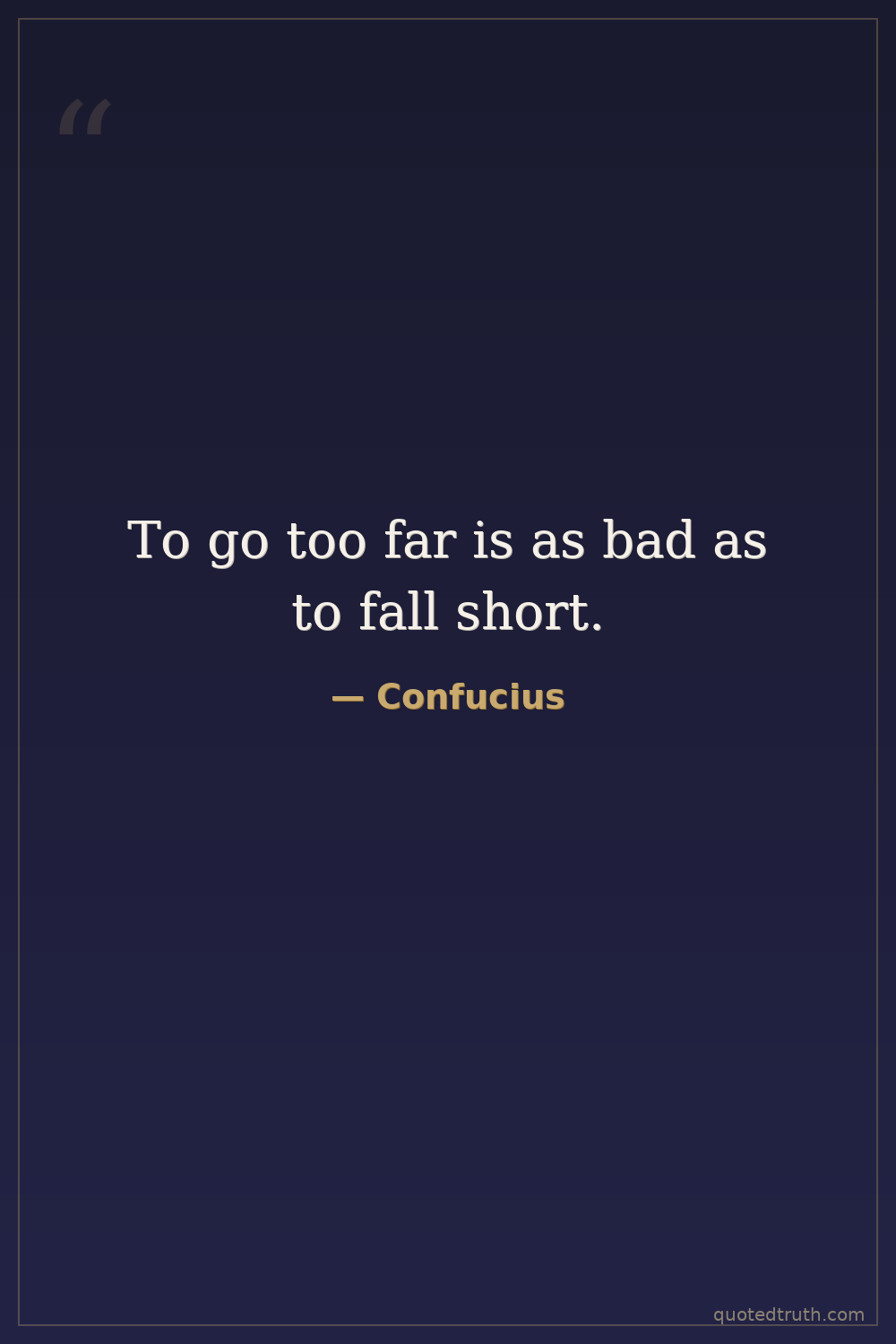
Confucius — "To go too far is as bad as to fall short."
To go too far is as bad as to fall short.
To go too far is as bad as to fall short.
Click any product to generate a realistic preview. Up to 3 at a time.
* Initial load can take up to 90 seconds — revising the preview in another color is nearly instant.
"It is man that can make the Way great, and not the Way that can make man great."
"The superior man is slow in speech but quick in action."
"The Master said, 'The superior man is firm in the right way, and not merely firm.'"
"In a state governed by the Way, poverty and low station are cause for shame; in a state bereft of the Way, wealth and high rank are cause for shame."
"The superior man is firm without being obstinate."
Chinese philosopher and teacher whose teachings (compiled by his students in the Analects) became the foundational ethical framework of East Asian civilization for 2,500 years. Closely associated with Mencius (his most-influential follower a century later). For an intellectual contrast, see Laozi, near-contemporary Chinese sage and Tao Te Ching author — Confucius systematized social order through ritual and family hierarchy; Laozi's Taoist effortless-action philosophy argued such systems were the disease, not the cure. The two founding poles of Chinese moral philosophy — every East Asian moral tradition since has positioned itself between them.
The standard scholarly entry points to Confucius's work: Philip J. Ivanhoe (Georgetown, Chinese philosophy) — Confucian Moral Self Cultivation (2000); Edward Slingerland (UBC, Asian Studies) — Effortless Action: Wu-wei as Conceptual Metaphor (2003); Tu Weiming (Harvard, Confucian scholar) — Confucian Thought: Selfhood as Creative Transformation (1985). These are the works graduate seminars cite when teaching Confucius.
Found in 1 providers: gemini
1 source checked
Excess and deficiency are equally flawed. Pushing any virtue, action, or emotion past its proper limit produces the same failure as not doing enough. Being overly generous wastes resources just as being stingy harms relationships; overworking damages health as much as laziness does. The wise path lies in balanced, measured action, where matching the response to the situation matters more than maximum effort or minimum risk.
Confucius built his teachings around the Doctrine of the Mean, treating balance as the highest moral achievement. As a teacher and minor government official who counseled rulers, he repeatedly warned that overzealous reform damaged states as much as neglect. His ethics emphasized ritual propriety, fitting each action to its context, cultivating virtue through disciplined moderation rather than extreme asceticism or indulgence, and judging character by proportion rather than intensity.
Confucius lived during the late Spring and Autumn period (551-479 BCE), when the Zhou dynasty was fracturing into warring states. Rulers swung between harsh Legalist crackdowns and weak indulgence, both producing chaos, famine, and rebellion. Warlords chased glory through reckless campaigns while peasants starved. In this volatile climate, his call for measured governance and personal restraint offered a practical alternative to the destructive extremes destroying Chinese society around him.
AI-generated insights based on extensive research and information for context. Factual errors? Email [email protected].
Your cart is empty