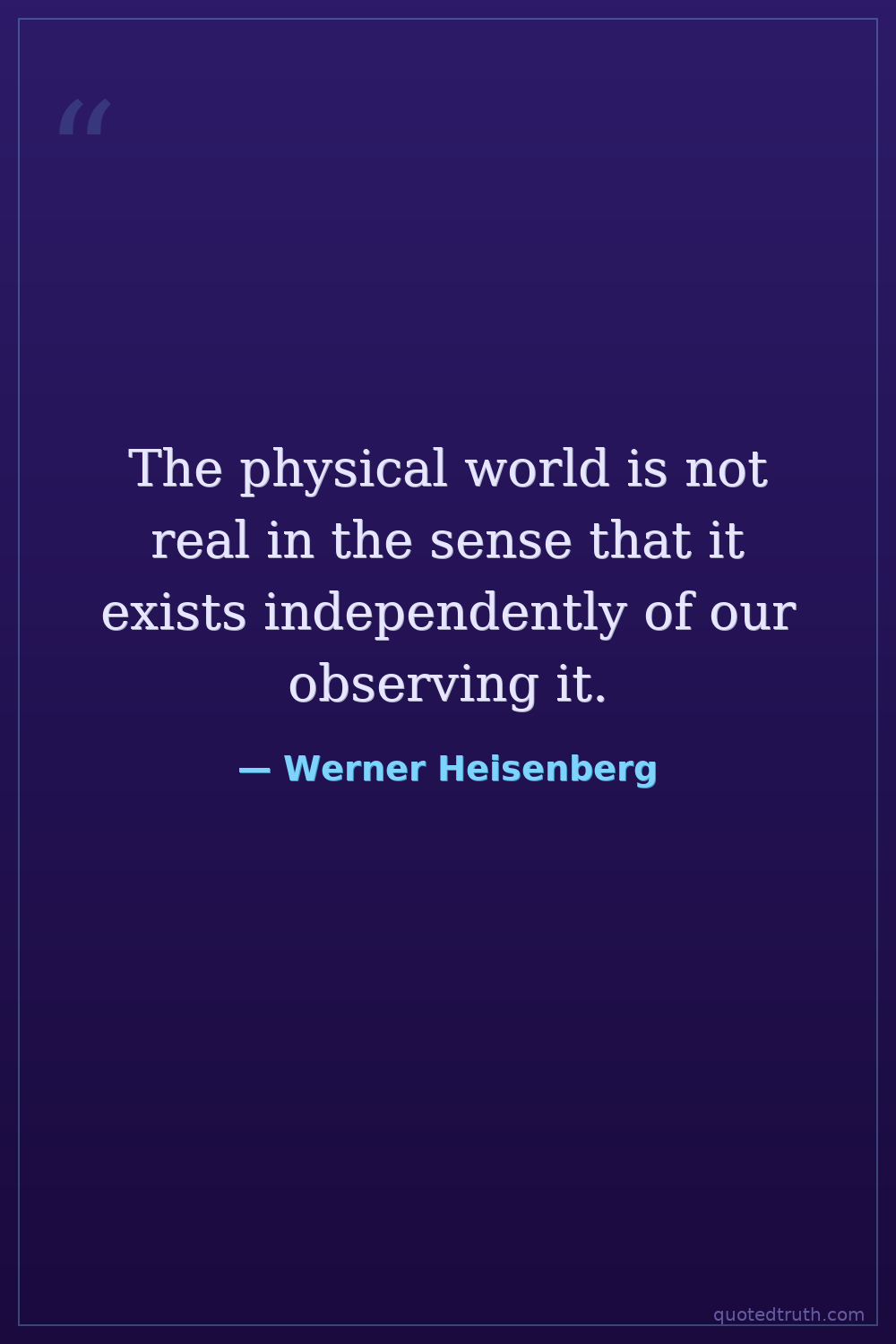
Werner Heisenberg — "The physical world is not real in the sense that it exists independently of our …"
The physical world is not real in the sense that it exists independently of our observing it.
The physical world is not real in the sense that it exists independently of our observing it.
Click any product to generate a realistic preview. Up to 3 at a time.
* Initial load can take up to 90 seconds — revising the preview in another color is nearly instant.
"The existing scientific concepts cover always only a very limited part of reality, and the other part which has not yet been understood is infinite."
"I was forced to find a new way of expressing the fundamental laws of nature, one which would not rely on the outdated concepts of classical physics."
"I remember discussions with Bohr which went through many hours till very late at night and ended almost in despair; and when at the end of the discussion I went alone for a walk in the neighboring par…"
"The problems of atomic physics are not problems of technology, but problems of philosophy."
"We have to remember that what we observe is not nature in itself but nature exposed to our method of questioning."
Found in 1 providers: grok
1 source checked
Reality isn't a fixed stage that exists out there waiting to be noticed. At the smallest scales, the act of measuring something helps determine what it becomes. Before you look, a particle doesn't have a definite position or speed in the ordinary sense. Observation isn't passive watching; it participates in producing the outcome. So calling the physical world fully independent of observers overstates how classical, solid, and predetermined nature actually is.
Heisenberg formulated the 1927 uncertainty principle, proving you cannot simultaneously pin down a particle's position and momentum. As a founder of matrix mechanics alongside Bohr in Copenhagen, he argued quantum theory describes what we can measure, not a hidden objective reality. This quote distills his Copenhagen interpretation: the observer and apparatus are inseparable from results. It reflects his philosophical bent, shaped by Plato and Kant, which pushed him beyond equations into questioning what physics actually says exists.
In the 1920s and 1930s, physics was overturning Newton's clockwork universe. Einstein's relativity had bent space and time; now Heisenberg, Bohr, Schrodinger, and Born were showing atoms behaved probabilistically. The Copenhagen interpretation clashed publicly with Einstein's 'God does not play dice' realism. Meanwhile Europe slid toward war, and Heisenberg stayed in Nazi Germany leading its uranium research, a choice still debated. Modernism in art and Godel's incompleteness echoed the same theme: certainty was dissolving everywhere.
AI-generated insights based on extensive research and information for context. Factual errors? Email [email protected].
Your cart is empty