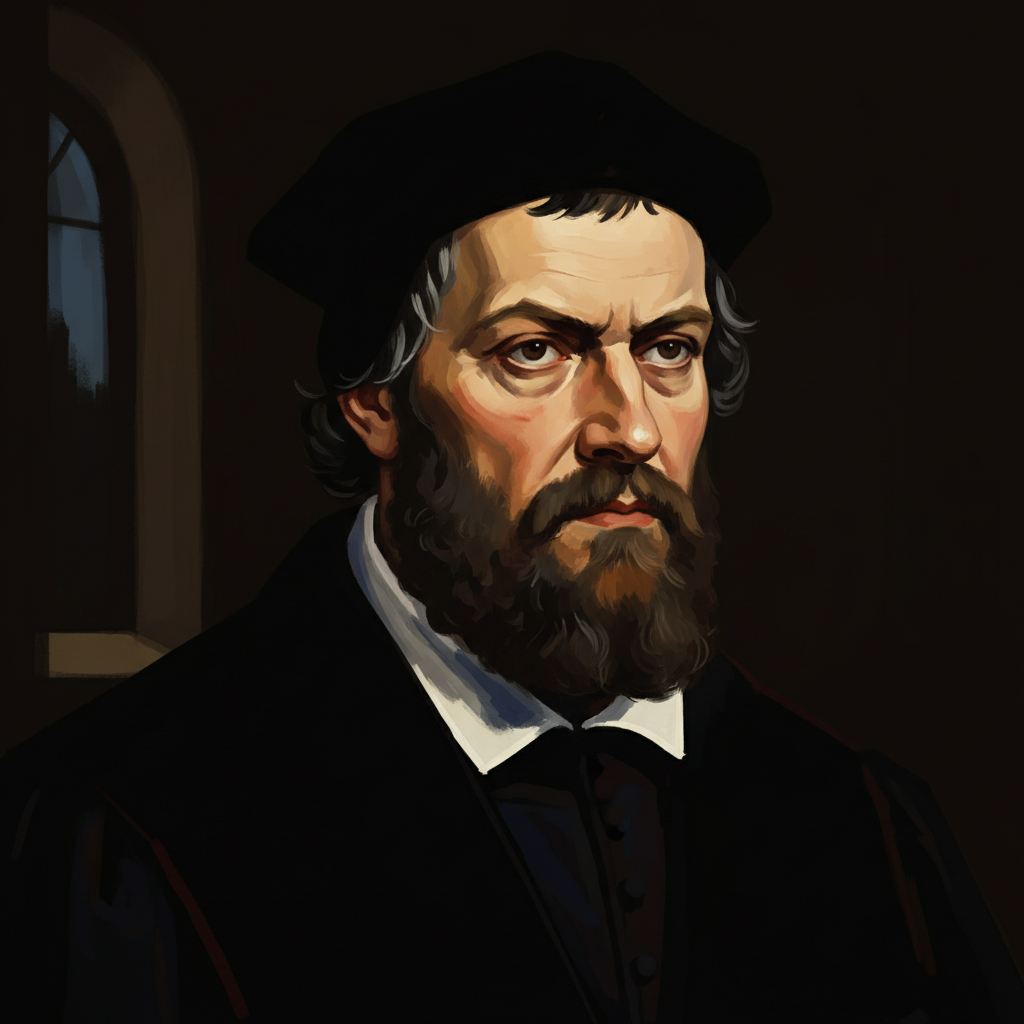
Martin Luther — "The more we are afflicted in this world, the more we are conformed to Christ."
The more we are afflicted in this world, the more we are conformed to Christ.
The more we are afflicted in this world, the more we are conformed to Christ.
Click any product to generate a realistic preview. Up to 3 at a time.
* Initial load can take up to 90 seconds — revising the preview in another color is nearly instant.
"The fewer the words, the better the prayer."
"Tomorrow I have to lecture on the drunkenness of Noah [Gen. 9:20-27], so I should drink enough this evening to be able to talk about that wickedness as one who knows by experience."
"I resist the devil, and often it is with a fart that I chase him away. When he tempts me with silly sins I say, 'Devil, yesterday I broke wind too. Have you written it down on your list?'"
"I would not give my faith for all the world's goods."
"Eating is a serious business. You must eat with delight and not as if you were doing penance."
German theologian whose 95 Theses (1517) launched the Protestant Reformation and broke the Catholic Church's monopoly on Western Christianity. Closely associated with Philipp Melanchthon (Lutheran systematizer) and John Calvin (later Reformer who built on Luther's break). For an intellectual contrast, see Pope Leo X, Renaissance pope (1513-1521) — Leo X's indulgence sales triggered Luther's break and Leo excommunicated him in 1521 — Luther's entire Reformation is structured as a direct answer to the indulgence-funded Vatican Leo represented.
Found in 1 providers: grok
1 source checked
Suffering and hardship in life are not meaningless or purely negative experiences. Instead, going through pain, struggle, and adversity actually shapes a person to become more like Jesus, who himself suffered. The more difficulty someone endures, the more their character, patience, and spiritual depth grow to resemble Christ's own example of enduring suffering with faith and purpose.
Luther lived this personally. He faced excommunication by the Pope in 1521, was declared an outlaw at the Diet of Worms, hid in Wartburg Castle fearing assassination, battled chronic illness, depression, and spiritual anguish he called Anfechtungen. His theology of the cross insisted God works through suffering, not around it. This saying reflects his core conviction that genuine faith is forged through trial, not comfort.
Early sixteenth-century Europe was consumed by religious upheaval, plague outbreaks, peasant uprisings, and war. Luther's 1517 Ninety-Five Theses shattered Catholic unity, triggering persecution of reformers and brutal crackdowns. Ordinary believers faced real danger for their faith, and the Peasants' War of 1525 killed an estimated 100,000. Luther's audience needed theological resources to make sense of suffering, and his cross-centered message gave meaning to hardships that felt overwhelming and unavoidable.
AI-generated insights based on extensive research and information for context. Factual errors? Email [email protected].
Your cart is empty