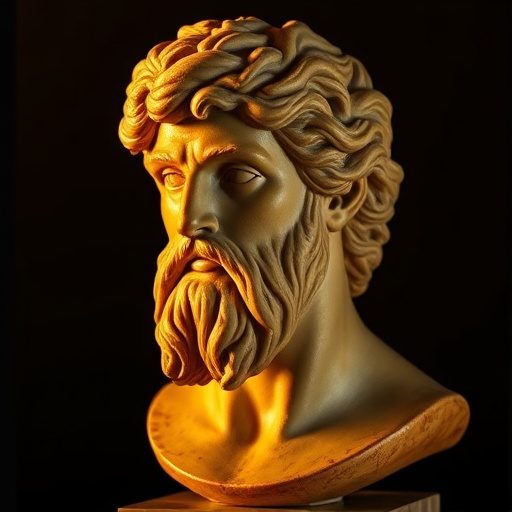
Pythagoras — "Eat not fish whose tails are black."
Eat not fish whose tails are black.
Eat not fish whose tails are black.
Click any product to generate a realistic preview. Up to 3 at a time.
* Initial load can take up to 90 seconds — revising the preview in another color is nearly instant.
"Above all things, reverence yourself."
"Don't wipe up a mess with a torch."
"Turn sharp blades away from you."
"A thought is an idea in transit."
"The strangest (and sexiest) of the legends surrounding the aura of Pythagoras is that he had a golden thigh that he would show to impress people he wanted to join his cult."
Greek philosopher and mathematician whose school in Croton combined geometry (the Pythagorean theorem), number-mysticism, and a religious-vegetarian way of life. Closely associated with Thales of Miletus (earlier pre-Socratic and the first philosopher). For an intellectual contrast, see Heraclitus, pre-Socratic Greek philosopher of flux — Heraclitus called Pythagoras 'the chief of swindlers' — among the founding insults of the philosophical-rivalry tradition. Their 'all is flux' vs 'all is number' poles still organize the philosophy of mathematics today (Platonist vs anti-realist).
A specific and unusual Pythagorean dietary rule, likely symbolic.
Date: c. 570-495 BCE (attributed later)
WisdomFound in 1 providers: gemini
1 source checked
Avoid things that appear tainted or marked by danger, even when the reason isn't immediately obvious. On its surface, a dietary safety rule about potentially spoiled or toxic fish. More broadly, it teaches cautious discernment — some things signal harm through visible markers, and wisdom means heeding those signs without demanding full explanation. Trust pattern-recognition over appetite. When nature marks something as suspect, prudence means abstaining rather than testing it.
Pythagoras led a strict religious brotherhood governed by cryptic behavioral codes called akousmata, covering diet, ritual, and conduct. He famously banned beans and certain meats, believing food directly affected the soul's purity — especially given his doctrine of metempsychosis, the transmigration of souls. This saying fits his pattern of dietary laws functioning simultaneously as spiritual discipline. For Pythagoras, controlling what you consume was inseparable from cultivating the mental clarity required for mathematical and philosophical truth.
In 6th-century BCE Magna Graecia, where Pythagoras settled, fish was a dietary staple. Without refrigeration or food science, visual cues like discoloration were genuine survival signals — black-tailed fish may have indicated specific toxic or rotting species. Simultaneously, mystery religions across the Mediterranean used food taboos to define sacred communities apart from ordinary society. Pythagorean dietary rules blended practical survival wisdom with ritual purity codes, giving his brotherhood a distinct identity in a world where what you ate declared who you were.
AI-generated insights based on extensive research and information for context. Factual errors? Email [email protected].
Your cart is empty